Canada’s absence from NATO’s new US$1-billion innovation fund will needlessly restrict venture capital investment in domestic companies, national-security tech experts say, while further reinforcing Ottawa’s growing reputation as a defence-spending laggard.
Skip to content

News
‘Where is Canada?’: Ottawa’s absence from NATO’s new US$1B tech fund raises questions
No-show comes amid growing criticism of Canada’s lagging NATO contributions
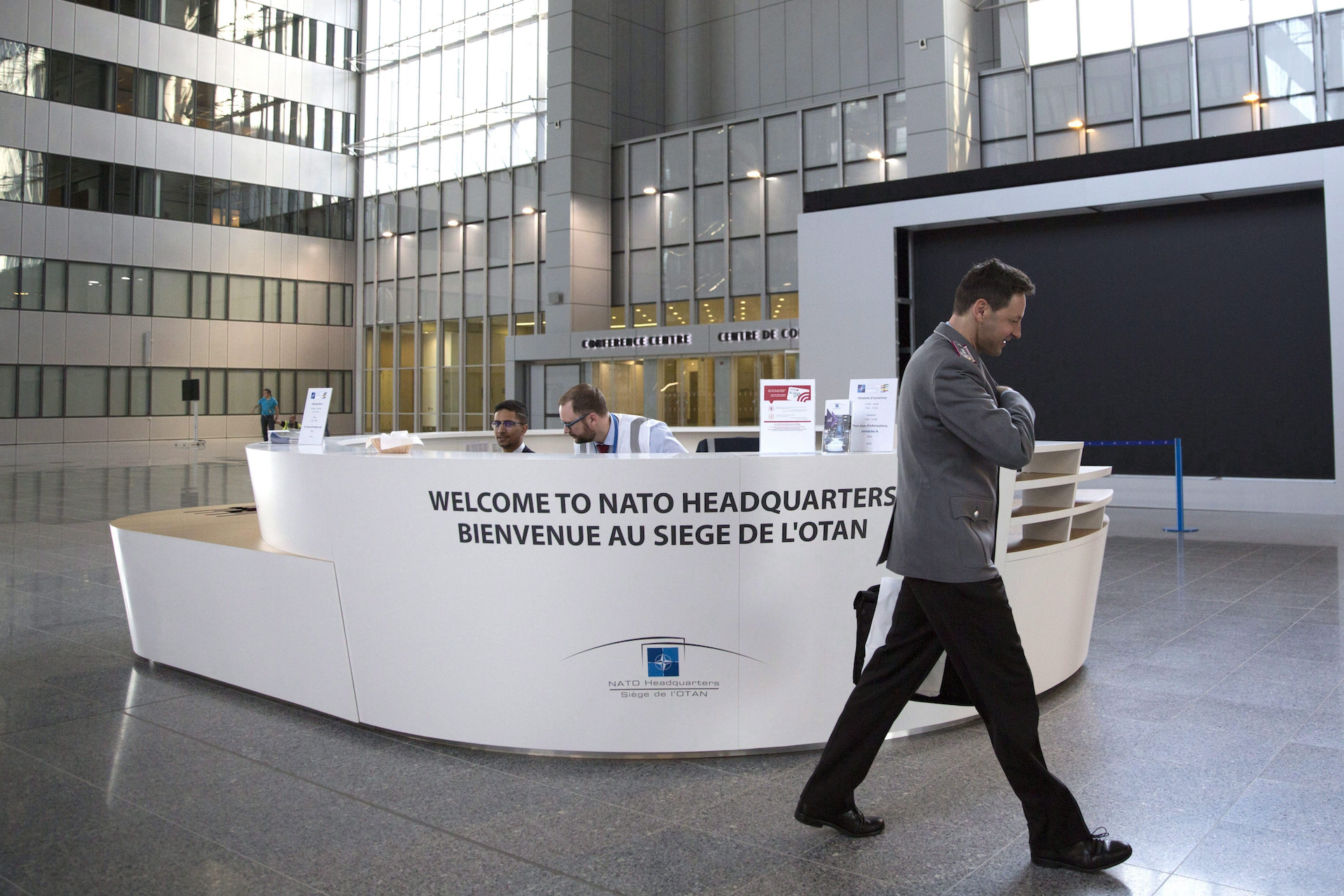
A man walks by a welcome desk at NATO headquarters in Brussels, in April 2018. Photo: AP Photo/Virginia Mayo
Canada’s absence from NATO’s new US$1-billion innovation fund will needlessly restrict venture capital investment in domestic companies, national-security tech experts say, while further reinforcing Ottawa’s growing reputation as a defence-spending laggard.
Talking Points
- Canada is one of the few NATO members not participating in a new US$1-billion fund that will invest in startups working on technologies that could bolster the national security of the military alliance’s members
- The absence comes as Canada’s “miserly” defence spending relative to other NATO countries comes under renewed scrutiny
Earlier this week, the international military alliance unveiled the NATO Innovation Fund (NIF). With funding from 23 of NATO’s 31 member states, it will invest in startups working on technologies including AI, quantum computing, hypersonic systems, cybersecurity, biotech, energy and propulsion and next-generation manufacturing.
In an email to The Logic, the Department of National Defence confirmed Canada is not a signatory to the fund, but also acknowledged that the NIF would be an “important element to developing the transatlantic innovation ecosystem.”
The federal government’s absence from the NATO effort comes amid increasing criticism of Canada’s defence contributions relative to other countries’. In an article last month, The Economist said Canada’s “miserly defence spending is increasingly embarrassing,” while a Wall Street Journal editorial called Canada a “military free-rider” within the North Atlantic alliance.
Representatives of Canada’s defence and national-security industry say the NIF could have been a critical avenue to boost the country’s defence contributions, particularly at a time when China’s rising aggression in the Indo-Pacific region, Russia’s invasion of Ukraine and conflicting Arctic sovereignty claims have raised geopolitical tensions.
“It’s absolutely a missed opportunity for Canada,” said Glenn Cowan, the founder of One9, a new Ottawa-based venture capital fund that invests in dual-use technologies with both commercial and military applications.
Cowan, who launched One9 alongside Shopify co-founder Daniel Weinand, said it was “very unlikely that Canadian founders will benefit from investment capital” under the NIF, which would instead favour entrepreneurs within member nations.
The United States isn’t involved in the NIF either, but Cowan pointed out that it already has its own well-established dual-purpose funding mechanisms, notably the Pentagon’s Office of Strategic Capital. The U.K., which joined the NIF, has the National Security Strategic Investment Fund. Signatories to the NATO effort, which aims to invest in “transformative technologies with the potential to shape our security for decades to come,” include Norway, Italy, Belgium, Lithuania, Luxembourg and others.
“A rhetorical question is, ‘Where is Canada?’” Cowan said. “We’re not doing our own fund; we’re not doing our own pool of strategic capital addressing some of the toughest challenges that we face.”
Nicholas Schiavo, director of federal affairs at the Council of Canadian Innovators, said the NIF’s structure appears to mimic other publicly funded venture capital efforts that have made strategic investments in technologies that bolster national security.
“We’d love to see the Canadian government involved with this program, and we’re curious why they’re not,” he said.
Related Articles

In response to The Logic’s questions, NATO spokesperson Lauren Covetta confirmed that Canada was given the opportunity to join the NIF. She said Canada had shown interest in joining the fund, and said “there remains an opportunity for Canada” to join later stages of the NIF now that the first stage has closed.
The NIF plans to invest predominantly in early-stage companies seeking pre-seed and seed, Series A and Series B funding.
National Defence spokesperson Daniel Minden did not answer The Logic’s questions about why Canada declined to join the NIF. He said Canada would contribute in other ways, like by offering to host the regional office for the Defence Innovation Accelerator for the North Atlantic (DIANA), an accompanying program to the NIF, in Halifax.
Anita Anand, who was defence minister until being shuffled to the Treasury Board last month, said in November 2022 that Halifax would serve as an “excellent backdrop” for DIANA, which aims to bring together member nations’ brightest innovators to develop defence-related technology.
Cowan said Canada and Canadian innovators are capable of showing “real leadership” on the defence and national-security technology front. One9 does not invest in kinetic weapons systems, he said, but patient investment in certain Canadian tech firms could be crucial in fortifying Canada’s defences in an increasingly hostile world, particularly in areas like cybersecurity and quantum computing.
Public-private collaborations like the NIF could help develop leading-edge technologies in everything from low-orbit spaceflight to defences against the fast-changing realm of hypersonic missiles, he said.
“When you look at how Canada’s being called out now internationally for not funding its NATO commitments, to me this is an absolute no-brainer.”



Loading...
Thanks for sharing!
You have shared 5 articles this month and reached the maximum amount of shares available.
CloseThis account has reached its share limit.
If you would like to purchase a sharing license please contact The Logic support at [email protected].
CloseGift the full article!
You have gifted 0 article(s) this month and have 5 remaining.
Recipients will be able to read the full text of the article after submitting their email address. They will not have access to other articles or subscriber benefits.
Photo: AP Photo/Virginia Mayo
Most Popular This Week




In-depth, agenda-setting reporting
Great journalism delivered straight to your inbox.
News
Ottawa is softening its ban on stablecoin yield
Briefing
Rio Tinto gets nearly $165M in additional federal funds for Quebec aluminum
U.S. to lift tariffs on some Canadian products crucial to Maine: Collins
Carney warns of tech dependence after Starlink disruptions in Ukraine
Best business newsletter in Canada
Get up to speed in minutes with insights and analysis on the most important stories of the day, every weekday.
Exclusive events
See the bigger picture with reporters and industry experts in subscriber-exclusive events.
Membership in The Logic Council
Membership provides access to our popular Slack channel, participation in subscriber surveys and invitations to exclusive events with our journalists and special guests.






