More than half of respondents to The Logic’s June subscriber survey say they don’t plan to buy a virtual-reality device, while a majority reported negative views on the concept of the metaverse.
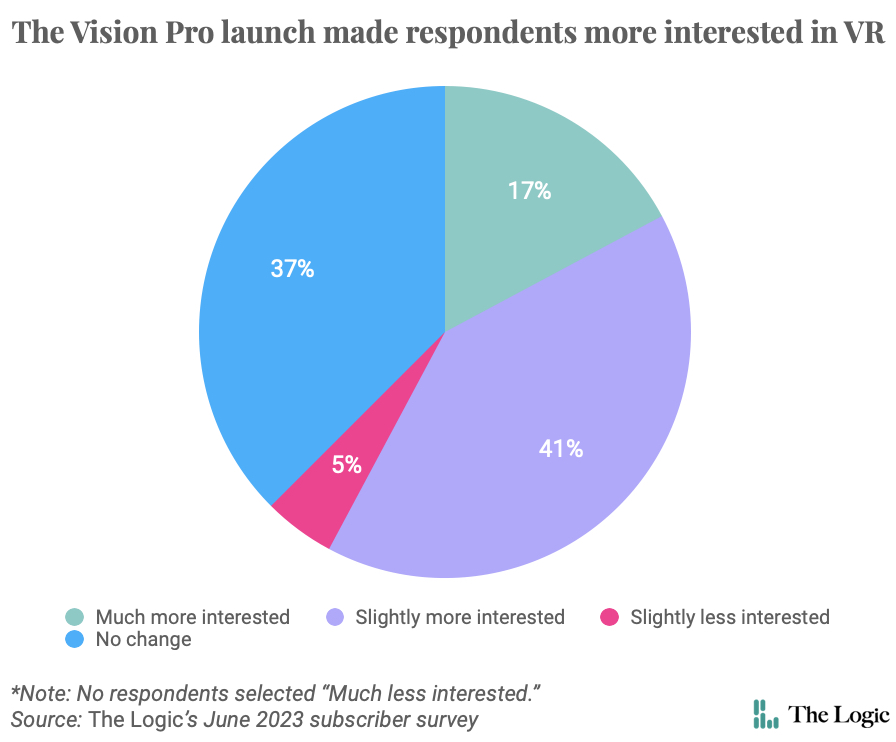
Close to 60 per cent, however, said the launch of Apple’s Vision Pro made them much more or slightly more interested in virtual- and augmented-reality technology.
The tech giant unveiled the VR/AR goggles—which retail at US$3,499—earlier this month. Several Canadian VR/AR entrepreneurs suggested that Apple’s entry into the space could be a tipping point toward mainstream acceptance of the technology. But companies like Microsoft and Disney recently paused their VR projects, and Google shelved its AR smart-glasses project earlier this year (though it’s still partnering with Samsung for its headsets). The term “metaverse” was absent from Apple’s announcement, suggesting that hype may be waning.
After the launch, The Logic asked readers in this month’s survey for their views on VR/AR technology. Roughly 17 per cent of respondents said the new Apple product made them much more interested in VR, and 41 per cent were slightly more interested. “The things they’ve done to support interaction with non-wearers and their gestural [user interface] are both very interesting,” one subscriber said.
Another said that the Vision Pro’s design was “an elegant and compelling departure from other devices,” but still “unjustifiable for the demonstrated use cases.”
Less than five per cent were slightly less interested, while roughly 38 per cent said their level of interest remained unchanged.
More than one in five respondents said they already owned a VR device, and a few readers who elaborated said they owned an Oculus Quest headset from Meta. A smaller group, roughly 13 per cent, said they planned to buy one. “Apple’s Vision Pro is the first headset I would consider buying,” one wrote.
However, a much larger group, at 52 per cent, said they have no plans to buy one (14 per cent were undecided). Some reported uncomfortable experiences with headsets in the past, while others disliked the VR experience. “The last thing I want to do is sit in my home office with a screen strapped around my face,” a reader said. “Go outside. Make some friends.”
Almost half said they couldn’t see themselves using a VR/AR device regularly. Another quarter said they could, while about 27 per cent said “maybe.” Some respondents in the last group said the price point or technology would have to improve before they’d consider it.
“I could see using VR/AR technology for things like looking at real estate via a real ‘tour,’ mapping out a walking route in a new city where I could ‘see’ where I was going. But I certainly wouldn’t buy a $3,000+ device for this purpose,” one reader wrote.
The barriers readers cited to adopting VR/AR tech varied. The most popular answer was “Other,” beating out price, a lack of available software and games, and big or bulky devices. Several respondents said it was not useful; one described VR devices as “little more than toys” at this moment, while another said they were an “absolute waste of money” with “no use case.”
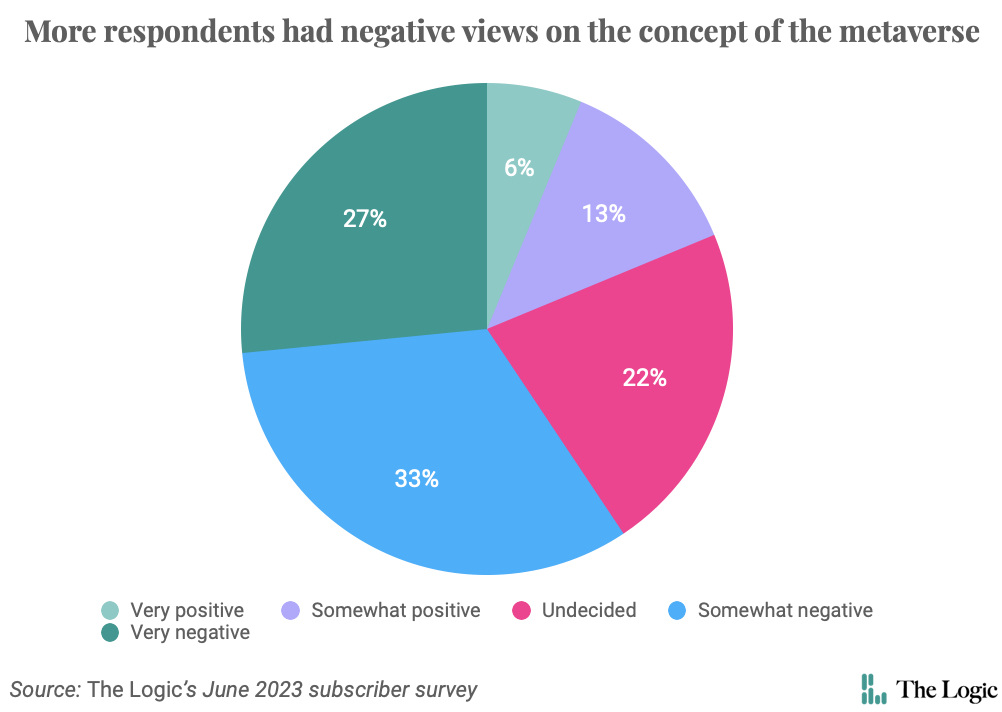
The majority of respondents also said they have a negative view on the concept of the metaverse, a VR environment where users can interact with each other. Meta rebranded from Facebook in 2021 to focus on developing the metaverse, though its Horizon Worlds VR game was not well received. Insider published a tongue-in-cheek obituary for the idea in May, though there is still experimentation in the metaverse, notably by Canada’s big banks.
Roughly 27 per cent of respondents reported a “very negative” view, while 33 per cent said it was somewhat negative. “It’s an interesting idea, but Meta’s offering is laughably bad, there’s no alternative that’s been developed that looks any better, and overall I am very skeptical of a totally immersive world where one corporation owns everything,” one subscriber said.
About 22 per cent of respondents said they were neutral; only 12.5 per cent were somewhat positive and six per cent were very positive.
Several readers said the metaverse seemed impractical for anything outside of team gaming. Others voiced concerns that spending too much time in virtual environments would cause loneliness and disconnect people from one another. “[I] want to spend my time pursuing real adventure and relationships—not living in my head,” one reader said.
Methodology
The Logic emailed subscribers a private link to an online survey on June 19, and the survey closed June 21. Respondents’ identities were kept anonymous. Subscribers were asked, “Do you currently own a VR/AR headset or plan to buy one?” with the following options: “I own one already,” “I plan to buy one,” “Undecided about whether to buy one,” or “I don’t plan to buy one.” Next, they were asked, “Do you see yourself using VR/AR technology regularly, such as for work or entertainment?” with the option to answer with “Yes,” “Maybe (list reasons below)” or “No.”
The third question was “What is the most significant barrier that would prevent you from adopting VR/AR technology?” Readers could answer with: “Price is too high,” “Lack of available content, games or software,” “Devices too big/bulky,” “Lack of other users,” “Don’t like spending time in VR environments,” or “Other (explain below).” They were then asked, “Has the launch of Apple’s Vision Pro changed your level of interest in VR/AR devices?” with the options: “Much more interested,” “Slightly more interested,” “Slightly less interested,” “Much less interested” or “No change.” Finally, they were asked, “How would you characterize your view on the concept of the metaverse, a shared virtual environment to be accessed through VR/AR technology?” with the options “Very positive,” “Somewhat positive,” “Neutral,” “Somewhat negative” or “Very negative.”