Skip to content

Canada's Business and Tech Newsroom

  • Professional Subscription
  • Partnerships & Advertising
  • Licensing & Syndication
Log In Subscribe
Welcome,
  • My Account
  • Log Out
  • Business
  • Tech
  • National
  • The Big Read
  • Briefings
  • Commentary
Search
Log In Subscribe
Welcome,
  • My Account
  • Log Out
News

The Canada Investment Summit’s US$430B deal book, in charts

Listen Now
0:00
News

The Canada Investment Summit’s US$430B deal book, in charts

We analyzed the 167 projects in the official summit prospectus by sector, province and capital expenditure

By Chaimae Chouiekh
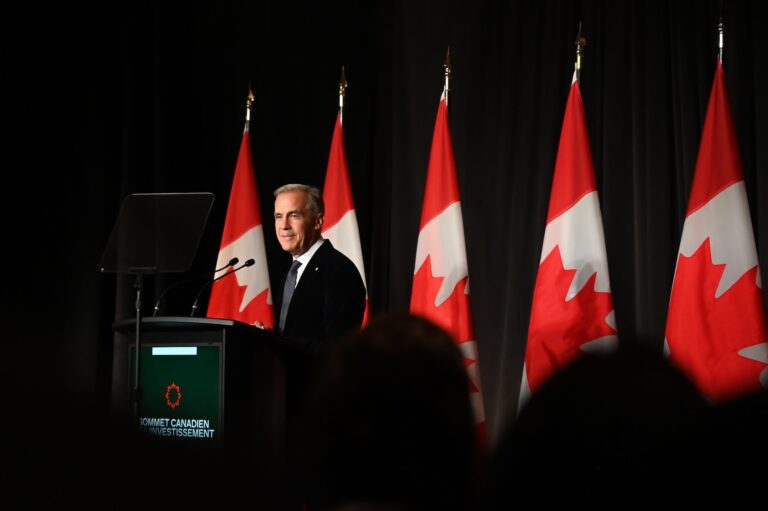
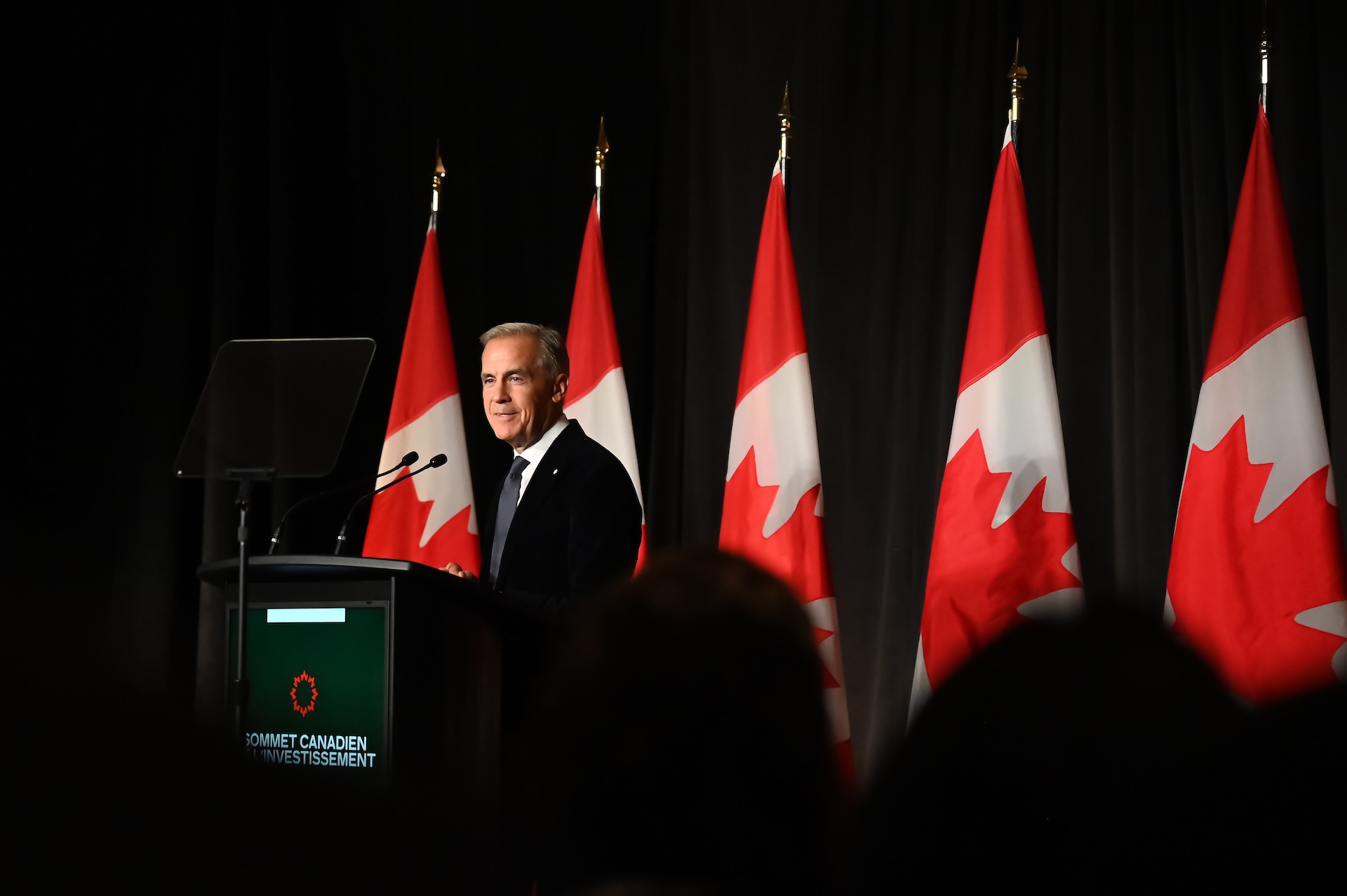
Prime Minister Mark Carney delivers remarks to Canadian business leaders at the Canada Investment Summit welcome reception in Toronto on Sept. 13, 2026. Photo: The Canadian Press/Jon Blacker
Sep 15, 2026 | 5:45 AM ET
A A
A Small A Medium A Large
Share

Gift

Share

Listen Now
0:00

Canada is pitching US$430 billion worth of projects to some of the world’s biggest investors this week, as the federal government tries to turn a wave of global interest in the country into $1 trillion in investment over the next five years.

The Logic obtained a copy of the prospectus for the Canada Investment Summit, which the Prime Minister’s Office organized in collaboration with the Canadian Pension Plan Investment Board and the Public Sector Pension Investment Board. The prospectus touts 167 projects at different stages of development, spanning oil and gas, clean energy, ports, transportation, power infrastructure, digital technology and advanced manufacturing.

Mining and critical-minerals projects make up the largest group of investment opportunities. Some projects are tied to individual provinces, while others span multiple jurisdictions or are international in scope.

The Logic analyzed the projects in the prospectus, breaking down where the opportunities are concentrated, which sectors account for the largest share and how much capital expenditure is required.
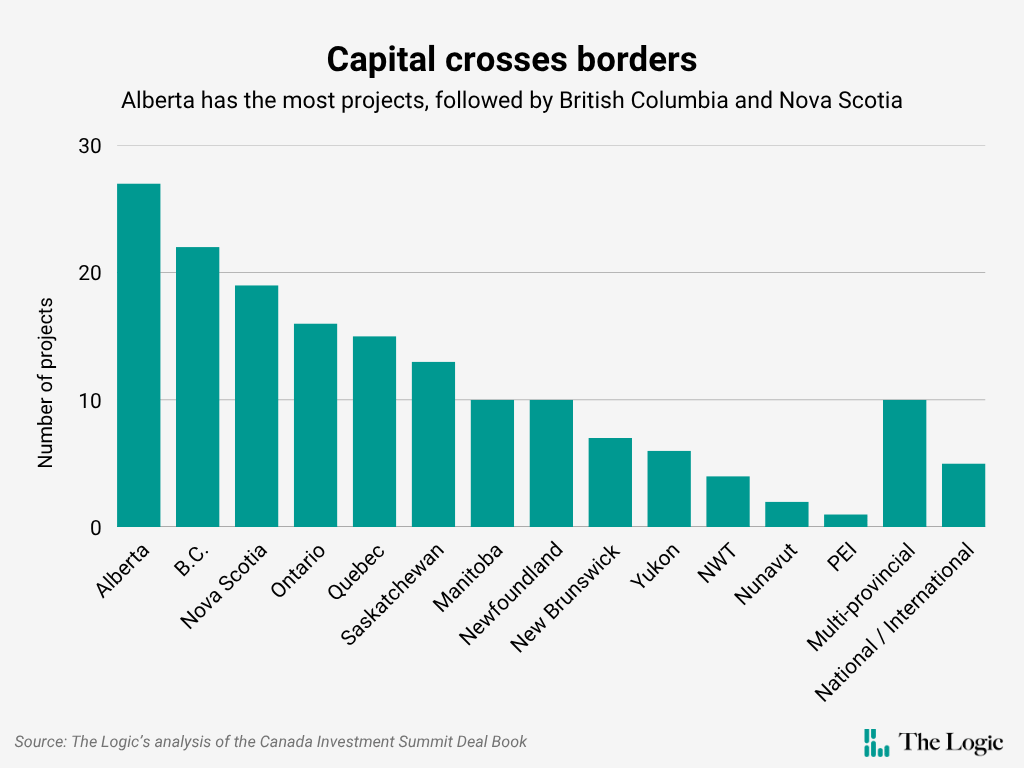
A chart titled "Capital crosses borders" with the subtitle "Alberta has the most projects, followed by B.C. and Nova Scotia." The chart shows Albert with 27 projects, B.C. with 22, and Nova Scotia with 19. Behind them are Ontario (16), Quebec (15), Saskatchewan (13), Manitoba (10), Newfoundland and Labrador (10), New Brunswick (7), Yukon (6), NWT (4), Nunavut (2), PEI (1), Multi-provincial (10), and National / International (5).

Alberta has the greatest representation in the prospectus of any province with 27 projects, followed by British Columbia with 22 and Nova Scotia with 19. Alberta’s tally spans every sector in the prospectus, with projects including conventional-energy plants, a cluster of AI data centres and two proposed high-speed transportation links between Calgary and Edmonton.

Related Articles
What Canada will pitch to the world’s investors at next week’s high-stakes summit

By Anita Balakrishnan, Chaimae Chouiekh, Murad Hemmadi and David Reevely
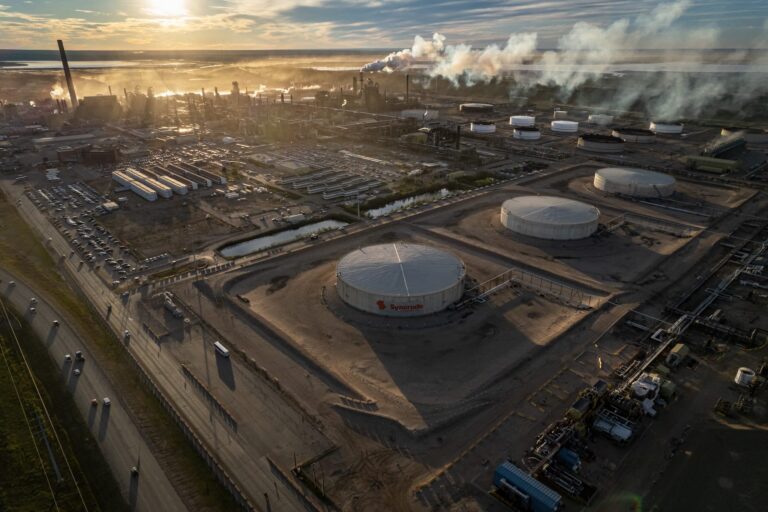
An aerial image of a Syncrude oilsands field in Fort McKay, Alberta.

Inside the provinces’ pitches to the world’s biggest investors

By Anita Balakrishnan

B.C.’s list is dominated by mining and minerals, alongside several large LNG and clean-energy proposals. Projects include the Wicheeda rare-earth, Baptiste nickel and Berg copper developments, as well as Ksi Lisims LNG, a proposed 12-million-tonne-per-year export terminal in northern B.C. with an estimated US$28.5-billion price tag.

Nova Scotia’s projects tilt more toward clean energy and Atlantic trade infrastructure. They include Wind West, a proposed offshore-wind and transmission project targeting up to five gigawatts of generation, the US$4.5-billion Nova Scotia Renewable Energy Park and several port developments. 

Ten projects cross provincial boundaries or have yet to settle on a single location. Among them are the proposed West Coast Oil Pipeline, which would carry up to one million barrels of Alberta crude a day to a deepwater export terminal in southern B.C.; Kino Aski LNG, which would connect Western Canadian natural gas to Baie-Comeau, Que.; and the Bissett Creek project, which would mine graphite in Ontario and process it into battery anode material in Baie-Comeau. 
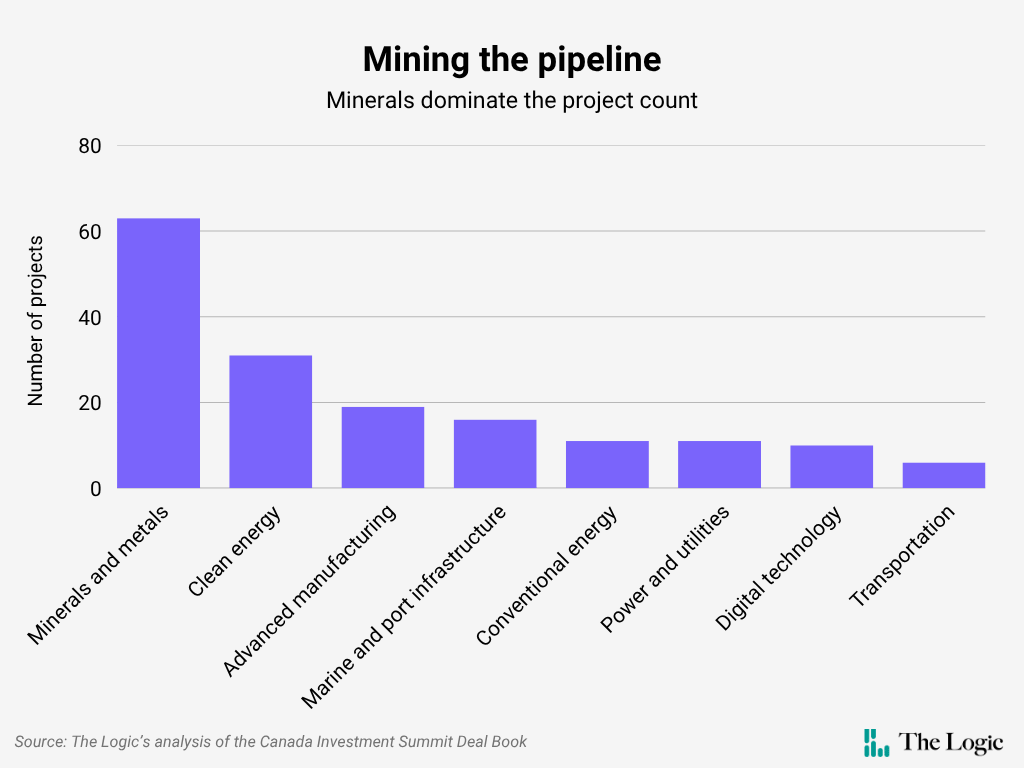
A chart titled "Mining the pipeline" with the dek "Minerals dominate the project count." It shows the minerals and metals sector with 63 projects in the Canada Investment Summit Deal Book, followed by clean energy with 31, advanced manufacturing with 19, marine and port infrastructure with 16, conventional energy and power and utilities with 11 each, digital technology with 10, and transportation with 6.

Minerals and metals make up the largest share of projects in the prospectus, accounting for 63 of the 167, or roughly 38 per cent of the total. They span gold, copper, nickel, lithium, graphite and rare earths, from early-stage exploration to mines and downstream processing facilities. The list includes Ontario’s Ring of Fire, where Juno Corp. is exploring for gold and critical minerals including titanium, vanadium, scandium, gallium and rare earth elements, as well as the Strange Lake project, an integrated rare-earth development spanning Quebec and Labrador with an estimated US$2.17-billion capital cost.

Clean energy is a distant second, with 31 projects covering offshore wind, hydrogen, sustainable fuels, carbon capture and energy storage. Among them are Newfoundland and Labrador’s U.S$10.6-billion EVREC Green Energy Hub, which combines wind, solar, battery storage and green hydrogen production, and Alberta’s Deep Sky One, a carbon-removal facility designed to capture as much as 500,000 tonnes of carbon dioxide annually. Notably, no housing projects feature in the prospectus.
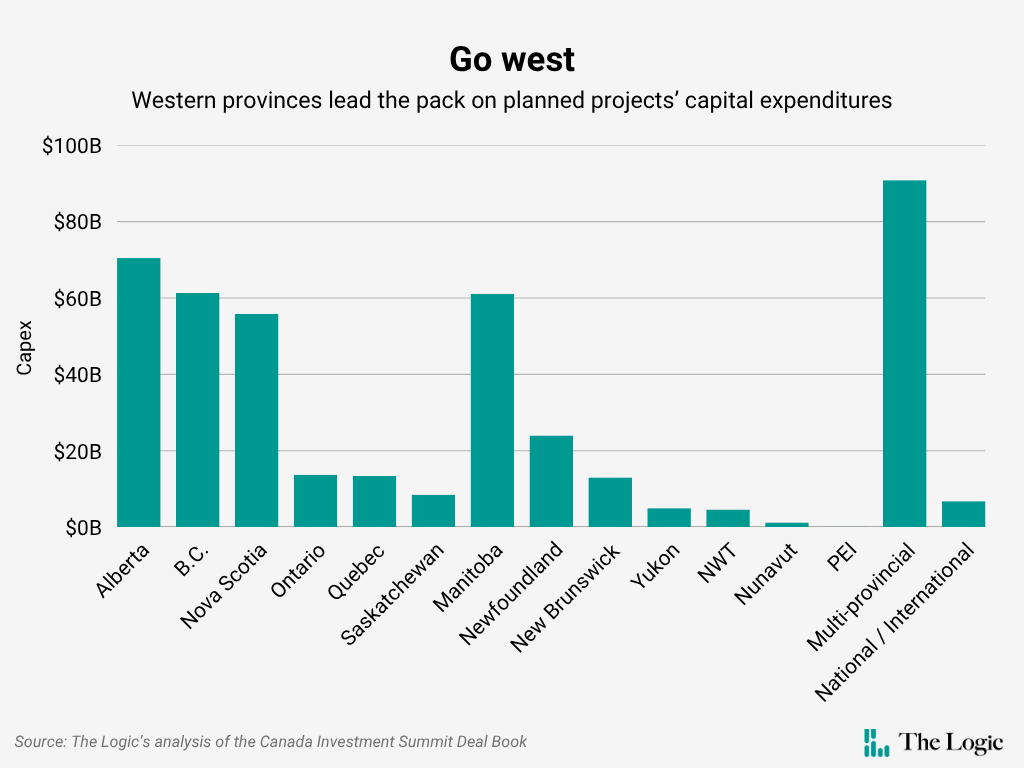
Chart with the headline "Go west" and the subheading "Western provinces lead the pack on planned projects' capital expenditures." Alberta, B.C., and Manitoba have more than $60 billion in total capital expenditures for projects, Nova Scotia has almost $56 billion, and the next highest is Newfound and Labrador with just over $20 billion. There are $90 billion in multi-provincial projects.

The picture changes when the provinces are ranked by the projects’ capital expenditure rather than by their number. Of the 167 projects in the prospectus, 155 projects disclose planned capital expenditure, representing about US$430 billion in proposed investment, according to The Logic’s analysis. Alberta leads the provinces with roughly US$70.5 billion in potential spending, followed by British Columbia at US$61.4 billion, Manitoba at US$61.1 billion and Nova Scotia at US$55.8 billion. 

Those totals are heavily influenced by a handful of megaprojects. Nearly all of Manitoba’s total comes from the US$57-billion Port of Churchill Plus proposal. The US$44-billion Wind West project similarly accounts for most of Nova Scotia’s total. 

The largest bucket overall is not a single province. Ten multi-provincial projects account for about US$90.9 billion in proposed capital spending. Three account for more than 90 per cent of that amount: the US$36-billion Novatron clean-energy and transmission platform linking Atlantic Canada with Quebec, the US$25.33-billion West Coast Oil Pipeline and the US$23-billion Kino Aski LNG.
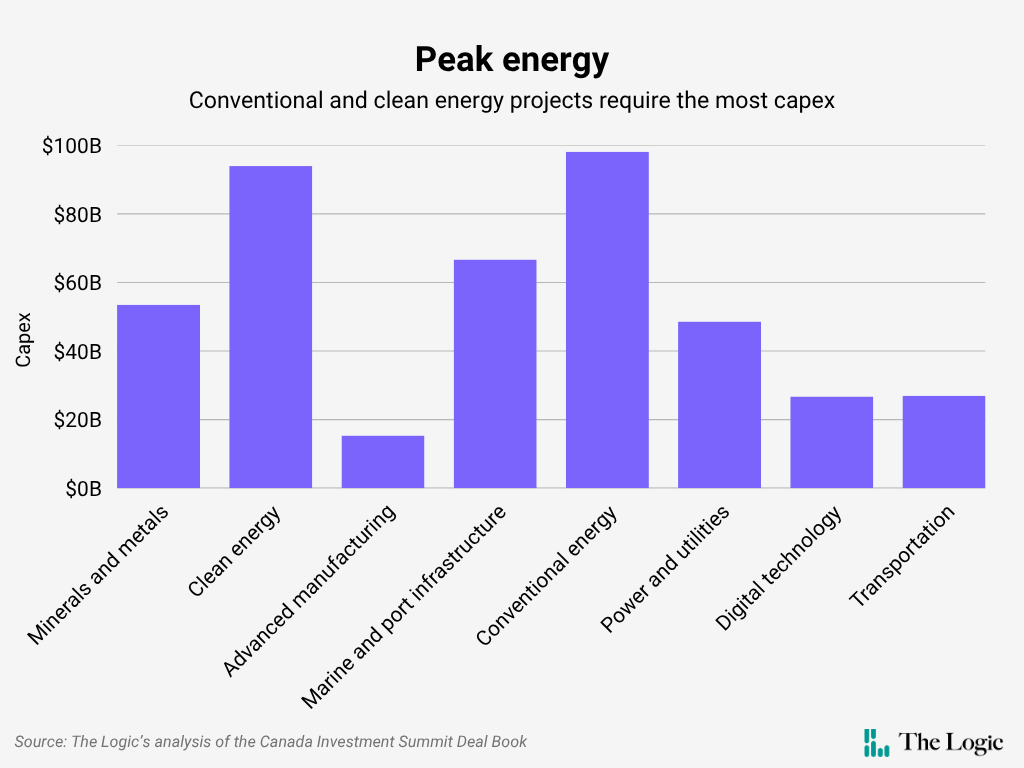
A chart titled "Peak energy" with the subtitle "Conventional and clean energy projects require the most capex." The chart shows $98 billion in capital expenditures for conventional energy projects, $94 billion for clean energy projects, and $67 billion for marine and port infrastructure. After that it's minerals and metals ($53 billion), power and utilities ($49 billion), transportation ($27 billion), digital technology ($27 billion), and advanced manufacturing ($15 billion).

Energy projects carry the biggest price tags in the prospectus. Conventional-energy projects account for about US$98 billion in disclosed capital expenditures, narrowly ahead of clean energy at about US$94 billion. Together, the two sectors represent nearly 45 per cent of the nearly US$430 billion in disclosed project costs.

Gift the full article

The ranking also flips the picture from the project-count chart. Minerals and metals make up 63 of the 167 projects, by far the largest group, but account for only about US$53.5 billion, or just over 12 percent of planned spending.


#Canada Investment Summit #financing #investment

Sponsored Content

How to shift your workforce from AI experimentation to adoption

By Jessica Aftimus Rosa

The real-world economic offshoots of sovereign AI

By Deborah Aarts
Illustration of a plane flying above a mailbox

Increasing healthcare access across Canada

By Deborah Aarts
Paid promotional content

Loading...

Thanks for sharing!

You have shared 5 articles this month and reached the maximum amount of shares available.

Close
This account has reached its share limit.

If you would like to purchase a sharing license please contact The Logic support at [email protected].

Close
Want to share this article?

Upgrade to all-access now

Close
Gift the full article!

You have gifted 0 article(s) this month and have 5 remaining.

Copy link and gift
Copy Link
Email to a friend
Send Email
Gift on Social Media

Recipients will be able to read the full text of the article after submitting their email address. They will not have access to other articles or subscriber benefits.

Photo: The Canadian Press/Jon Blacker

A chart titled "Capital crosses borders" with the subtitle "Alberta has the most projects, followed by B.C. and Nova Scotia." The chart shows Albert with 27 projects, B.C. with 22, and Nova Scotia with 19. Behind them are Ontario (16), Quebec (15), Saskatchewan (13), Manitoba (10), Newfoundland and Labrador (10), New Brunswick (7), Yukon (6), NWT (4), Nunavut (2), PEI (1), Multi-provincial (10), and National / International (5).

A chart titled "Mining the pipeline" with the dek "Minerals dominate the project count." It shows the minerals and metals sector with 63 projects in the Canada Investment Summit Deal Book, followed by clean energy with 31, advanced manufacturing with 19, marine and port infrastructure with 16, conventional energy and power and utilities with 11 each, digital technology with 10, and transportation with 6.

Chart with the headline "Go west" and the subheading "Western provinces lead the pack on planned projects' capital expenditures." Alberta, B.C., and Manitoba have more than $60 billion in total capital expenditures for projects, Nova Scotia has almost $56 billion, and the next highest is Newfound and Labrador with just over $20 billion. There are $90 billion in multi-provincial projects.

A chart titled "Peak energy" with the subtitle "Conventional and clean energy projects require the most capex." The chart shows $98 billion in capital expenditures for conventional energy projects, $94 billion for clean energy projects, and $67 billion for marine and port infrastructure. After that it's minerals and metals ($53 billion), power and utilities ($49 billion), transportation ($27 billion), digital technology ($27 billion), and advanced manufacturing ($15 billion).

Most Popular This Week

News

What Canada will pitch to the world’s investors at next week’s high-stakes summit

By Anita Balakrishnan, Chaimae Chouiekh, Murad Hemmadi and David Reevely
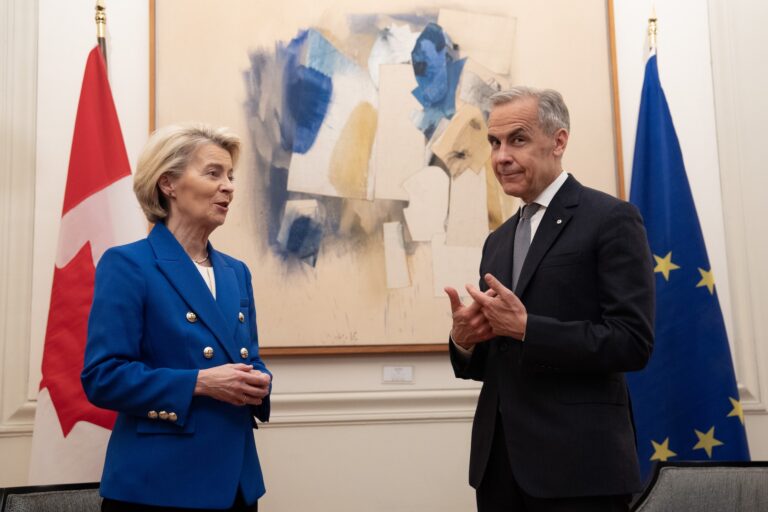
A shot of Mark Carney and Ursula von der Leyen in front of an abstract painting with Canadian and EU flags on either side of it. Von der Leyen is speaking, and Carney appears to be shrugging at the camera with a sly smile on his face.
News

Major partnership between Canada and EU on track for October reveal, says envoy

By Joanna Smith
An image of Mark Carney against a light and dark background.
News

Foreign investment could give investors a say in Canada’s critical infrastructure—and its sovereignty

By Claire Brownell
News

Tangerine plans new products as it reinvents itself as a tech-powered challenger bank

By Claire Brownell

In-depth, agenda-setting reporting

Great journalism delivered straight to your inbox.

News

The Canada Investment Summit’s US$430B deal book, in charts

By Chaimae Chouiekh

Briefing

Cohere’s Gomez says Silicon Valley giants shouldn’t get to set the rules for AI

By Murad Hemmadi   |   Sep 14, 2026 | 4:19 PM ET

TD pledges $150B in new financing and support in key Canadian sectors

By Claire Brownell   |   Sep 14, 2026 | 3:49 PM ET

Scotiabank commits more than $100B to fund Canadian businesses

By Claire Brownell   |   Sep 14, 2026 | 3:42 PM ET

Best business newsletter in Canada

Get up to speed in minutes with insights and analysis on the most important stories of the day, every weekday.

Exclusive events

See the bigger picture with reporters and industry experts in subscriber-exclusive events.

Membership in The Logic Council

Membership provides access to our popular Slack channel, participation in subscriber surveys and invitations to exclusive events with our journalists and special guests.

Recent Popular Stories

News

Tangerine plans new products as it reinvents itself as a tech-powered challenger bank

By Claire Brownell   |   Sep 8, 2026
News

What Canada will pitch to the world’s investors at next week’s high-stakes summit

By Anita Balakrishnan, Chaimae Chouiekh, Murad Hemmadi and David Reevely   |   Sep 9, 2026
News

Major partnership between Canada and EU on track for October reveal, says envoy

By Joanna Smith   |   Sep 9, 2026
A shot of Mark Carney and Ursula von der Leyen in front of an abstract painting with Canadian and EU flags on either side of it. Von der Leyen is speaking, and Carney appears to be shrugging at the camera with a sly smile on his face.
News

Foreign investment could give investors a say in Canada’s critical infrastructure—and its sovereignty

By Claire Brownell   |   Sep 9, 2026
An image of Mark Carney against a light and dark background.
News

Trump ups trade war stakes with bans on Canadian booze and other imports

By Joanna Smith   |   Sep 8, 2026
Canadian and U.S. flags wave beside Gordie Howe International Bridge under a clear blue sky.
News

Economic damage from Trump’s latest trade salvo may not be as bad as feared

By Joanna Smith and David Reevely   |   Sep 10, 2026
Close-up of a red American roadside call box marked “Made in the U.S.A.,” with a blurred semi-truck approaching on Gordie Howe International Bridge.

Canada's most influential executives and policymakers are reading The Logic

  • CPP Investments
  • Sun Life Financial
  • C100
  • Amazon
  • Telus
  • Mastercard
  • bdc
  • Shopify
  • Rogers
  • RBC
  • General Motors
  • MaRS
  • Government of Canada
  • Uber
  • Loblaw Companies Limited
logic-logo

Canada's Business and Tech Newsroom

100% human-crafted journalism

Newsroom

  • News Tips
  • AI Policy
  • Editorial Disclosures
  • Story Pitches

Company

  • About Us
  • Terms of Service
  • Privacy Statement
  • Corporate Information

Contact

  • Contact Us
  • Advertise
  • FAQs
  • Work at The Logic

© 2026 The Logic Inc. All Rights Reserved.

Trusted by leaders

Error

Account creation failed.

Please email us at [email protected].

Create Account

[wppb-register form_name=”cozmo-registration-form-for-modal”]

I do have an account
Login
or

[wppb-login]

I don’t have an account