Listen Now
0:00
Hydro-Québec is belatedly seeing the light.
After more than 80 years of harvesting energy from tumbling water, the Crown corporation is looking to the sun to fulfill the province’s ever-growing electricity demands. In May 2025, for the first time in its history, Hydro-Québec put out a tender for the development of solar projects. The expected collective output, 300 megawatts, is a pittance—less than a single percentage of Hydro’s capacity, or enough to power around 225,000 homes.
Yet the precedent is huge, and the enthusiasm behind the initiative says a lot about the future of hydroelectric power in the province. Hydro has since received 60 offers as of last month, for a total potential capacity of 481 megawatts. The utility expects to release the result of the tender in early 2027.
Related Articles

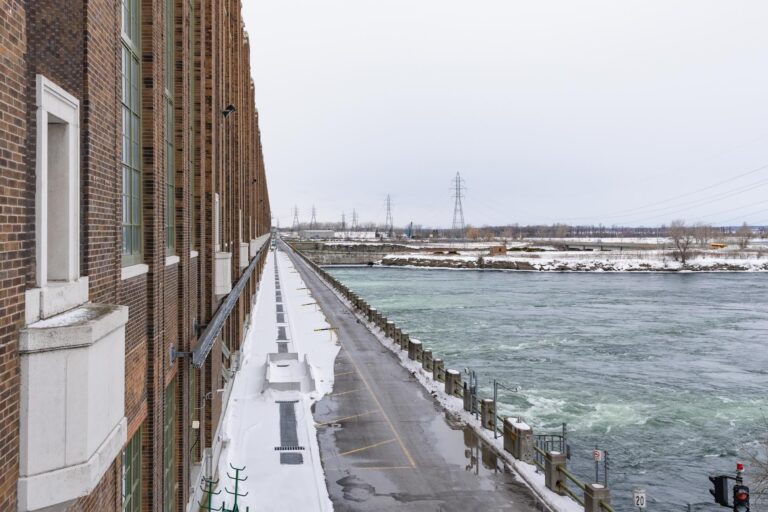
Hydro-Québec has long operated as though other means of electricity generation simply don’t exist. It’s right there in the name, which alludes to the electrical and political might that the utility churns from its 61 hydroelectric generating stations. Hydro’s disco-era foray into nuclear power was widely condemned as a dangerous mistake, so much so that it shuttered Quebec’s lone nuclear power station in 2012 rather than refurbishing it.
The province’s push into wind power has been more successful, though output remains relatively small and projects have been labelled as an expensive folly throughout the last half-century. In both cases, the reasoning was simple enough: why erect wind towers, or tempt nuclear catastrophe, when we can just dam up some river in the far-flung north?
Solar’s entry into Quebec has been comparatively criticism-free. This is in part due to the technology’s relative discretion: carpets of photovoltaic panels, rather than horizon-busting propellers or brutalist atomic sprawls by the river. Though it operates only two solar facilities, Hydro-Québec is so jazzed with solar that it plans on installing aims to develop 3,000 megawatts of capacity by 2035. Roughly 1,000 Quebecers have hooked up their own at-home solar panels to the grid. Hydro-Québec wants more than 125,000 by 2035.
It further speaks to how the utility is projected to run out of electricity surpluses next year—and building dams, long its go-to fix and raison d’être, isn’t as feasible as it once was. In fact, it may never be again.
Hydro’s DNA lies in huge, legacy-sized hydroelectric projects like La Grande-2, which launched in 1971, commissioned in 1979, and whose installed capacity is more than enough to handle the city of Los Angeles’s electrical needs on an average day. Building such a thing now, in an age of environmental reviews and respect for Indigenous treaties, is a far longer and more expensive endeavor. There was a time when the utility pumped out a new generating station every few years. The last one, the Romaine, was commissioned over a decade ago.
Solar might also be a renewable energy source, but it’s different from hydro in just about every other respect. Setup is comparatively cheap and quick, and output is relatively consistent where hydro is susceptible to the whims of water cycles and climate change. Quebec also gets 20 per cent more sunshine than Germany, which is already home to over 80,000 MW of installed solar capacity—representing about 16 per cent of the country’s energy generation.
So why the decades-long holdup? Benoit Marcoux, a Quebec-based energy consultant, blames Hydro-Québec’s success, saying the utility has been against other forms of energy generation precisely because it’s so good at building dams. “There’s a reluctance, when you’re so good at one thing, to launch yourself at something you’re not good at,” Marcoux told me.
Hydro’s attitude has changed, albeit slowly. In solar, the utility now sees a host of advantages, which spokesperson Cendrix Bouchard listed off in an email to me. It will mitigate supply risks, increase grid resilience and allow the utility to better serve remote communities with clean, reliable power. In offsetting supply, solar also allows the utility to store water behind dams for use during peak periods.
And it does it all without damning another river. Better late than never.
Martin Patriquin is The Logic’s Quebec correspondent. He joined in 2019 after 10 years as Quebec bureau chief for Maclean’s. A National Magazine Award and SABEW winner, he has written for The New York Times, The Guardian, The Walrus, Vice, BuzzFeed and The Globe and Mail, among others. He is also a panellist on CBC’s “Power & Politics.”