CALGARY — The Alberta government tabled its annual budget on Thursday, setting the tone for its economic recovery plans built around attracting investment and building up its skilled workforce.
Skip to content


Special Report
Alberta budget hones in on talent crunch as province returns to surplus
Alberta Premier Jason Kenney applauds after Finance Minister Travis Toews delivered the 2022 budget in Edmonton on Feb. 24. Photo: The Canadian Press/Jason Franson
CALGARY — The Alberta government tabled its annual budget on Thursday, setting the tone for its economic recovery plans built around attracting investment and building up its skilled workforce.
The budget marks a sharp turnaround in the province’s fiscal health, as the government laid out plans to eliminate its deficit this year on the back of roaring oil prices and higher royalty payouts from some oil-sands projects. Alberta expects to post a $500-million surplus in 2022–23, erasing its massive $18.2-billion shortfall last fiscal year.
Talking Point
Alberta’s latest budget marks a sharp turnaround for the province, virtually eliminating its COVID-related deficit with the help of soaring oil prices. Now the province has pivoted toward mobilizing workers as employers struggle to hire skilled labourers.
Still, the budget is likely to get mixed reviews on its innovation agenda, even as it pays substantial attention to addressing Alberta’s current labour crunch and launches a new—yet vague—$73-million innovation strategy program. Long-awaited details on broad strategies for AI, data management and intellectual property were not provided in the sprawling 232-page document.
Here’s a rundown of the Alberta budget and what it means for the innovation economy:
Attracting talent
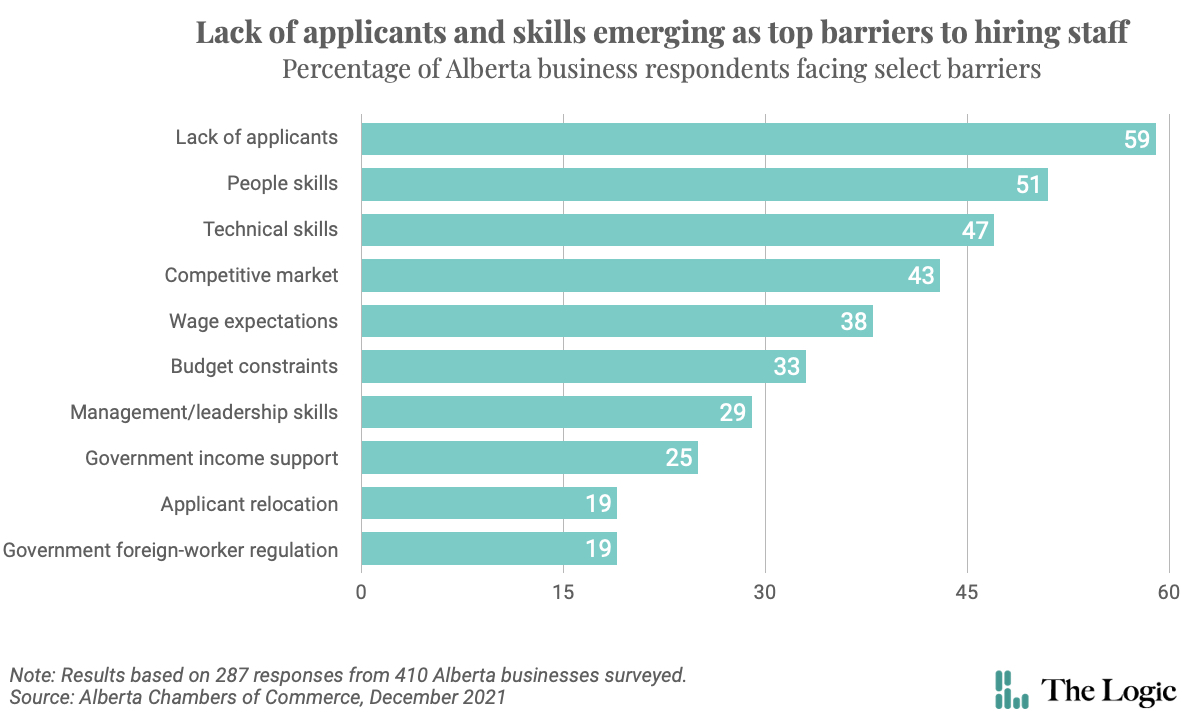
The United Conservative Party spilled considerable ink explaining its approach to the Alberta workforce, and how it seeks to loosen “pronounced skill shortages” in some sectors, including technology. Alberta now has a job-vacancy rate of 4.4 per cent, roughly double its February 2020 rate, the budget says.
The government laid out a few remedies to address the issue, including spending $171 million over three years to grow college and university enrollment in areas with shortages. The UCP claims those efforts will lead to 7,000 new post-secondary spots in tech-related areas like computer sciences, fintech, data modelling and aviation.
Alberta will spend $20 million this year as it presses “employers to create more job-placement opportunities,” followed by another $10 million next year. It will allocate $6 million over three years to “expand work-integrated learning programs for up to 1,200 students.” Another $30 million will go toward boosting apprenticeship programs.
To cap it off, the province will spend $15 million on a marketing campaign to “create national and international awareness of the benefits of living, working and starting a business or investing in Alberta” to help attract highly-skilled workers.
Tech-industry representatives applauded the government’s focus on talent. Bronté Valk, government affairs manager of the Council of Canadian Innovators, said the budget is a “big win for Alberta’s burgeoning technology sector” as it would increase access to skilled workers through a variety of measures.
“Many details in today’s budget still need to be coloured in, but at first blush, it’s clear that the advocacy of the local tech community has made its mark on the economic blueprint of this government,” she said in a statement.
Another call for carbon-capture money
The UCP government continues its push for federal government support for carbon capture, utilization and storage (CCUS) in the latest budget, but this time with more specificity than usual.
The government clearly outlines that it would prefer the federal government to cover 60 to 75 per cent of investment costs on CCUS projects, loosely in line with industry guidelines laid out last year. The provincial government argues that such an investment would allow Alberta to sequester 50 million tonnes of pollutants every year, well above the 15-million-tonne target set by Ottawa.
A (vague) strategy for innovation
The UCP also lays out plans to spend $73 million over three years on the Alberta Technology and Innovation Strategy (ATIS). The new, undefined program “envisions Alberta becoming an internationally recognized technology and innovation hub,” the budget states, without providing any further details.
That lack of detail comes as some industry representatives say Alberta is behind schedule in its promises to deliver a broad strategy on data management and intellectual property. Another strategy around regulating and enabling AI hasn’t been released.
Measuring success
Also in the budget, Alberta called for improved measuring and reporting practices at two key innovation programs in response to a study from the provincial auditor general last year saying they had failed to “fully demonstrate” their value to taxpayers. The Alberta Enterprise Corporation will have to introduce targets and improve reporting regimes by June 2022, it said. Alberta Innovates must bring in new standards to evaluate the cost of its investments by March 2023.
Looking ahead
It’s hard to ignore that this latest budget is a triumph in Alberta’s fiscal position, even if it’s largely due to soaring oil prices. A “chronic” supply shortage among major oil producers has persisted amid the global pandemic, alongside recent geopolitical strife that has pushed oil prices well over US$90 per barrel.
The province plans to remain out of the red for the next three fiscal years, posting a $700-million surplus in 2024–25. Net debt-to-GDP is estimated to drop to 16.7 per cent, down from 24.5 per cent in 2021–22, and is projected to continue on a downward curve.
But rising interest rates, the ongoing COVID-19 pandemic and volatile commodity markets could spoil today’s rosy projections.
“Prospects for the Alberta economy are solid, although supply-chain disruptions, elevated inflation and COVID-related disruptions remain headwinds,” the budget reads.



Loading...
Thanks for sharing!
You have shared 5 articles this month and reached the maximum amount of shares available.
CloseThis account has reached its share limit.
If you would like to purchase a sharing license please contact The Logic support at [email protected].
CloseGift the full article!
You have gifted 0 article(s) this month and have 5 remaining.
Recipients will be able to read the full text of the article after submitting their email address. They will not have access to other articles or subscriber benefits.
Photo: The Canadian Press/Jason Franson
Most Popular This Week




In-depth, agenda-setting reporting
Great journalism delivered straight to your inbox.
News
Canadians are open to pension funds investing in airports and railways
Briefing
Micrologic raises $45M to expand cloud services for clients seeking sovereignty
Calgary’s Ultimarii raises $13M for AI tools to do paperwork for infrastructure
Feds scale back reviews of oilsands extraction projects and fossil-fuel power plants
Best business newsletter in Canada
Get up to speed in minutes with insights and analysis on the most important stories of the day, every weekday.
Exclusive events
See the bigger picture with reporters and industry experts in subscriber-exclusive events.
Membership in The Logic Council
Membership provides access to our popular Slack channel, participation in subscriber surveys and invitations to exclusive events with our journalists and special guests.