Some of Canada’s biggest charitable foundations gave away less money than the minimum required of them, in a year when the value of their investments grew almost $13 billion, an investigation by The Logic has revealed.
Skip to content



Investigation
Uncharitable: As Canada’s charitable foundations grow, some of the biggest are spending less than required
An analysis by The Logic found that in 2019, seven per cent of charities failed to meet a minimum rate of charitable spending designed to prevent organizations from becoming wealth-accumulation vehicles. Photo: Zachary Monteiro for The Logic
Some of Canada’s biggest charitable foundations gave away less money than the minimum required of them, in a year when the value of their investments grew almost $13 billion, an investigation by The Logic has revealed.
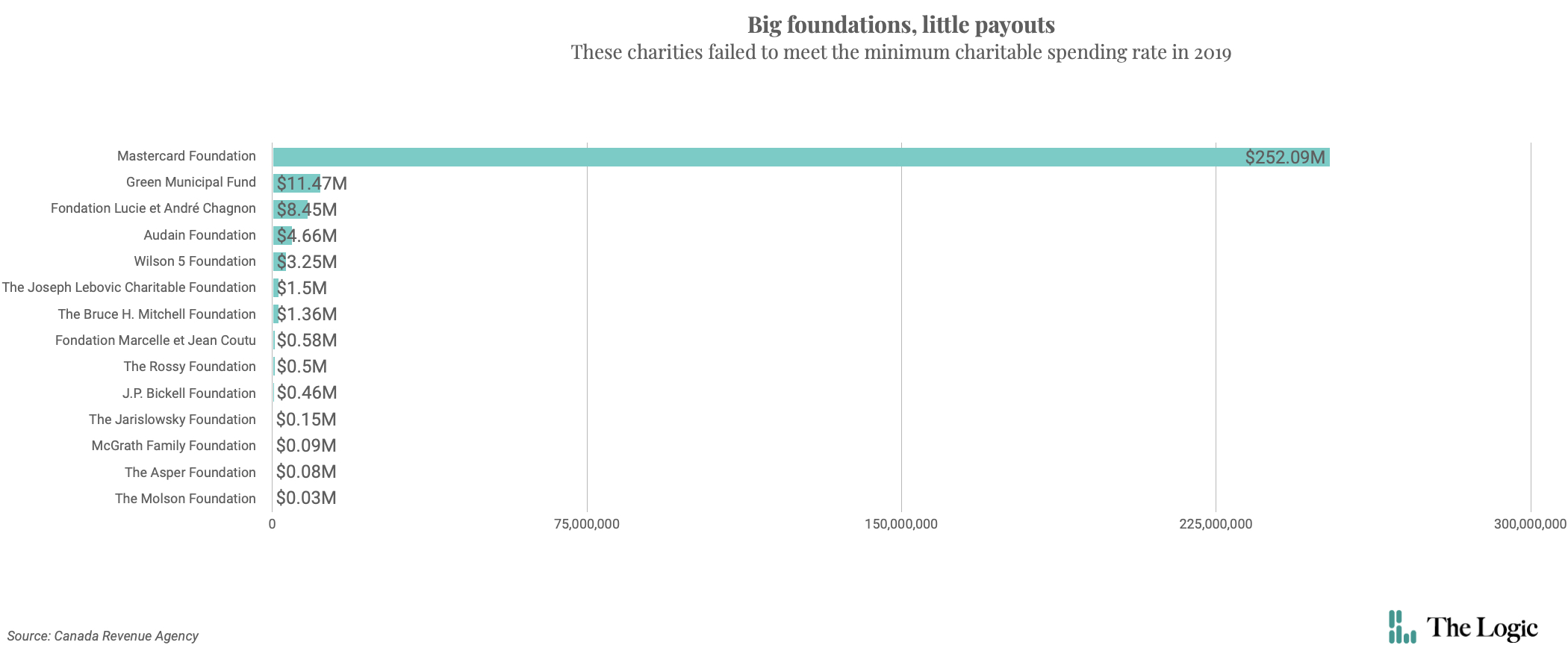
These 14 foundations, which include those of some of Canada’s wealthiest families, weren’t alone. The Logic examined the tax records of 83,000 registered charities and found that 2,095 reported an amount of charitable spending that failed to meet the minimum rate, for a collective spending shortfall of $414 million—money that could have flowed to frontline charities and into communities and projects.
Thanks to an assortment of loopholes over how the minimum giving threshold is calculated by the Canada Revenue Agency, these charities are not necessarily breaking the law. But The Logic’s findings come as Canada debates whether to raise that minimum rate in consultations run by Finance Canada.
Greg Thomson, Charity Intelligence Canada’s director of research, said these findings support calls to increase that minimum rate and improve oversight and enforcement of Canada’s charitable sector. “There are a ton of charities not meeting their quota, representing hundreds of millions of dollars in donations not making its way to the frontline charities each year,” he said.
The CRA calls that minimum rate of charitable giving the disbursement quota. Under the agency’s rules, charities with enough assets to qualify must spend 3.5 per cent of the average value of their assets in the prior two years on donations or running charitable programs, subject to certain deductions.
The disbursement quota was created in 1950, designed to prevent foundations from becoming tax-sheltered wealth-accumulation vehicles. In 1976, amid a debate about changing the threshold, Finance said its purpose was to make sure “tax-exempt monies flowing to charities are used as intended,” because “revenue forgone as a result of deductions or exemptions … impose[s] an equivalent extra tax burden on all other taxpayers.”
Talking Point
- An analysis by The Logic found that in 2019, seven per cent of charities, and one in five of the country’s largest foundations, failed to meet a minimum rate of charitable spending.
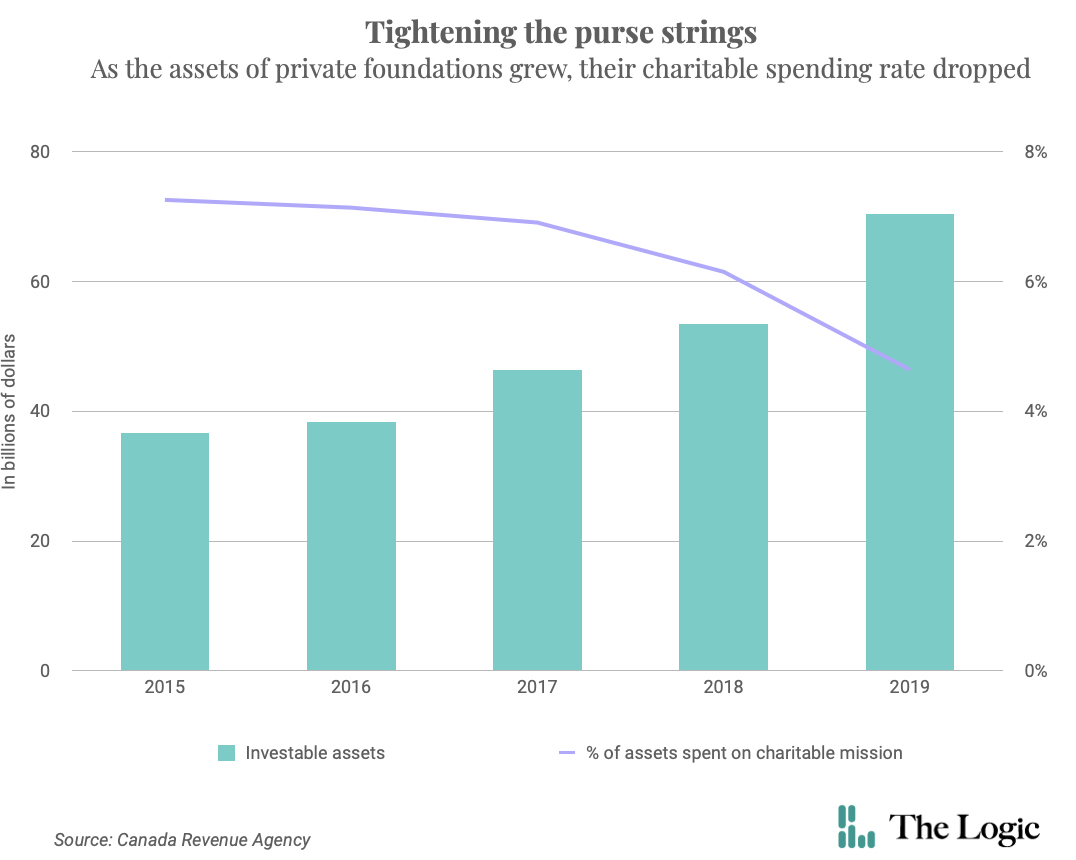
- Total investable assets held by Canadian foundations have increased 70 per cent from from 2015 to 2019. Meanwhile, private foundations’ charitable spending has gone down over the same period, from almost 7.3 per cent of assets in 2015 to just over 4.6 per cent in 2019.
- Finance Canada is conducting consultations to examine whether that rate, known as the disbursement quota, should be increased.
It applies to all charities, but today’s debate about raising the quota is focused on foundations. Foundations are like the banks or venture capitalists of the charitable sector, collecting and investing assets which they then draw on to make grants that help operating charities fund their work—hospital foundations, for example, raise money to make grants to hospitals.
Public foundations, such as hospital foundations, typically raise money from a wide pool of donors. Private foundations, on the other hand, are funded by contributions from a single person, family or company that also controls its board. All but one of the 14 large foundations The Logic identified as failing to meet the 3.5 per cent charitable-spending rate in 2019 are private foundations.
Of the top one per cent of foundations with enough assets to be subject to the disbursement quota in 2019, about one in five, or 14, failed to meet the 3.5 minimum disbursement rate that year. Those 14 foundations collectively held $41.8 billion, more than the government of Alberta’s total spending this year. They include the foundations of Lululemon founder Chip Wilson, Videotron founder André Chagnon and Setter Capital founder Peter McGrath.
Read the rest of the series
Uncharitable is a series based on a data investigation by The Logic’s Claire Brownell. Don’t miss these other stories:
Foundations falling short: Who’s making use of the CRA’s ‘carry-forward’ loophole
Methodology: How The Logic crunched the numbers
Canada’s only ‘mega-foundation’ in the spotlight during debate over minimum giving
Questions raised over Sabia sitting out Finance Canada’s discussions on charitable sector
The Mastercard Foundation, whose total assets of over US$39 billion make it Canada’s biggest charity by far, looms over the disbursement-quota debate. The foundation was the biggest contributor to the $414-million shortfall that The Logic identified in 2019, responsible for about 61 per cent of it.
The Mastercard Foundation has an arrangement with the CRA that allows it to fall short of the 3.5 per cent charitable-spending rate in some years, as long as it meets it on average over a 15-year period, which ends this Dec. 31. “The Mastercard Foundation has consistently complied with disbursement requirements,” said spokesperson Toni Tiemens, who added that it will meet its full obligations under the averaging arrangement by the December deadline.
Making the issue more pressing is that foundations’ investment returns have far outpaced 3.5 per cent in recent years.
The total investable assets held by Canadian foundations have increased 70 per cent from $59 billion to $100 billion from 2015 to 2019. For private foundations alone—including the Mastercard Foundation—investable assets are up over 92 per cent. Meanwhile, private foundations’ charitable spending has gone down over the same period, from almost 7.3 per cent of assets in 2015 to just over 4.6 per cent in 2019.
With billions in assets sitting in foundations’ investment portfolios, raising the disbursement quota could significantly increase the amount available to tackle some of Canada’s toughest problems.
An analysis by Charity Intelligence found that increasing the quota to 10 per cent would generate an extra $4 billion in charitable funding annually—by some estimates, enough to end homelessness in Canada for a year, upgrade much of the drinking water and other infrastructure in First Nations communities or provide COVID-19 vaccines to nearly one-quarter of the developing world.
A growing number of organizations have been calling on the government to raise the disbursement quota. Those calls appear to have Ottawa’s attention. Buried deep in April’s 725-page federal budget document, a section titled “Boosting Charitable Spending in Our Communities” included an acknowledgement that “while most charities meet or exceed their disbursement quotas, a gap in charitable expenditures still exists today.” Finance Canada is now consulting on the issue, noting in a background document that the Canada Revenue Agency’s “toolkit for enforcing the disbursement quota is currently limited.”
While the Finance document and many in the sector acknowledge there is a compliance problem among some charities, some of those which The Logic’s analysis identified as falling short of the 3.5 per cent rate in 2019 may nonetheless have met their legal obligations.
It’s common for charities to make errors in their tax filings, which means some may have satisfied the 3.5 per cent charitable giving rate despite indicating in their returns that they had not. The number of charities failing to meet the 3.5 per cent rate may also be higher than the nearly 2,100 The Logic identified—about 10 per cent of charities subject to the disbursement quota did not report any charitable spending at all, but they were excluded from this analysis because most appeared simply to have failed to fill out that section of their tax returns.
There are also many loopholes that allow charities to spend less than the minimum in a given year and still meet their obligations under the law. If a charity exceeded the 3.5 per cent minimum rate in the five years before or one year following a shortfall, it can draw from those excesses to meet the disbursement quota.
In other cases, such as that of the Mastercard Foundation, the CRA grants charities special permission to fall short. The CRA declined to say how often it grants such requests, or why it allowed the Mastercard Foundation’s.
Jeremy Bellefeuille, a spokesperson for Diane Lebouthillier, who oversees the CRA as national revenue minister, said he couldn’t comment on a specific charity.
Regarding the larger issue of charities failing to meet the disbursement quota, Bellefeuille sent a statement that repeated the language on the disbursement quota from April’s federal budget.
For the wealthy, having a private foundation comes with significant tax benefits. Canadians can claim a tax credit on donations of up to 75 per cent of their net incomes. Thanks to those tax credits, the after-tax cost of a donation of $1 million is between just over $470,000 and over $598,400, depending on where in Canada the donor lives. If a charity or foundation invests that donation, its income and capital gains grow tax-free.
The people tasked with managing the assets of foundations stand to make significant fees, which grow as the assets grow: “Over decades the amounts can really add up,” wrote charity lawyers Mark Blumberg and Jessie Lang in a recent report on the disbursement-quota debate.
Jean-Marc Mangin, president and chief executive of Philanthropic Foundations Canada, said the debate about raising the disbursement quota has been “a lightning rod” among his organization’s members. The organization ultimately recommended a modest increase to five per cent from the current 3.5 per cent.
“Not every one of our members is happy, but most members are comfortable with our position,” Mangin said.
Mangin said his members are concerned a disbursement-quota increase above five per cent could eventually force them to spend all their capital and wind down operations, an issue he said is most pressing for small foundations. Not every foundation posts the same big returns as the largest ones, he noted.
Other measures, such as broadening the types of organizations to which foundations can give, are just as important as making changes to the rate, he said.
But John Hallward, a retired entrepreneur and founder of the Increase the Grants campaign, said making sure foundations last forever is a bad policy goal and a poor reason to keep the disbursement quota down.
“For policymakers, their interest has to be the ecosystem and the interest of the nation, not the existence of every foundation that exists today,” he said. “It’s fine if a foundation goes out of business 40 years from now. There’ll be new ones.”
Hallward said he started the Increase the Grants campaign because he saw an easy way to significantly increase the amount of money flowing to charities, and by extension, to people in need. Its critics try to complicate the issue by saying other problems should be fixed first, or that there’s not enough data to assess its impact, he said.
“You can fix the disbursement quota tomorrow,” he said. “It’s low-hanging fruit. And it’s a simple idea.”



Loading...
Thanks for sharing!
You have shared 5 articles this month and reached the maximum amount of shares available.
CloseThis account has reached its share limit.
If you would like to purchase a sharing license please contact The Logic support at [email protected].
CloseGift the full article!
You have gifted 0 article(s) this month and have 5 remaining.
Recipients will be able to read the full text of the article after submitting their email address. They will not have access to other articles or subscriber benefits.
Photo: Zachary Monteiro for The Logic
Most Popular This Week




In-depth, agenda-setting reporting
Great journalism delivered straight to your inbox.
Commentary
Carmichael: Being boxed in will help Canada focus on what matters
Briefing
Rio Tinto gets nearly $165M in additional federal funds for Quebec aluminum
U.S. to lift tariffs on some Canadian products crucial to Maine: Collins
Carney warns of tech dependence after Starlink disruptions in Ukraine
Best business newsletter in Canada
Get up to speed in minutes with insights and analysis on the most important stories of the day, every weekday.
Exclusive events
See the bigger picture with reporters and industry experts in subscriber-exclusive events.
Membership in The Logic Council
Membership provides access to our popular Slack channel, participation in subscriber surveys and invitations to exclusive events with our journalists and special guests.






