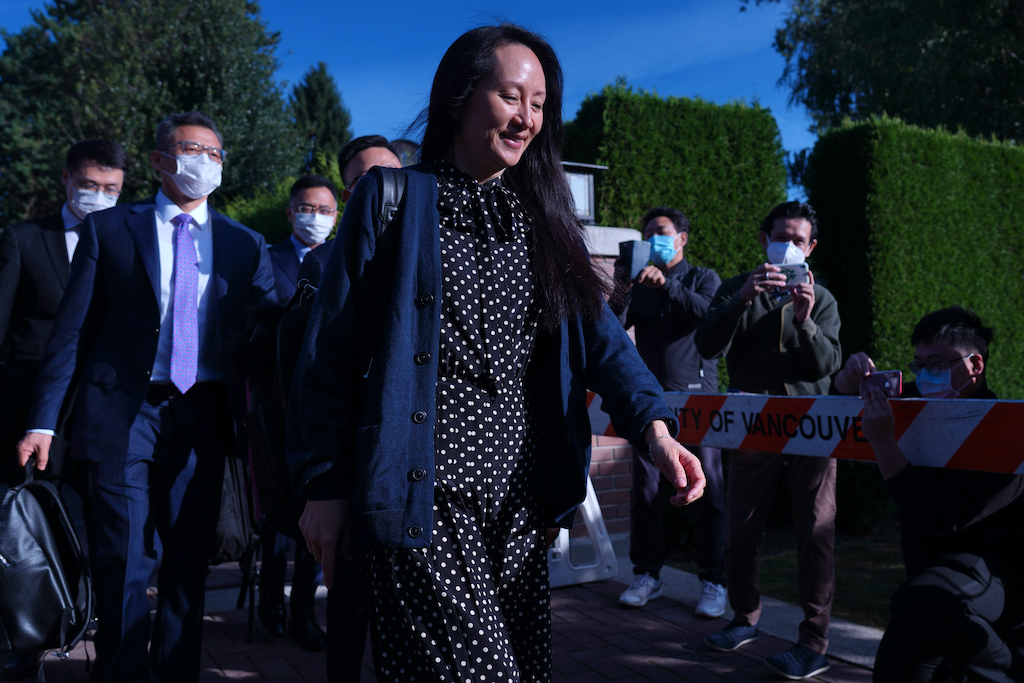
Huawei chief financial officer Meng Wanzhou agreed to a deferred prosecution agreement in a Brooklyn court Friday, ending the United States’ effort to have her extradited from Canada for a U.S. trial on fraud charges. Hours later, China released two Canadians, Michael Kovrig and Michael Spavor, it had detained days after Meng’s arrest in 2018.
The developments could begin a new chapter for Canada-China relations, which have been in crisis since Meng’s arrest at Vancouver’s airport.
Here’s what you need to know:
What happened in New York: Judge Ann Donnelly accepted a deal between U.S. prosecutors and Meng over charges she lied to HSBC in the United States about a subsidiary accused of violating U.S. sanctions against Iran. By wonky video link from Vancouver, Meng pleaded not guilty to criminality, but agreed to a four-page account of her actions that includes an admission that she told multiple financial institutions a Huawei subsidiary doing business in Iran was merely a partner. In turn, assistant U.S. attorney David Kessler said Meng won’t be prosecuted if she remains on good behaviour until December 2022.
(The hearing began nearly an hour late because Donnelly was instructing the jury in the sex-trafficking trial of singer R. Kelly.)
Kessler told Donnelly the U.S. would inform Canada it was withdrawing its extradition request.
What happened in Vancouver: Meng’s extradition case wrapped after a short hearing in a Vancouver courtroom. Calling it the “final chapter” in the proceedings, counsel representing the attorney general of Canada on behalf of the U.S. asked to withdraw the authority to proceed with an extradition, effectively setting Meng free. The judge signed the order, which also vacated Meng’s bail conditions, and thanked Meng for being “cooperative and courteous throughout.” After court was adjourned, Meng cried as she hugged her legal team.
With the U.S. withdrawing its request, “there is no basis for the extradition proceedings to continue,” said Canada’s department of justice in a statement, adding Meng “is free to leave Canada.” The statement also lauded the country’s legal system, saying Meng “was afforded a fair process before the courts.”
She reportedly flew out of Canada almost immediately.
What happened in China: Prime Minister Justin Trudeau called a rare evening news conference Friday to announce that Kovrig and Spavor had been freed and were already on a plane of their own, bound for Canada, accompanied by Ambassador Dominic Barton.
Trudeau cited concerns about the ongoing operation in saying little about how the men were released. He thanked their families, Canadian diplomats and Canada’s allies for their support during an ordeal that lasted more than 1,000 days.
How we got here: Shortly after the RCMP arrested Meng, China detained Kovrig and Spavor on national-security allegations. In June 2020, a spokesperson for China’s foreign ministry linked the cases.
Spavor was sentenced to 11 years and ordered deported by a Chinese court. Kovrig had been tried, but no verdict had been issued.
A third Canadian in China, Robert Schellenberg, who had been sentenced to 15 years of prison for smuggling drugs, was swiftly retried and sentenced to death; Trudeau didn’t mention him Friday.
China also began obstructing imports of canola seed from Canada in early 2019, and barred Canadian pork for several months.
What to watch for: The Liberal government has been working on a new “framework” for its relations with China, which might need reassessment.
Canada has also been dragging a decision on whether Huawei products can be used in 5G wireless networks and is maintaining a studied silence on whether China or Taiwan should join the Trans-Pacific Partnership trade agreement. But it has joined in criticizing China’s suppression of liberties in Hong Kong.
The Meng case might have started this, but there’s much more animosity between the countries now than when it began.