Amid an industry-wide race to build next-generation automotive operating systems, BlackBerry’s smart-car collaboration with Amazon has started testing its software-development kits with outside companies.
Skip to content

News
Operation Ivy: BlackBerry and Amazon’s play for the future of the connected car takes shape
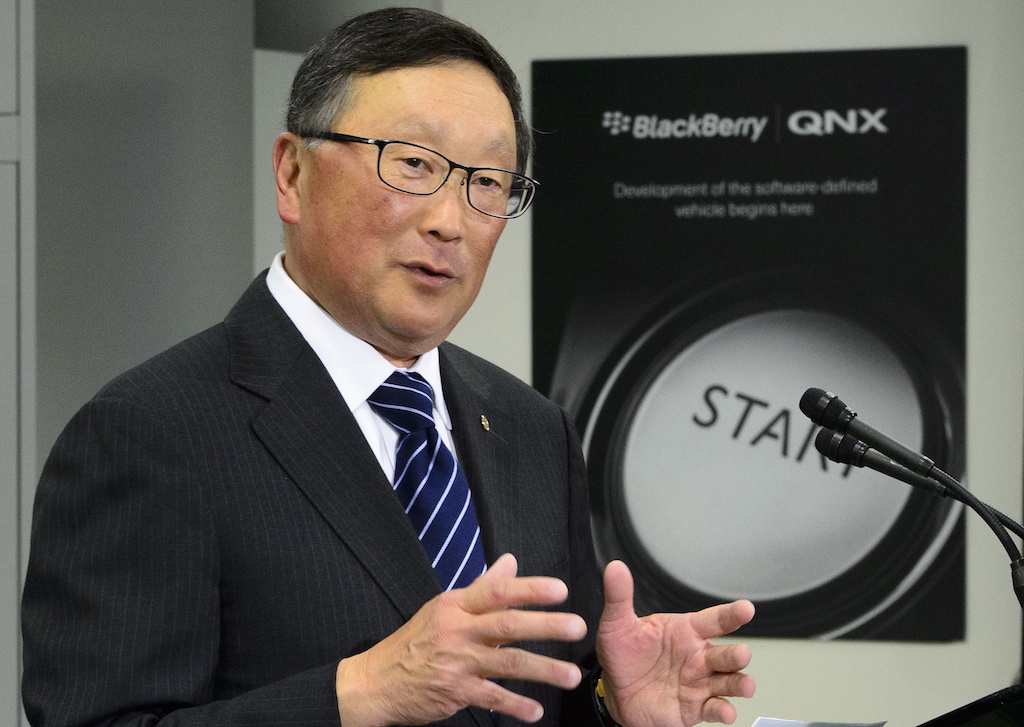
BlackBerry CEO John Chen in Ottawa in February 2019. Photo: The Canadian Press/Sean Kilpatrick
Amid an industry-wide race to build next-generation automotive operating systems, BlackBerry’s smart-car collaboration with Amazon has started testing its software-development kits with outside companies.
The joint project, dubbed Ivy, is an effort to create an OS that extends to apps beyond the built-in programs that simply operate the vehicle. It is giving exclusive first access to developer tools to Telus, Geico, location-data company Here Technologies and voice-command platform Cerence. The companies, plus Amazon Web Services, are part of a growing advisory council that BlackBerry said evolved after widespread interest in the December launch. There are further plans to bring startups into the fold, with an open call from BlackBerry and a $50-million fund that just made its first seed investment.
Talking Point
There’s an industry-wide race to build the future operating system of the car’s computer, one that expands to apps beyond the built-in programs that simply operate the vehicle. Amazon and BlackBerry may have the lead, and are trying to woo automakers before they become the competition.
In an interview, Peter Virk, BlackBerry’s vice-president of the Ivy Ecosystem, told The Logic that Ivy is pursuing the “flywheel effect,” which helped Amazon attract customers and vendors, by creating a platform to connect automakers with innovative companies like those on the advisory council. “Ivy, at the highest level, is a way for us to help automotive car manufacturers to bring relevant and personalized products and services to the car space.”
BlackBerry’s first move into automotive software came with the 2010 acquisition of QNX, the Ottawa-based developer of an operating system that could be deployed in vehicles. QNX is now focused on keeping the critical systems embedded in the vehicle running safely and smoothly by controlling engines, airbag deployment, brakes, displays, driver assistance, EV battery voltage and cybersecurity updates.
Ivy, however, would run either on QNX or a rival operating system to “enhance” the vehicle, help automakers monetize data and connect vehicle makers to an app store-like ecosystem to add features beyond the car’s core operations. According to BlackBerry, Ivy is designed to consider both vehicle performance, like speed and seat pressure, and environmental factors, like wearables, smart-city installments and weather. Combined, the data could lend itself to uses like pinging drivers with recall alerts, for instance.
Ivy is distinct from consumer software like Android Auto, which Virk said doesn’t capture all the data created by the car itself, like electric-battery performance. It would be a dashboard for the automaker and the app maker, rather than just the driver.
“BlackBerry and Amazon are trying to create something totally new,” Morningstar Research equity analyst William Kerwin said in an email to The Logic.
Virk said the companies that make up the advisory council will test features like how 5G coverage affects connected-car performance. Eventually, he envisions a platform that automatically books an EV charging station, searches the map for a parking space, feeds into black boxes for insurance quotes and manages the subscriptions to all of the aforementioned services. The goal is to create a platform more universal than those that might be developed by the automakers themselves.
“One of the things that we’ve seen historically from [automakers] who have created their own platforms is, while they may have been great to market, the pain has always been the longevity and the maintenance,” said Virk, noting that vehicles have much longer shelf lives than phones.
“How do you then keep that pace and speed? That’s where BlackBerry can help.”
It is, he admits, early days. When BlackBerry and Amazon unveiled Ivy last year (sending BlackBerry’s stock up 20 per cent), CIBC analyst Todd Coupland and research associate Valery Heckel wrote in a note the real payoff for Ivy would not come until 2023 or 2024. BlackBerry CEO John Chen said in an earnings call last month that the early access version would be available in October and a production version would start shipping next February.
With the “trend of increasing software content per vehicle” already benefiting QNX, the company is recruiting executives with “deep” expertise for its connected-car division, Chen said.
Morningstar analyst Kerwin said the upside case for Ivy is precisely that it isn’t exclusive to one automaker or even to BlackBerry’s other auto play, QNX. The downside risk, he said, is that automakers could make their own competing offerings to collect vehicle data that “would undermine the open nature of Ivy.” For now, Kerwin said, Ivy has “no true competitors,” unlike QNX.
In the meantime, though, most carmakers are aggressively pursuing their own in-house software development. Tesla collects “massive amounts of IoT data.” EV upstart Rivian, which makes electric vans for Amazon that use AWS, has a software hub in Vancouver. General Motors is on a hiring spree (with some positions in Canada) that includes developers for its vehicle-intelligence platform. Stellantis—the parent company of Chrysler, Jeep and Maserati—is working with Foxconn, which itself has ambitions to become the equivalent of Android for electric cars. A Stellantis executive at its EV Day 2021 event last week said software was one of investors’ two main interests, along with electrification.
Virk himself came to BlackBerry in April from the connected-car team at Jaguar Land Rover (which also worked with Amazon). He said that even with engineers working in-house, BlackBerry’s platform could bring down development costs for automakers through its scale.
“Each car company can do their own development. But then that makes it very difficult for the content providers. You can imagine if you’ve got 10 car companies that you want to provide your service or technology or product to,” Virk said. “What happens when they have an update?”
BlackBerry’s deepening focus on the auto sector comes amid CEO Chen’s shift to chasing growth, not just profit. Revenue jumped 48 per cent last quarter in BlackBerry’s internet-of-things business, which is primarily QNX but also includes Ivy and other products. The IoT division still made less than half the sales of BlackBerry’s cybersecurity unit and less than a third of the revenue of its larger “software and services” unit in the quarter, but both those businesses showed patchier growth over the past year. Chen said in the earnings call that almost all major customers of QNX, which is in about 195 million vehicles, are engaged in exploring Ivy, with five automakers starting talks last quarter.
In announcing the venture last year, Amazon said one of Ivy’s potential applications is to “leverage vehicle data to recognize driver behavior and hazardous conditions.” Aside from operating a massive and feverish delivery-driver fleet, the tech giant has also toyed with offering auto insurance and bought a self-driving-vehicle startup last year, with potential plans to get a stake in another.
Amazon said its co-development of Ivy is a way to bring in developer talent “from outside the auto industry,” saying the sector had a “critical data access, collection, and management problem.” (It has done past data work for Honda, Toyota Racing and BMW, to name a few.) Ivy would feed automakers directly onto an AWS Management Console to update machine learning tools.
Virk said Amazon’s involvement with the system so far stems mainly from Amazon Web Services, which BlackBerry will use to get the information off the vehicle in a unified way. But, he said, the “opportunity is there” for BlackBerry’s partnership with Amazon to extend to its “huge family” of services like entertainment and Alexa.
“You don’t have to push everything into the cloud…. You can actually use the hardware inside the car to work out the information that you need that is relevant to you,” said Virk.



Loading...
Thanks for sharing!
You have shared 5 articles this month and reached the maximum amount of shares available.
CloseThis account has reached its share limit.
If you would like to purchase a sharing license please contact The Logic support at [email protected].
CloseGift the full article!
You have gifted 0 article(s) this month and have 5 remaining.
Recipients will be able to read the full text of the article after submitting their email address. They will not have access to other articles or subscriber benefits.
Photo: The Canadian Press/Sean Kilpatrick
Most Popular This Week


In-depth, agenda-setting reporting
Great journalism delivered straight to your inbox.
Commentary
Carmichael: What Finland can teach Canada about sleeping next to an elephant
Briefing
Financing instability is slowing down Ottawa’s housing agency, CEO says
Cleveland-Cliffs CEO says federal lawsuit would be a bad business decision for Canada
BoC shows off its new forecasting model, Prima
Best business newsletter in Canada
Get up to speed in minutes with insights and analysis on the most important stories of the day, every weekday.
Exclusive events
See the bigger picture with reporters and industry experts in subscriber-exclusive events.
Membership in The Logic Council
Membership provides access to our popular Slack channel, participation in subscriber surveys and invitations to exclusive events with our journalists and special guests.