By the time Martinrea CEO Pat D’Eramo announced his company’s new investment in autumn 2017, it had already tripled in value. That, D’Eramo assured financial analysts, was not the exciting part.
Skip to content

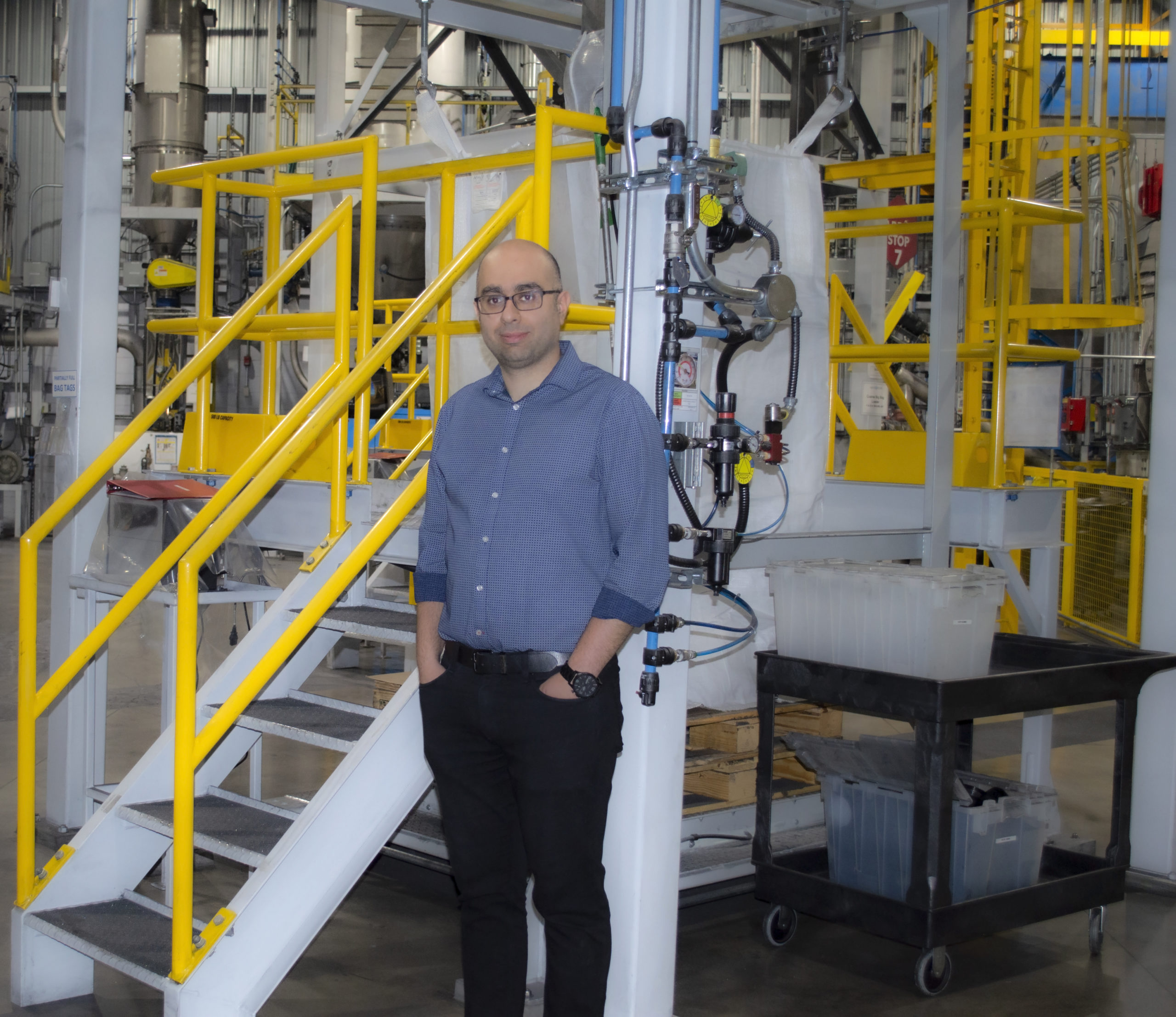 NanoXplore CEO Soroush Nazarpour. Photo: NanoXplore | Handout

News
Martinrea’s moonshot: Why the auto-parts maker is betting on a small Montreal firm that makes a fantastical material
A graphene structure. Photo: Marco_de_Benedictis | iStock
By the time Martinrea CEO Pat D’Eramo announced his company’s new investment in autumn 2017, it had already tripled in value. That, D’Eramo assured financial analysts, was not the exciting part.
The investment wasn’t in Martinrea’s bread-and-butter auto-parts business—making and supplying lightweight ones, particularly, to several major auto brands. It was in NanoXplore, then a six-year-old Montreal startup that made a material called graphene.
Talking Point
Martinrea, like many traditional auto-parts makers, is reinventing itself in an age where vehicles are set to have thousands fewer moving parts going forward. But it’s taking an unusual tack: investing in the teenage wunderkind of battery technologies, graphene.
“In the past, the ability to manufacture [graphene] on a large scale has not been practical,” D’Eramo said at the time. “Through the work of companies like NanoXplore, this unique material is becoming more available and we believe will be a significant player in the future of lightweighting.
“We have no doubt that graphene is becoming a bigger player.”
Since then, graphene has indeed become bigger, and so has NanoXplore, quietly building what it claims is the largest graphene-production facility in the world.
Martinrea, meanwhile, has kept upping its stake, and this spring, the two companies launched a joint venture to develop electric-vehicle batteries enhanced with graphene.
In doing so, the Vaughan, Ont. auto-parts supplier is betting on the teenage wunderkind of battery technologies. It’s a case study in how traditional auto-parts makers are reinventing themselves in an age when vehicles are set to have thousands fewer moving parts.
***
If you’re over the age of 30 and you’re not sure what graphene is, there’s a good reason: it was probably too experimental to make it into your science textbook. When two graphene researchers won the Nobel Prize in physics in 2010, the Royal Swedish Academy of Sciences called the material “completely new.”
“So far, most of the possible practical applications for graphene exist only in our fantasies,” the Academy said in its explanation.
Graphene conducts heat and electricity at least as well as copper, is predicted to make computer chips run faster than silicon, and is tougher than diamond and stronger than steel. But it’s also flexible. As the Academy noted, a graphene layer about the heaviness of a cat’s whisker could support the weight of an entire cat. The material, scientists theorized, had all the properties needed to make a smartphone that rolls up and fits behind your ear like a pencil.
Outside university labs, there were few ways to make graphene at any sort of scale—it was originally isolated in 2004, when the two researchers used tape to pull impossibly thin flakes of carbon out of a bulk supply of graphite, of the sort used in pencils. Despite the abundance of graphite available in nature, Canadian and British researchers at Deloitte said in 2015 that graphene cost about US$100 per gram that year. While the Deloitte report predicted the market for the “wonder material” could reach “the low tens of millions of dollars” in 2016, it also said it would be about a decade before graphene would be commercially viable for replacing common electronics materials like silicon.
“The number of ‘graphene’ products on sale in 2016 will likely number in the tens,” the report predicted.
Just a year later, however, D’Eramo was boasting of Martinrea’s investment in NanoXplore.
CEO Soroush Nazarpour, a PhD in nanotechnology, founded the company a year after others researching the material won the Nobel. “We are techy people. We are a bunch of smart scientists doing good work, but business is more than just good science projects,” he said in an interview with The Logic.
NanoXplore went public on the TSX-V in the summer of 2017 via a US$25-million reverse merger, then raised more than US$33 million over the next three years across three private placement deals with undisclosed investors, according to PitchBook data. A second public offering this February raised another US$36 million. As of the offering, Martinrea owned 22.2 per cent of the company, and is its largest shareholder.
When Nazarpour’s team approached Martinrea, they were easily able to excite the auto-parts maker about graphene’s potential, he said, though in some quarters it was still thought of as “moonshot” technology.
Amr Ezzat, an equity research analyst at Echelon Capital Markets, said the cost-saving technology Nazarpour developed differentiates NanoXplore from other graphene makers.
Graphene prices typically range between US$50 and US$200 a kilogram, said Ezzat, who has a “speculative buy” rating on NanoXplore’s shares with a $6 target price, reflecting the early-stage technology. “[NanoXplore] are currently selling their graphene for US$8 to US$10 a kilo—way cheaper, obviously, than the typical player …. as far as I know, it’s the only sort of company that’s able to consistently produce at these prices.”
For autos, graphene’s super light structure and super fast conductivity could improve the “durability, longevity, barrier properties, resistance to oxidation, and UV resistance” of car parts, NanoXplore’s website claims.
While one of Martinrea’s core businesses is lightweighting—making auto parts with lighter materials to improve fuel efficiency—it had been “a bit slow” to take on some of the more cutting-edge technologies, Nazarpour said. However, the first results of the partnership are beginning to take shape.
On top of its efforts to make cars lighter (and hopefully more fuel-efficient to extend EV battery life), Martinrea recently launched what it claims are the world’s first graphene-enhanced brake lines, coated with a mixture of graphene and nylon that makes them 25 per cent lighter and more durable against chemicals and abrasion.
More ambitious is VoltaXplore. The joint venture between NanoXplore and Martinrea would create graphene-enhanced lithium-ion battery cells for electric vehicles that could operate at a safer, lower temperature and improve battery charging and distance.
“You don’t hear a lot about battery-life issues so far. But if you owned a Nissan Leaf, you would probably be exchanging your batteries by now, because the Nissan Leaf has been out for some time. The older Teslas are now switching out batteries,” D’Eramo said in a presentation to shareholders earlier this month. (Martinrea did not respond to an interview request for this story.)
“You’ve heard the stories of fires in vehicles that are electric, such as the Tesla in Texas, which was most recent. And, even if you look back to the development [at] Boeing …. initial planes were delayed due to battery fires. So that’s a big problem. And graphene can help resolve those issues.”
Nazarpour said the graphite will be mined in Quebec and the batteries will be produced in a Canadian factory—if VoltaXplore can find customers for its new technology. D’Eramo said in his presentation that the building has been leased for demonstrations of the technology and that the go-ahead decision for a 10-gigawatt-hour manufacturing facility would come in mid-2022.
While the battery side of NanoXplore’s business is “extremely exciting” and has people talking, Ezzat points out that VoltaXplore is a small investment. Each company has pledged $4 million in startup capital for a construction facility, and an additional $6 million in development funding if needed.
Despite the novelty of graphene, Nazarpour is emphatic that VoltaXplore is not toying with a “disruptive” technology. When announcing the joint venture, D’Eramo suggested that graphene could be a step toward “ultimately bringing solid-state battery technology to market sooner,” an achievement that Nazarpour does not predict will happen before about 2030 or even 2035 using graphene. Rather, he said, VoltaXplore will focus on upgrading existing lithium-ion technologies.
“They are a very conservative market,” Nazarpour said of potential EV battery clients. “You cannot come at them with a totally disruptive technology—adoption would be a problem. So we are improving the current batteries without changing chemistry and the standards.”
***
NanoXplore’s business isn’t without risks. Its February prospectus noted the startup’s negative cash flow from operations last year. And its large market share in the graphene market could actually have downsides, Ezzat said.
“You’re dealing with a new material that requires long-term testing and validation, as well as obviously a lot of customer education. And the speed of that market adoption is primarily driven by secondary considerations or availability of large volumes of supply,” said Ezzat.
“You have this one player out of Canada producing potentially 4,000 tons a year, but the market is massive. So at this point what would be beneficial, I think even for NanoXplore, is if you start to have other companies able to produce at these sorts of prices.”
Nonetheless, Martinrea has benefited as NanoXplore’s largest shareholder, growing its investment over 200 per cent, according to a May 7 letter to shareholders. CIBC analyst Kevin Chiang wrote in a note that the joint venture will have a further positive impact on Martinrea.
“Consumer adoption of EVs has rapidly increased, but there remains some hesitancy by some, reflecting range anxiety and charging times (versus the convenience of filling up a gas tank). Using graphene in an EV battery may help address these concerns,” wrote Chiang of the joint venture.
“Coming out of the pandemic, the auto industry [has] been hit by supply chain disruptions. This has placed a greater focus on nearshoring key technologies within the auto industry. We believe VoltaXplore, which will be manufacturing its batteries in Canada, plays into the nearshoring strategy.”
Martinrea already makes propulsion systems and works with EV supplier Samsung on battery trays, and it also has structures and brake-line deals with Tesla. The company already estimates that about 80 per cent of its products are agnostic to vehicle electrification, while it also plans to make more money per vehicle on electric vehicles. But to Wildeboer, NanoXplore provides further evidence for investors that Martinrea is not just a supplier, but a technology company.
“The company has been entrepreneurial in nature since inception,” Martinrea executive chairman and co-founder Rob Wildeboer said at the company’s annual meeting last week, with D’Eramo later adding, “Is the graphene enhanced battery going to provide what’s needed to make enough of an improvement to be attractive to the market? We certainly believe it will.”



Loading...
Thanks for sharing!
You have shared 5 articles this month and reached the maximum amount of shares available.
CloseThis account has reached its share limit.
If you would like to purchase a sharing license please contact The Logic support at [email protected].
CloseGift the full article!
You have gifted 0 article(s) this month and have 5 remaining.
Recipients will be able to read the full text of the article after submitting their email address. They will not have access to other articles or subscriber benefits.
Photo: Marco_de_Benedictis | iStock
NanoXplore CEO Soroush Nazarpour.
Most Popular This Week


In-depth, agenda-setting reporting
Great journalism delivered straight to your inbox.
News
ApplyBoard was the worst-performing Canadian startup in Fidelity’s portfolio in 2026
Briefing
Ottawa’s major projects push could require 580,000 more workers by 2030, BDC predicts
Defence minister picks longtime CCI executive as new chief of staff
U of T launches $100M program to draw top-tier PhD students to focus on key social issues
Best business newsletter in Canada
Get up to speed in minutes with insights and analysis on the most important stories of the day, every weekday.
Exclusive events
See the bigger picture with reporters and industry experts in subscriber-exclusive events.
Membership in The Logic Council
Membership provides access to our popular Slack channel, participation in subscriber surveys and invitations to exclusive events with our journalists and special guests.