On a cool spring evening in April 2020, a resident of Ottawa was closely tracking the movements of an important package. Though it’s a ritual familiar to any shopper who’s bought something online during the COVID-19 pandemic, this particular delivery was a little larger and more consequential than most. After a fraught week, a precious cargo of personal protective equipment (PPE) was on its way from the U.S. to Canada. “The 500k 3M N95 mask shipment will hopefully arrive late tonight or early tomorrow morning,” the resident, a staffer in the office of Prime Minister Justin Trudeau, wrote in an email to her colleagues. She included a link to “a little tracker that I will continue to check every 5 mins.”
Skip to content

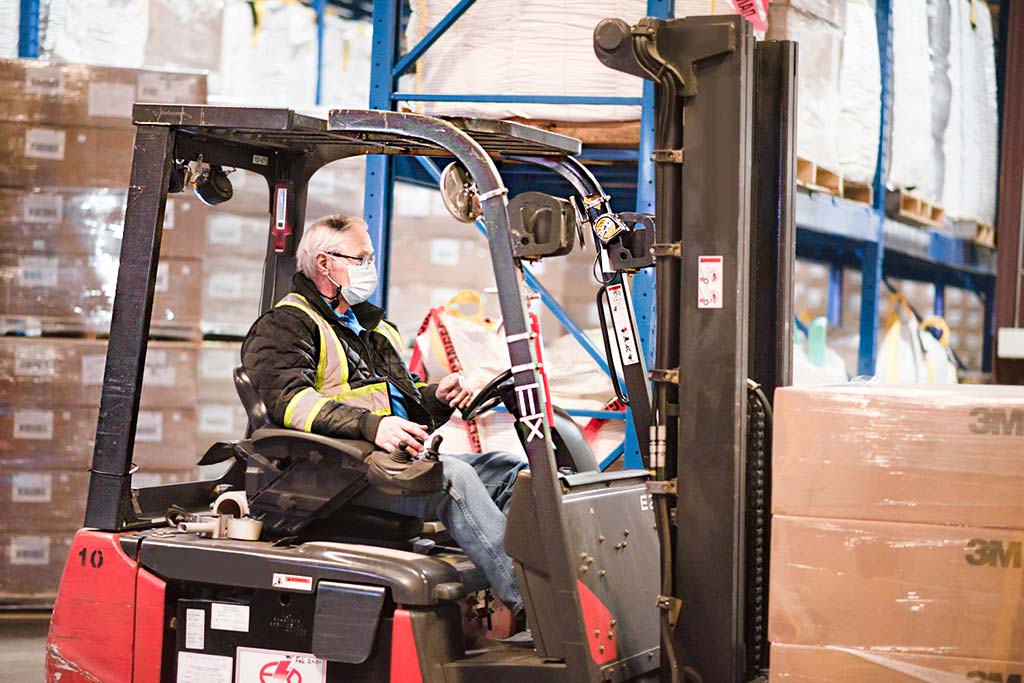 A worker moves cases of N95 respirators at 3M’s Brockville, Ont. plant. Photo: Photo courtesy of 3M Canada
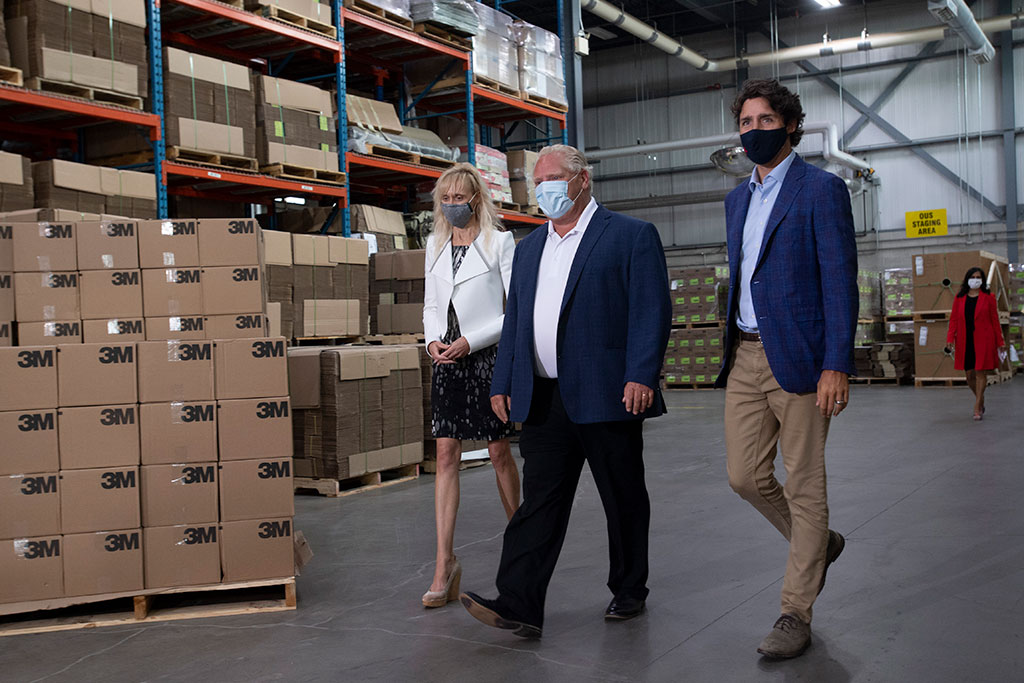 3M Canada president Penny Wise, Ontario Premier Doug Ford and Prime Minister Justin Trudeau at the announcement of the company’s new N95 facility in Brockville, Ont. in August 2020. Photo: The Canadian Press/Adrian Wyld

The Big Read
Made in Brockville: Reshoring is all the rage, but 3M’s new N95 plant shows what it’ll take to bring manufacturing back to Canada
Photo: Hanna Lee for The Logic
On a cool spring evening in April 2020, a resident of Ottawa was closely tracking the movements of an important package. Though it’s a ritual familiar to any shopper who’s bought something online during the COVID-19 pandemic, this particular delivery was a little larger and more consequential than most. After a fraught week, a precious cargo of personal protective equipment (PPE) was on its way from the U.S. to Canada. “The 500k 3M N95 mask shipment will hopefully arrive late tonight or early tomorrow morning,” the resident, a staffer in the office of Prime Minister Justin Trudeau, wrote in an email to her colleagues. She included a link to “a little tracker that I will continue to check every 5 mins.”
It was an experience Canadian policymakers did not want to repeat: competing in a frantic global scramble for PPE and finding themselves at the mercy of the Trump administration’s decisions on whether U.S. producers could export vital supplies to fight a pandemic. So, four months later, the federal and Ontario governments pledged tens of millions of dollars in funding and contracts to U.S. materials giant 3M to build a gleaming new respirator plant in Brockville, Ont. Three and a half kilometres from the U.S. border, the facility is meant to ensure Canada has a secure supply of PPE to see out this crisis, and that it is ready for the next. It began shipping N95s in late March, just seven months after the big announcement.
During the COVID-19 pandemic, the N95 has not only been a vital bit of kit, a necessary barrier between the wearer and a hostile world filled with the breath of other people. It has also become a symbol—of governments’ struggles to procure equipment to combat the virus; of companies’ pivots to produce newly in-demand goods; and of policymakers’ attempts to rebuild domestic supply chains and reshore manufacturing. The story of the Brockville plant offers insight into those efforts: what it takes for them to succeed, and how smaller local firms risk being left out in the process.
Talking Point
U.S. materials giant 3M has set up a plant to make N95 respirators in Brockville, Ont. backed by federal and provincial funding and contracts, after demand for personal protective equipment soared during the pandemic. The facility is an example of the conditions necessary for and challenges to efforts by governments around the world to establish or reshore production of critical supplies.
***
The first N95 to roll off the line at 3M’s Brockville plant was a year in the making. Penny Wise, the newly installed president of the Canadian subsidiary, began pitching the project in March 2020, both to 3M headquarters in St. Paul, Minn. and officials in Ottawa. That August, Prime Minister Justin Trudeau, Ontario Premier Doug Ford and various of their ministers alighted at the site to announce that the two governments had each pledged $23.33 million in funding and had committed to buying 25 million respirators annually for the next five years from the $70-million facility. “Today I know that Ontario will never have to depend on another country for the N95 masks we need to protect our nurses and doctors, our frontline heroes,” said Ford.
As many people all over the world learned in 2020, an N95 is a respirator that filters out 95 per cent or more of 0.3 micron particles, including viruses—about 230 times smaller than the width of a human hair. The construction and mining industries use N95s, while health-care workers often don so-called surgical versions.
The pandemic created “just absolute massive demand” for N95s, said Wise, who noted that 3M produced two billion—“with a ‘b’”—respirators last year. As hospitals filled up with COVID-19 patients, governments around the world scrambled to buy PPE for the doctors, nurses and support staff tending to the infected. Top U.S. and Canadian public health officials pleaded for a panicked public to leave N95s for frontline health-care workers.
In the days after the World Health Organization declared a pandemic in March 2020, Ottawa called on vendors to share information on what supplies they had for sale to combat the virus, and it appealed to manufacturers to retool to produce more of them. Thousands of offers streamed in, more than 500 of them proposals to make N95s.
Marketing firms, stationery distributors and event promoters developed sidelines in respirator procurement. Some claimed to be sitting on millions of units in the U.S., or Poland, or Singapore, or Vietnam. Prices quoted ranged from US$2.75 a piece to US$6.50. A Quebec soil-additive company said it had a direct line to 3M, and could deliver 100 million N95s—more than half the total number Ottawa has ordered during the entire pandemic—for just US$283 million, but the offer was only good for a day. MPs’ riding offices and the odd elected representative passed on the overtures of constituents seeking to become suppliers.
The HESA Docs
Details of Ottawa’s internal deliberations and discussions with companies are usually hidden from public view. But over the last five months, the House of Commons Standing Committee on Health (HESA) has released thousands of pages of emails and memos as part of its study of the government’s pandemic response from the industry, procurement and public-safety departments, and the Prime Minister’s Office, among others. The Logic’s ongoing analysis of these documents provided some of the basis for this story.
The N95s made by 3M were in particular demand. Provinces and territories were “reluctant to accept certain kinds of” respirators, noted a summary of a procurement-update call circulated in late May within the Prime Minister’s Office (PMO) and to key ministerial staff—“essentially … everything that isn’t 3M.” The email and other documents about Ottawa’s pandemic response efforts were released by the House health committee. (Provinces and territories have “identified preferred respirator models” to minimize fit testing for health-care workers, and have accepted shipments of non-3M units, said Public Health Agency of Canada spokesperson André Gagnon in a statement to The Logic.)
The case for domestic production was boosted by trade complications at the country’s southern border. Canada’s 3M N95s came from U.S. plants, and in early April 2020, the company said the Trump administration had asked it to stop exporting respirators to Canada. In response to the U.S. measures, Ambassador Kirsten Hillman drew up a list of bilateral personnel and product flows for Trudeau’s chief of staff Katie Telford to deploy in a call with then-presidential senior advisor Jared Kushner. Among the goods moving across the border were the filter cartridges made by 3M’s existing Brockville plant for military gas and industrial masks used in the U.S. The message: “The U.S. is not immune to the impact of a disruption” at the border. The Trump administration backed off three days later.
***
By then, Wise’s plan to make the vital respirators in Brockville was already in motion. “There [were] lots of countries [and] 3M subsidiaries that wanted to set up N95 manufacturing,” said Wise, who spent a decade working within the U.S. parent company. Headquarters had decided to expand and add respirator production, but it was only going to commission a certain number of new plants. “We [were] pitching, because there are limited resources,” Wise said. The Canadian division won out thanks to market opportunity, government backing and local strengths.
That last factor was critical. Pre-pandemic, London, Ont.-based 3M Canada had eight plants and several R&D labs across the country, including a centre focused on respiratory protection in Brockville, where existing lines produced reusable filter cartridges. “There’s in-depth expertise onsite in production, design and development,” said Manon Gauthier, a project manager responsible for quality management and certification for the N95 facility. Regulatorily, the respirators are medical devices, and the Canadian subsidiary had experience with those, as well. “I don’t know that it would have been possible to meet the schedule without having those experts locally,” said Gauthier.
As the 3M plant shows, pivots and expansions are easier when a company or local cluster of firms is entering into a closely related field—for example, breweries and distilleries moving to make hand sanitizer, which is, after all, mostly alcohol. “Policymakers can want all they like to bring back a lot of manufacturing, but it’s not an overnight venture,” said Tara Vinodrai, an associate professor at the University of Toronto Mississauga’s Institute for Management & Innovation. “The building-up of skill and knowledge takes a lot of time,” she said. Large-scale factory equipment isn’t cheap, either.
The Brockville project had other advantages. The plant would be producing an established 3M product, already approved by the U.S. National Institute for Occupational Safety and Health (NIOSH), whose certification many provincial regulations accept and government tenders seek. The manufacturing equipment it installed was very similar to that in the company’s existing N95 plants, so the Canadian division could send staff like product developer Jennifer Chaisson over the border to see how they worked.
Chaisson spent six weeks in the U.S., then returned to teach the Brockville team how to use the machines, make the respirators and test them. One major difference from the respiratory items on which she previously worked: sheer volume. The N95 typically has an eight-hour lifespan, but health-care workers are supposed to switch them after close contact with patients with some infectious diseases. That means a doctor or nurse may be “using a few a day,” noted Chaisson. “Whereas in our other businesses, they’re reusable, so you might only switch out your filters six times a year.”
Like every other company in the pandemic, 3M’s employees spent a lot of time on video calls. Unlike most firms, though, many of 3M’s video calls were to help set up heavy machinery. “We were literally on [Microsoft] Teams with our computer held up to the line, showing some aspects [to colleagues elsewhere] and getting their suggestions,” said project manager Kevin Pilling, a local HR leader with manufacturing experience who coordinated the on-site and global teams working on the project. Staff also used Microsoft’s HoloLens AR goggles. Employees took on new tasks to get it all done. Gauthier set up the gowning room, where operators don hairnets and smocks, and helped lay out the quality lab. The team hung banners on the building to attract new recruits in a competitive labour market.
Government backing also helped 3M Canada get the Brockville N95 plant off the ground. Interdepartmental emails show that the firm’s lobbyist raised the plan with top PMO officials in mid-March 2020, with Wise seeking a written signal of support she could use to convince the parent company to approve the project.
Between that first contact and the August announcement, company representatives spoke with then-innovation minister Navdeep Bains and Procurement Minister Anita Anand, and on other policy issues with then-finance minister Bill Morneau and Labour Minister Filomena Tassi. The Brockville discussions were part of a broader ongoing conversation with the government, which extended to senior staffers in five cabinet offices and which also saw the firm pass along details of U.S. export restrictions and try to enlist customs officials to stop counterfeits.
Ottawa didn’t merely provide capital via the Strategic Innovation Fund; it also used its buying power to back the new 3M facility. Its initial five-year contract for 25 million respirators annually is worth just over $111 million, according to briefing notes prepared for Anand in November 2020; Ottawa has since upped its order to 30 million units annually. Add in Ontario’s 25 million, and more than half the facility’s fully operational reported capacity of 100 million is pre-sold. Ottawa also has a right of first refusal on any extra uncommitted respirators, according to a copy of its contract with 3M Canada, which The Logic obtained via access-to-information request.
3M also drew on the help of multiple levels of government to address logistical issues. The federal government assisted with travel exemptions to allow U.S. colleagues to help set up the plant. The City of Brockville didn’t provide financial support to the project, but municipal staff worked to rapidly issue permits and other approvals. “Our building official [came] in a couple of times outside of office hours to make sure their inspections [were] done as quickly as possible,” said Robert Nolan, the city’s director of economic and development services.
3M Canada declined to comment directly on details of its government communications and contracts, including the information in the documents released by the health committee, citing commercial confidentiality. But it acknowledged that public-sector support was vital to the effort. “This project wouldn’t have been possible without the close collaboration with the Government of Canada and the Government of Ontario,” Wise wrote in a statement, adding that the plant “contributes to Canada’s overall resiliency for the future.”
***
The Brockville plant is just one example of a global movement to localize supply chains. During the pandemic, governments around the world have sought to reshore or revive manufacturing, particularly for critical health and safety goods. Canada was no different. Ottawa and several provinces have promised funding for firms that could develop and produce PPE, ventilators and vaccines. But the 3M N95 project suggests the playbook for reshoring and manufacturing revival won’t work for just any product, or any firm.
In fact, some local firms that answered governments’ calls to retool for pandemic production say they haven’t received the same support. Domestic manufacturers account for just two of the 24 companies from which Ottawa ordered $855 million worth of N95s, on behalf of the provinces and to replenish its expiring stockpile.
In April 2020, Cambridge, Ont.-based Eclipse Automation acquired a respirator line from a Chinese firm, with plans to finish the machines to North American standards and sell them to local manufacturers. “We quickly realized there was very little demand in anybody wanting to get into the N95 business,” said CEO Steve Mai. So the firm started producing the respirators itself.
Eclipse faced a series of challenges, starting with certification. Although provincial regulations allow the use of respirators approved by other bodies, governments have focused on NIOSH-endorsed models. Eclipse applied for NIOSH certification; but the U.S. agency is prioritizing firms with existing certifications and domestic manufacturers, so the Ontario firm keeps getting bumped, according to Mai; the company does have interim Health Canada authorization.
Mai also claims the group purchasing organizations (GPOs) that buy on behalf of hospital systems and clinics re-opened and expanded existing long-term bulk contracts with foreign PPE suppliers, locking out new local vendors. And he points out that governments closed off another channel in restricting consumer demand. Public health officials have not revisited the directive to reserve respirators for health-care workers, deterring consumers from purchasing the N95s now more readily available on the market.
Through the pandemic, governments have “created more of a monopoly around this industry, to ensure that there’s no way companies like us can survive [in the respirator trade],” said Mai. “They refused to buy from us [and] they told the public not to buy from us.” Eclipse has sold limited quantities of N95s to fire departments, long-term-care homes and a few hospitals. Mai says the project has cost the firm about $10 million, and it now has a million respirators in storage.
The Ontario government sees it differently. Its PPE purchasing decisions, informed by GPOs, “ensured short-term emergency supply arrangements were in place to protect frontline workers,” said Kwok Wong, spokesperson for the economic development ministry, adding that it’s “inaccurate to suggest that the government has executed long-term contracts with any group other than 3M.” He also said funding for CSA Group to develop a Canadian N95 standard will help domestic manufacturers get certification faster.
Meanwhile, Eclipse, whose clients have included Tesla, has received interest in the machinery from the U.S., Europe and East Asia; it will focus on selling the equipment outside Canada. 3M’s Brockville project, too, is partly based on export potential, courtesy of Canada’s many trade agreements. Wise said governments need to strike a balance between ensuring domestic sources of critical goods and the efficiencies of global supply chains. “The reality is Canada is a small market,” she said, and trade ensures “we’ve had access to inexpensive goods from around the world.”
Policymakers should also remember that many of the big firms that make things in this country are headquartered elsewhere, so the reshoring trend could work against Canada, too, leading to the loss of manufacturing. In May 2017, Procter & Gamble announced it would shift production of Swiffer pads and other items from Brockville to a new facility near Martinsburg, W.Va., costing 458 jobs. Local manufacturers such as the lighting and HVAC firm Canarm, and electrical company Northern Cables have grown to take up some of that labour-market slack. “The decision-making is in our community,” said Nolan, the Brockville official. “When you’ve got a corporate [owner] based somewhere else, their tendency is going to be to pull back to [that place].”
In a crisis, governments may favour established players who can scale production up or down as necessary. “We should be looking at as many reputable options as possible,” wrote Matt Stickney, PMO executive director of operations, in a March 2020 email about N95 production to Anand’s and Bains’s chiefs of staff. “Some of these are going to fail, a big company like 3M is less likely to do so in my opinion.”
But that approach won’t help domestic firms that retooled to help become sustainable. “It would be nice to see this as a moment to help some of these growing and quite savvy Canadian manufacturing companies [to] scale,” said Vinodrai, the UTM professor.
***
Back in Brockville, the planning, creative tactics and long hours have paid off. “In August when we made the announcement, it was an empty green field,” said Wise. “Now, it’s a building and functional.”
The facility has now shipped more than 10 million respirators to the federal and Ontario governments, with hundreds of millions more scheduled to stream off the line over the next few years. With the months-long rush to set it up now complete, Pilling is thinking longer term. “I can’t wait for 15 years from now, when I’m driving down the road with my grandkids and able to say, ‘I built that plant,’” he said. “Hopefully we don’t remember what the COVID was [by then]. But it made a difference.”
With files from Claire Brownell. The number of respirators 3M has shipped from the Brockville facility has been updated in this story. The story has also been updated to clarify 3M’s communications with the federal government.



Loading...
Thanks for sharing!
You have shared 5 articles this month and reached the maximum amount of shares available.
CloseThis account has reached its share limit.
If you would like to purchase a sharing license please contact The Logic support at [email protected].
CloseGift the full article!
You have gifted 0 article(s) this month and have 5 remaining.
Recipients will be able to read the full text of the article after submitting their email address. They will not have access to other articles or subscriber benefits.
Photo: Hanna Lee for The Logic
A worker moves cases of N95 respirators at 3M’s Brockville, Ont. plant.
3M Canada president Penny Wise, Ontario Premier Doug Ford and Prime Minister Justin Trudeau at the announcement of the company’s new N95 facility in Brockville, Ont. in August 2020.
Most Popular This Week



In-depth, agenda-setting reporting
Great journalism delivered straight to your inbox.
Commentary
Carmichael: Canadian ignorance about India is a strategic weakness
Briefing
Aritzia shares pop after earnings rise 204%
First Nation in Alberta goes to court over fast-tracked oil pipeline
Chinese EV maker Geely Auto Group to launch in Canadian market in 2027
Best business newsletter in Canada
Get up to speed in minutes with insights and analysis on the most important stories of the day, every weekday.
Exclusive events
See the bigger picture with reporters and industry experts in subscriber-exclusive events.
Membership in The Logic Council
Membership provides access to our popular Slack channel, participation in subscriber surveys and invitations to exclusive events with our journalists and special guests.