Naga Parvatharajan has big names like Goldman Sachs, Discover and Capital One on his resume, but don’t call him a Wall Street banker.
Skip to content
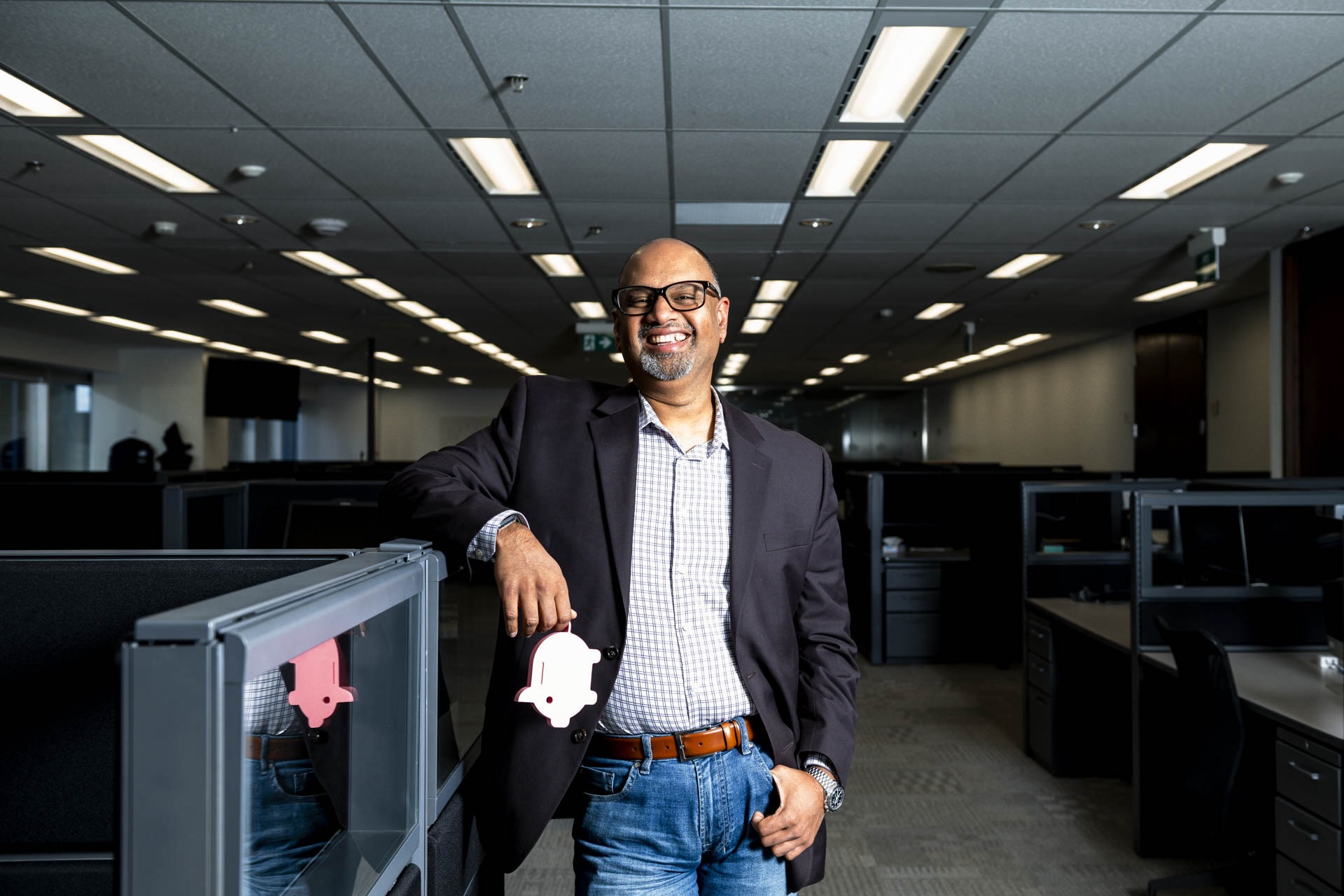
 Parvatharajan sees an opportunity to improve the user experience and bring some of traditional banking’s “trust and credibility” to the fintech sector. Photo: Christopher Katsarov Luna for The Logic

The Interview
The Silicon Valley banker who thinks Canadian finance is ripe for disruption
Ratehub’s new CEO Naga Parvatharajan would rather partner with the banking giants than try to beat them
Naga Parvatharajan is looking to disrupt Canadian banking, but as a partner for big banks instead of a competitor. Photo: Christopher Katsarov Luna for The Logic
Naga Parvatharajan has big names like Goldman Sachs, Discover and Capital One on his resume, but don’t call him a Wall Street banker.
The San Francisco resident, who was named CEO of Toronto-based fintech Ratehub last June, describes himself as a catalyst for the evolution of the Canadian financial services sector. He saw such an evolution play out south of the border more than a decade ago, he says, and he believes it’s coming to Canada, too.
Part of 45-year-old Parvatharajan’s confidence may stem from his leadership as a group general manager at San Francisco-based fintech SoFi, where he led multiple lending and credit card businesses after joining in 2018. The company, which started in 2011 out of Stanford University focusing just on student loans, went public in 2021 and now operates as a direct bank.
Parvatharajan has taken the reins of Ratehub—in which Montreal-based private equity giant Novacap took a majority stake of undisclosed value in 2022—as the Canadian fintech scales further from its roots as a mortgage rate comparison site. Founded in 2010 by former co-CEOs Alyssa Furtado and James Laird, it has grown beyond just financial product comparisons to offering mortgage lending and insurance brokerage services, personal finance content (with its acquisition of media brand MoneySense in 2018) and most recently, loan originations.
In a December interview with The Logic, Parvatharajan spoke about “Ratehub 2.0,” why he thinks he’s a catalyst for banking disruption in Canada, and his take on the best places to eat as a CEO hopping between San Francisco and Toronto.
This interview has been edited for length and clarity.
Related Articles


What drives an American finance executive in San Francisco to sign up to run a Canadian financial services platform?
I’ve been blessed to be part of big banks for most of my career. When the U.S. fintech movement started, I joined Goldman Sachs, and we launched a consumer-facing fintech called Marcus. And then in 2018, I joined SoFi, a student loan refinance business, and scaled many businesses there. We took them public in 2021 and today, it’s an US$18 billion company. In some ways, that is the evolution of fintech in the U.S. And in many ways, that is my journey.
When I look at the fintech and banking ecosystem in Canada, I think it’s ripe for disruption. It’s at a similar position to what I saw in the U.S. in 2012, 2013. And Canada is exactly at that spot where the big banks dominate financial services. There is a huge opportunity for new players to deliver financial services products in a customer-centric way. And, having been through the fintech evolution and journey myself, I’m confident I can be one of the catalysts of that change that needs to happen in Canada.
Then, the question is, who is going to disrupt financial services? My vision for Ratehub is to be the one-stop shop for all consumer financial needs. It has the right ingredients to actually be that for Canadians.
When I put all that into a decision framework, I said, why not? This is perfect for me. I’ve seen the movie in the U.S. so I can execute a script here.
You’ve seen the movie before, but the cast, characters and sets aren’t the same. What differences do you see in the industry?
There are actually two parts. There’s the regulatory ecosystem itself, and then there’s the consumer mindset. In the U.S. in 2012, it was still a very bank-dominated financial services marketplace. That’s still true here [in Canada]. The U.S. market is more fragmented, whereas in Canada, it’s five to six big banks, right? It’s a lot more concentrated. Banks have a lot of power in this ecosystem. They have the balance sheets, they have the lower cost of capital, they have the deposits—whereas the fintechs don’t have that structural advantage.
Where I think we can actually make a difference by way of Canadian fintechs is the fact that the customer experience can be so much better. There’s a huge gap where customers want trust and credibility, and sometimes that is equated to, “Is there a real person behind this?”—and that’s where banks have been scoring traditionally.
What’s the vision for the company?
I want to transform Ratehub from a transactional business to a membership business. And I want it to be the one-stop shop for all consumer financial needs—save, spend, borrow, invest, protect—and I want them to come to me first.
We have mortgage and insurance businesses that are doing well. We will continue to double down on those. But I also want to diversify.
We’re adding new products like credit cards, loans. And why are those businesses relevant and important? When one business goes down, you want other businesses that are negatively correlated to pull you up. Credit cards and loans have done very well through the cycle, and mortgages [are] a very cyclical business. It’s as simple as that: add more products to the existing portfolio, and invest in data and technology to build a membership business. That’s when we become the one-stop shop for all consumer financial needs. This is the vision that I shared with the board, and they liked it. That’s how the marriage happened.
How does Canada’s open banking plan play into that?
The more open banking gives the customer the ownership of their data and their relationships, the more the customer wins. And I think that’s the right kind of regulation. Open banking—as it’s played out in the U.S.—has been in the direction of giving customer ownership of the data versus the banks. And if we move in that direction, then I think a lot of what I’m talking about is possible with respect to everyday data. Even without that, a lot can be done.
What’s the weakness in Canadian banking’s oligopoly that Ratehub thinks it can exploit?
I’m not competing with the banks at all. I’m actually partnering with the banks on a daily basis because I don’t want to be a balance sheet player, taking on risk. What I am is a digital origination partner. And so, in some ways, I like the fact that there are fewer banks in Canada than in the U.S.
But at the same time, there’s only five big banks, so the amount of competition in the markets is less than in the U.S. The reality, though, is, I want to make sure consumers are connected with the best product, the best value that we can give to them through these five banks. At some level, it doesn’t matter whether there are 100 banks or just five. What I care about is, how can I take the consumer base that is coming to me and better match them with the best product that is available in the market?
Interesting. So the disruption is not necessarily to upend them, but to complement them.
Absolutely, the disruption is not in replacing what the banks do.
SoFi went public in 2021, while you were a leader there. Is that on the cards for Ratehub?
My job as a CEO is to scale and position the company very attractively for all possible outcomes. I wouldn’t count out an IPO, but at the same time, I wouldn’t say IPO is a target, either. If we execute on the playbook of Ratehub 2.0, we would be a much bigger company, delivering more products and solutions to our consumers. And at that point, we become very attractive for a lot of players, a lot of strategic buyers. My job is to position the company for more options in three to five years. Between Novacap and us, we’ll figure out what the right exit strategy is at that point.
You’re expecting mortgage growth demand to be higher, but competition is also heating up. Wealthsimple, for example, stepped into the business last May. How is Ratehub preparing?
Competition is a good thing. More competition will mean better rates for the consumer.
I also think where we generate value is because customers—17 million unique users—are coming to us without us spending any money on marketing. Number two, we’re investing in data and technology to build new customer experiences that will actually take friction out of the equation. Number three, I would say the diversity of products that we have is unique. Most of the fintechs right now have one, perhaps two, products at most. Whereas we have a mortgage business, insurance business, content, credit cards and loans. There’s a product suite.
Wealthsimple has done very well within the wealth management business, and they [partnered with] Pine to offer a mortgage product, but they don’t offer credit cards or loans. They don’t have as much content as we do.
There’s been a debate recently about whether Canadian businesses have enough ambition to build big companies, or the next Shopify. You hop between San Francisco and Toronto. How do you view these two different tech hubs, and their approaches to innovation?
I can’t profess to be an expert on Canada and the ecosystem yet, but in my interactions with a lot of Canadian fintech CEOs and bank executives, the hunger is there. The ambition is there. The question is, is it widespread to the levels in the U.S.? Maybe there’s a little bit of a question mark there.
I think what you will see in the next 10 to 12 years in Canada is a very similar scale of innovation happening as people come in with new visions to enhance the customer experience, challenge the status quo, approach it with a growth mindset. There’s more scaled startups, and eventually, as they say in Silicon Valley, you build it and they’ll come. But you’ve got to build it with the right level of quality, with the customer at the centre of it, and eventually they’ll come.
Same kind of question, but different subject. You’re travelling between two incredible food spots. What are your favourite places to eat in Toronto and San Francisco?
I am a foodie. I’m doing a lot of dinners with bank executives and investors in and around downtown Toronto. My favourite is Lee, which is, I think, an Asian-French fusion restaurant. I had dinner with a fintech CEO there, and I would go back again.
I come from South India, and the cuisine itself is its own delicacy. There’s a lot of South Indian restaurants in the San Francisco Bay Area that I’m a big fan of, and my favourite is Mylapore Express. I’m a sucker for good South Indian food.
Correction: Novacap is based in Montreal. Wealthsimple partnered with Pine to offer a mortgage product. This story has been updated.



Loading...
Thanks for sharing!
You have shared 5 articles this month and reached the maximum amount of shares available.
CloseThis account has reached its share limit.
If you would like to purchase a sharing license please contact The Logic support at [email protected].
CloseGift the full article!
You have gifted 0 article(s) this month and have 5 remaining.
Recipients will be able to read the full text of the article after submitting their email address. They will not have access to other articles or subscriber benefits.
Photo: Christopher Katsarov Luna for The Logic
Parvatharajan sees an opportunity to improve the user experience and bring some of traditional banking’s “trust and credibility” to the fintech sector.
Most Popular This Week




In-depth, agenda-setting reporting
Great journalism delivered straight to your inbox.
News
Canada’s landmark ESG case heads to a final decision
Briefing
Matthew Proud-led SPAC threatens to pull out of merger with UniUni
Ottawa awards Mitacs $162M to create AI-focused work placements
Ontario puts $30M into Vector Institute for AI adoption
Best business newsletter in Canada
Get up to speed in minutes with insights and analysis on the most important stories of the day, every weekday.
Exclusive events
See the bigger picture with reporters and industry experts in subscriber-exclusive events.
Membership in The Logic Council
Membership provides access to our popular Slack channel, participation in subscriber surveys and invitations to exclusive events with our journalists and special guests.