VANCOUVER — Late last October, Shahrzad Rafati’s company, Vancouver-based BBTV Holdings, completed a $172.4-million initial public offering on the Toronto Stock Exchange. With many companies going public each year, Rafati’s move shouldn’t have made history. And yet, Rafati was the sole female founder over five years to still helm her company when it started trading on the TSX via an initial public offering, according to an analysis by The Logic.
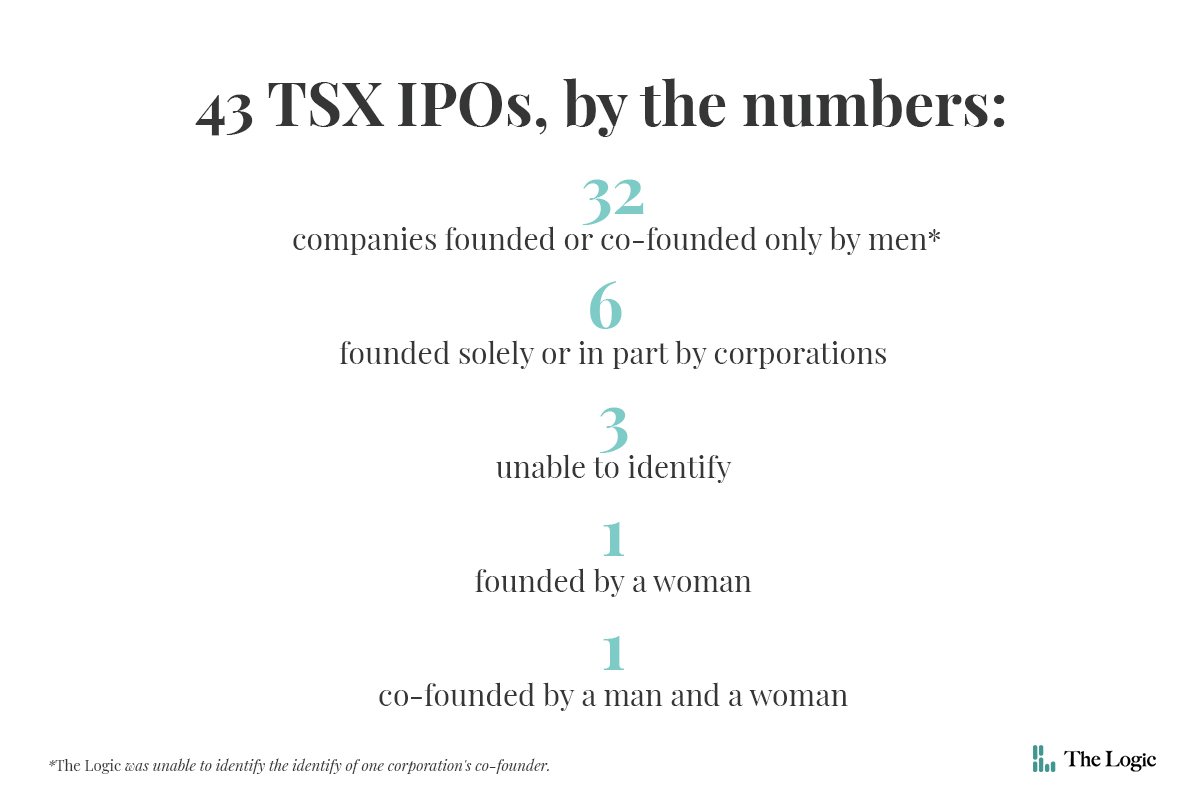
Between 2016 and 2020, 43 companies completed IPOs on the TSX. Only two were started or co-founded by women. Only one—Rafati—was still serving as CEO when the company went public. Three times more men named David achieved the same milestone in those five years.
The Logic compiled this analysis by scouring publicly available documents, such as corporate financial filings, press releases and other sources, to determine each company’s founder and CEO at the time of listing. That’s because it appears no organization tracks the names—let alone gender—of founders of publicly listed companies. A Statistics Canada spokesperson confirmed the agency doesn’t record this information. Neither does the Ontario Securities Commission or TMX Group, which owns and operates the TSX and TSX Venture Exchange.
BBTV’s research shows it ranked among the top 10 TSX tech listings ever. “We really broke important new ground,” said Rafati. “I want young women to think that, ‘If she’s done it, I can do it, too.’”
Talking Point
Between 2016 and 2020, only two out of 43 companies that completed IPOs on the Toronto Stock Exchange were started or co-founded by women, according to an exclusive analysis by The Logic. Only one—Vancouver-based BBTV Holdings’ Shahrzad Rafati—was still serving as CEO when the company went public.
The road to a successful TSX IPO is tougher for women than men. Women need to be not just prepared, but overprepared, said Rafati. She started her business in her 20s, and knows gender and age can work against women. “Certainly that comes with some of these systemic—unfortunately—barriers.”
Of the 43 companies that had IPOs on the TSX between 2016 and 2020, only Rafati’s BBTV was founded solely by a woman. Just one of the rest of the companies has a female co-founder: Jeanette VanderMarel, who launched The Green Organic Dutchman Holdings, a cannabis company, with Scott Skinner. Neither founder served as CEO during the company’s 2018 IPO; that job was held by Robert Anderson.
Men solely founded or co-founded 32 of the 43 companies that went public in those five years (Six were started solely or in part by existing corporations. The Logic could not identify the founders of the remaining three, which did not respond to requests for comment, or the co-founder of one). Twenty-one male founders or co-founders were serving as their company’s chief executive when it completed its IPO. Forty-two out of 43 companies, or nearly 98 per cent, had male CEOs at the time of the public offering.
Methodology
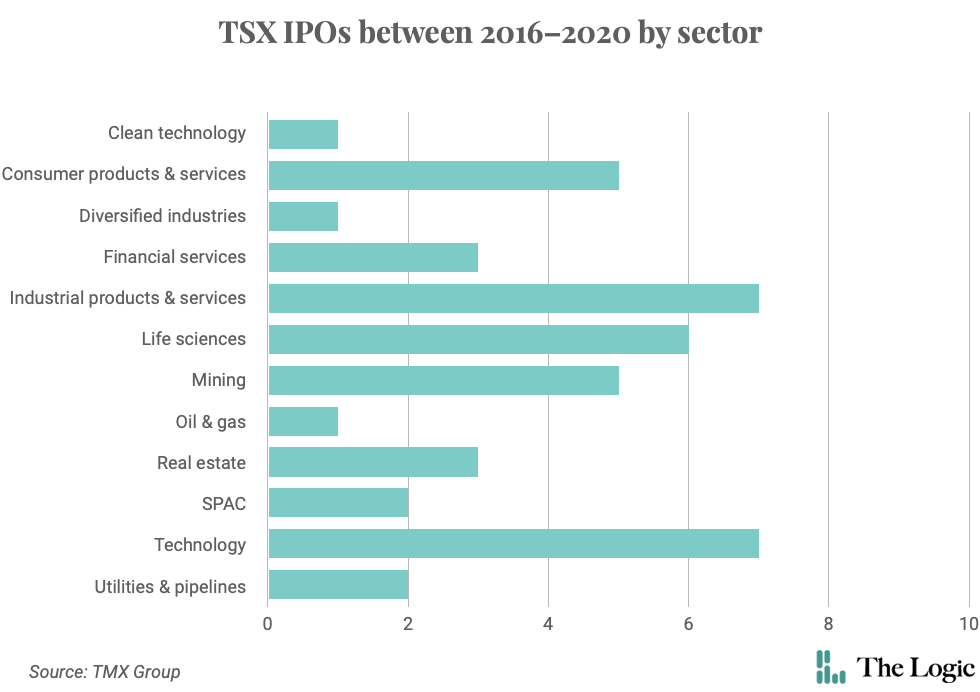
The Logic obtained data from TMX Group, which operates markets including the Toronto Stock Exchange, of all the companies that went public on the TSX between 2016 and 2020. It narrowed them down to those that listed via an IPO and eliminated those listed through other methods, such as a TSX Venture Exchange graduate. It relied on company filings, websites, press releases and other sources to identify the founders and CEOs at the time of the IPO.
In the tech sector, there’s information dating back more than two decades after BBTV compiled data on founders in the sector ahead of its listing. Rafati is the only female founder to lead her company to an IPO in the tech sector since at least 1997, according to BBTV’s research, which was verified by TMX. TMX confirmed the figure. Between 1997 and October 2020, the time of BBTV’s offering, only two tech companies that went public and had multiple founders had at least one woman in the group. Nancy Knowlton and David Martin started Smart Technologies together in 1987, and Knowlton served as CEO when it went public in 2010, though she’s no longer in the role. Rose and Dieter Evertz co-founded Evertz Technologies, which Romolo Magarelli helmed during its 2006 IPO.
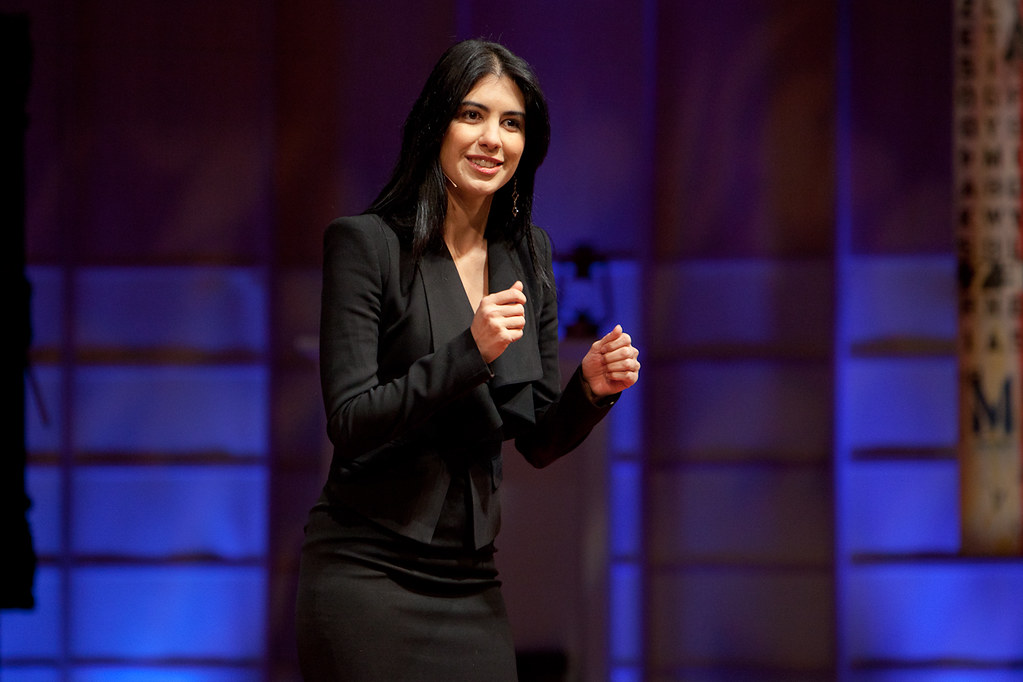
BBTV founder and CEO Shahrzad Rafati at a TEDXVancouver event in 2011. Photo: Jeremy Lim/Flickr
Outside of Canada, too, the situation is grim. Since the New York Stock Exchange was founded in 1817, only about 20 companies that went public via an IPO were founded and led by women, reported Business Insider earlier this year.
The funding gap for female leaders doesn’t just exist in the public markets. Women also struggle to access larger sums from venture capitalists. As of 2019, in eight of the previous 10 years, exclusively women-founded companies raised only two to three per cent of all venture capital dollars available, according to a report by Crunchbase, despite an increase in the share of female-founded startups.
Toronto-based fintech Brim Financial announced a $25-million Series B in March. Rasha Katabi founded the company in 2016. When the raise was announced, she was surprised to learn that her company was one of few woman-led early-stage firms to complete a $20-million-plus funding round in Canada, as there’s “very strong capital flows and liquidity” in venture capital. Annual venture capital investment in 2020 was at its second-highest level, with $4.5 billion invested across 510 deals, according to the Canadian Venture Capital & Private Equity Association’s preliminary findings. It was only outpaced by an “outlier” 2019.
Brim Financial founder and CEO Rasha Katabi. Photo: Handout
Katabi, who said she preferred to drop the word “woman” ahead of labels like CEO or founder, said she may have been helped by the fact she did not imagine such a glass ceiling existed. “I think that’s probably a blessing, because glass ceilings by definition push you down,” she said. She was instead able to focus on building out the business and differentiating it from others in fintech, which she believes helped the company secure its large funding round.
Kim de Laat, a research collaborator with the Brookfield Institute, has studied the gender funding gap. She interviewed 24 women founders of high-growth companies for a report on how they scaled their businesses and what challenges they faced. “One of our main findings was that they still did have a hard time accessing capital,” she said, referring to both venture capital and financial institutions, which entrepreneurs may turn to for loans.
Much of that boils down to bias. Women don’t look like the entrepreneur we’ve been socialized to imagine, she said, a problem that’s compounded for racial minorities. One founder told her a male venture capitalist said he didn’t want to work with a so-called mompreneur, who would “get married and pop out a couple of kids.” Another woman said a male venture capitalist told her, “You don’t look like the kind of person that can make hard decisions.”
The types of questions investors ask founders tends to depend on their gender. Research shows men face promotion-focused queries that allow them to discuss ideas whereas women field prevention-type questions centred more on avoiding failure. “It’s much easier to make yourself look bad” answering the latter, said de Laat.
She sees a direct tie to broader gender inequality. Women tend to hit their prime as entrepreneurs around the same time they enter their childbearing years, she said. “It’s hard to do it all.” (No matter what Sheryl Sandberg tried to tell us in Lean In. Even Sandberg rethought some of her claims after her husband died and she experienced some of the challenges of being a single parent.)
One of the biggest problems stems from a lack of diversity at venture capital firms or financial institutions. “The numbers are abysmal,” said de Laat, citing a 2019 CVCA survey. People gravitate to others who look like them, she said, which puts women at a disadvantage when men are making the decisions.
De Laat has some suggestions for improvement: universal child care, for example, and men in heterosexual partnerships doing more domestic work, as opposed to just believing they do more. She is working on a project to help venture capital firms change their practices to thwart biases against women: “It’s not the women entrepreneurs that need to change.”
Rafati agrees that men need to be involved as they hold the majority of decision-making roles. One solution is to increase representation of women at all levels. At BBTV, women make up more than 40 per cent of the board, managers, and overall staff, she said. Every company should set targets and report progress, much as they do with annual budgets, she said.
Rafati wants action over conversations. In the meantime, she encourages other female founders looking to fundraise to work hard and be prepared to force male venture capitalists to pay attention.
Meanwhile, Brim’s Katabi hopes to follow in Rafati’s footsteps, seeing a future for her fintech firm on the TSX, too.
If she achieves that goal, it would be another rare female-founded and -led company to go public on the exchange. “But I do hope I’m not the next female founder to do this,” Katabi said. “I hope that tomorrow there’s another one, and the day after there’s another one.”