Listen Now
0:00
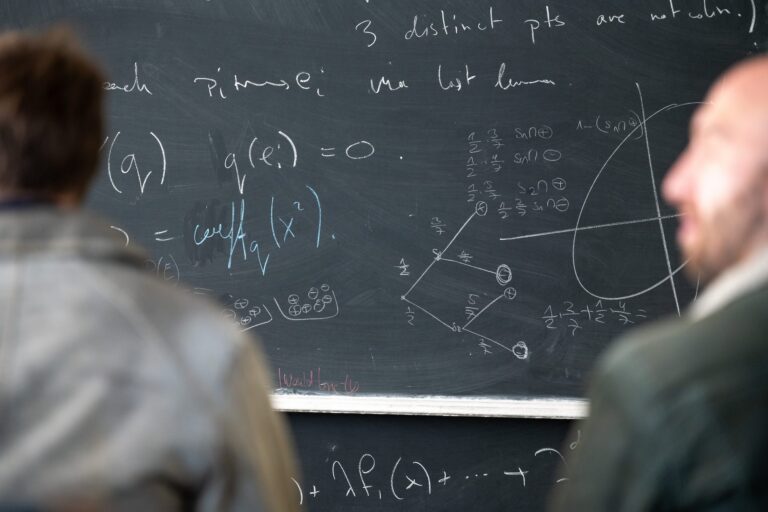
Ilia Binder spent 35 years trying to solve one of the world’s most fiendish mathematical problems. Last month, an unreleased OpenAI model solved it in three hours. Binder, 56, a mathematics professor at the University of Toronto, was excited at first—but then he looked at how the AI had solved the problem.
“It felt like the machine was doing exactly what I was doing, and somehow succeeded, and I didn’t,” Binder said. “I understood all the steps, but I had no idea what it was doing.” The proof in question was Brennan’s Conjecture, a long-standing problem posed by U.S. mathematician James Brennan in 1978.
Talking Points
- OpenAI and Anthropic claim their AI models are solving some of the hardest problems in mathematics. The scale and speed of their apparent breakthroughs, though, are overwhelming human researchers.
- The quantity of claimed breakthroughs, and AI’s unusual way of trying to solve problems, is causing a major headache for human academics. Some say that humans and machines need to find a new way of working together.
OpenAI’s results, Binder found, were bloated and riddled with confusing redundancies. Within the slop, though, he found an idea the AI had tried that he hadn’t. “It’s not a new idea in mathematics, but it’s a new idea in my field of mathematics,” Binder said. To work out what the AI had done, he teamed up with three colleagues to shorten the AI’s proof and strengthen the paper’s central argument.
While concerns swirl about AI putting scores of mathematicians out of work, Binder and many others in the field see a different future. Swarms of AI agents, he argues, could soon do the grunt work of solving big, complex problems, with human minds free to push at the mathematical frontier. “We would do things which are creative for us,” says Binder.
First, though, mathematicians have a lot of AI slop to wade through. OpenAI’s Brennan Conjecture paper was simultaneously published alongside 721 others that claimed to show AI’s remarkable mathematical achievements. A day later, the company retracted three of the papers, citing errors. The incident highlighted the gap between the speed at which AI companies are moving and math’s slow, deliberate, community-verified approach to getting ideas out.
Related Articles
AI’s incursion into the field has been rapid. In the summer of 2025, it was the equivalent of an elite high school mathematician. By this spring, it was outdoing top-level human researchers. In response, the mathematics community has issued a declaration, of which Binder is a signatory, outlining the key threats of the rapid advancement of AI in the field and a series of recommendations on AI tool disclosure, peer review and independent funding for foundational mathematics.
Despite concerns, AI’s upending of math keeps accelerating. Both OpenAI and Anthropic released papers this summer that contributed directly to the production of new mathematics. In September, OpenAI claimed that its AI agents had generated a breakthrough solution to the Navier-Stokes equations, one of the seven $1 million Millennium Prize problems, some of the most challenging in math.
The Navier-Stokes equations describe how fluids like air and water move and are used for designing rockets and forecasting the weather. For over 90 years, mathematicians have wondered if flowing liquids or gases can suddenly become infinitely chaotic or completely tear apart. OpenAI said it took 88 hours, a swarm of 10,000 agents and around US$10 million worth of compute to arrive at its solution.
Some human mathematicians are unimpressed with the company’s approach. “Choosing to put these huge resources into what may be a more expensive way of getting these results has got a lot to do with publicity for AI and not a great deal to do with any efficient way of advancing mathematics,” Robert Dawson, editor-in-chief of Notes, the Canadian Mathematical Society’s newsletter, and a mathematics professor at Saint Mary’s University in Halifax, told The Logic.
Dawson said similar results to some of these problems could’ve been achieved by putting a million dollars into funding a group of graduate students rather than on a bunch of AI compute.
Like Binder with Brennan’s Conjecture, many mathematicians have decried OpenAI’s 166-page Navier-Stokes paper, and others that have been released since, as long and unreadable. “If that proof holds up, then yes, it’s a proof,” Dawson said of AI’s mathematical work to date. “If someone can come up with a proof a tenth as long that’s easy to read a few years down the line, this will generally be seen to be a big improvement.”
Until then, the technology’s scattergun approach is causing major headaches for academia. Daniel Panario, a professor in the mathematics department at Carleton University in Ottawa, said AI’s polymathematical tendencies are creating a deluge of new information, much of which is hard to scrutinize. “The publication system is swamped by papers,” said Panario, who’s on the editorial board of a number of mathematics journals.
One of the more niche journals he edits, Finite Fields and Their Applications, is on track to hit 800 submissions by the end of the year, nearly double last year’s count. “This is not a young journal; it started 31 years ago, and it was kind of the same numbers all around until AI came,” Panario said. The flood of new papers is similar at all the other journals he edits.
The challenge, said Panario, isn’t just the sheer volume of work but also AI’s meandering, multidisciplinary approach, which makes it nearly impossible to find mathematicians who can vet the work, let alone sift through pages of slop to find research gold.
The rapid rise of AI in mathematics is also creating ethical concerns. In September, a group of 28 Fields medalists—widely known as the Nobel Prize of mathematics—signed a joint declaration titled A Severe Misalignment of AI in Mathematics condemning the unethical approach AI firms such as OpenAI and Anthropic are taking to solving mathematical problems. “Often these solutions are announced in a rush, leaving no time for a proper write-up, the isolation of new methods and ideas and citing relevant previous work of others,” the Fields medalists argued. “As in all creative professions, this raises severe attribution and plagiarism questions.”
OpenAI’s Navier-Stokes solution created further controversy when Levent Alpöge, an Anthropic employee, and Tristan Buckmaster, a math professor at New York University, alleged that the AI firm might have accessed some of their work on the problem, which had been conducted using another of the firm’s AI tools. Following an investigation, OpenAI said that Buckmaster’s use of its AI systems preceding the company’s announcement and paper could not have influenced the research.
Joy Morris, an award-winning mathematician and professor at the University of Lethbridge, said that the math community is tight-knit and respectful. “There’s a community recognition, typically, that if you find out that somebody’s student is working on a problem, then you don’t work on that problem,” she said. “AI endangers that social contract.”
She said she’s still grappling with the pace of change. “Maybe we rethink what a PhD thesis is,” Morris told The Logic. “Maybe it’s not about proving results anymore, maybe it’s some other way of demonstrating that you understand mathematics broadly and that you have some gift or passion or insight that you bring to the field.” Right now, though, she has no particular answers for the conundrum.
It’s an identity crisis William Verreault, a fourth-year PhD student in mathematics at the University of Toronto who works with Binder, is also grappling with. “A few months ago, I wasn’t even thinking of AI,” he said.
Verreault recently wrapped a two-year-long project. He wondered if he could’ve tackled the project in a month with AI’s help. “Did I waste my time? Is math going to evolve this way forever?” he said. “I feel like the answer has to be yes, in a sense, but there’s also this dread that we don’t really know what’s going to happen.”
For Verreault, AI’s noisy ascendancy raises questions about his future profession even as he’s in the process of applying for postdoctoral research positions. “If this job changes, then why am I still pursuing this?” he said. “There’s not much I can do except keep going because if I stop everything, then I’m the only one being penalized.”
In the meantime, the math community continues to sift through the claimed AI breakthroughs and refine and improve its bewildering proofs. “Humans take years to digest things,” said Panario.
The work is painstaking. First, these unreadable AI-generated papers need to be understood by a small subset of mathematicians, Panario said, then trickle down through the community until they can be taught at an undergraduate level. “The whole aim of the area is to understand and explain and develop for the next generation,” he said. AI, he added, risks bulldozing over crucial skills that humanity took thousands of years to build. “In a way,” he said, “it’s the end of mathematics as we used to do it.”