When Mark Carney returned to Canada this spring, the former Bank of England governor brought with him a new sense of urgency for a cause he’d been boosting for years. Long concerned with the risks climate change posed to the financial markets, he had always believed companies and investors would report and mitigate those risks if they understood the issues and had the tools to address them. But after three years of urging organizations to volunteer information about how floods or fires could hurt their bottom lines, Carney, in his new role as UN special envoy on climate action and finance, was now ready to play hardball: regulators, he said, must force companies, banks and investors to disclose the risks climate change posed to their operations.
Talking Point
In November, the U.K. became the first major economy to make financial climate-risk disclosure widely mandatory, and other countries are moving in the same direction. While Canada has made some gestures towards improving how companies and investors disclose the real and potential risks of climate change on their operations, its fragmented regulatory structure has held the country back, and experts warn it could be left scrambling if global standards take hold.
“The demand [for climate-risk disclosure] is very much coming from the suppliers of capital,” said Carney during a conference held this fall by the Queen’s University Institute for Sustainable Finance. “When you total up all the balance sheets of the systemic banks, asset owners, asset managers, it’s $150 trillion of balance sheets that want disclosure,” he said. “But that’s not going to take you all the way. It’s the official sector’s job to take that core reporting and make it mandatory.”
Governments and regulators around the world are beginning to heed Carney’s calls for more robust climate-risk disclosure. In November, the U.K. said all large companies, banks and pension funds would have to report any risks that climate change has on their operations and how they might affect customers and investors. Companies are expected to use guidelines from the Task Force on Climate-related Financial Disclosures (TCFD), a system Carney himself helped design.
Canada, however, is lagging. In the Liberal government’s landmark climate plan, unveiled in Ottawa Friday and presented to the world the next day in Prime Minister Justin Trudeau’s address to the United Nations Climate Ambition Summit, there was no new push for financial-risk disclosure.
Many finance-sector leaders believe the capital markets will have a significant impact on whether or not Canada achieves its goal to reach net-zero carbon emissions by 2050. But navigating how to gauge and report climate risk is a cumbersome task that’s complicated by a dizzying slate of acronyms—disparate standards programs—from which companies and investors must choose. Industry experts who spoke to The Logic said the country’s fractured regulatory system has also hampered what little progress policymakers have made on the file, and worry that capital could flee the country if it doesn’t catch up. Carney believes global standards will inevitably take hold. The question, he said at the Queen’s talk, is “do we take a smooth [transition] and predictable one, or is it late and abrupt … where there’s a lot of stranded assets and sharper adjustment?”
The number of weather-related disasters in Canada has been steadily ticking up for decades, from a low of eight in the early 1970s to a high of 27 in 2016. The financial cost of dealing with these disasters is increasing even faster. An analysis by the Canadian Institute for Climate Choices found that the average loss per event has ballooned from about $8.3 million in the ‘70s to $112 million per event in the 2010s. “There have been $14.5 billion in disaster costs tallied so far for 2010 to 2019, while the total for the four previous decades was $21 billion,” the report reads. “The $21 billion includes the 1998 Eastern Canada ice storm—a $7-billion event.”
“When we look at businesses, we see direct risks related to events like storms,” said Dave Sawyer, principal economist at Climate Choices. “We look at what happened in Fort McMurray, where the fires and flooding took massive bits of production offline.”
Financial climate-risk disclosure means assessing and reporting the risks that climate change has on a business. Investors and consumers can then weigh the risks to make better-informed decisions about whether to support those businesses, either through investing, purchasing habits or proxy voting. Such disclosures may lead companies to choose to change the behaviours that increase their climate-related risks, under the assumption that “what gets measured gets managed.”
A big part of climate-risk disclosure is planning for scenarios in which weather-related events could disrupt a company’s operations: what if a drought dries up a commercial crop? What if flooding washes out a bridge along a key shipping route? What if wildfires ravage a real estate development?
But disclosing risk also involves planning for factors that are tangential to the physical risks of climate change, said Sawyer, like reputational risk and policy changes. In 2019, for example, an Australian court blocked a new open-pit mine from operating in New South Wales, ruling that its negative impacts, including those related to the environment, outweighed the project’s economic and public benefits.
The U.K. is the first major economy to make climate-risk disclosure widely mandatory, and others are moving in the same direction. Starting March 2021, the European Union will implement new rules requiring all financial-services firms to disclose environmental, social and governance (ESG) factors in their risk-management processes. This spring, the U.S. Securities and Exchange Commission recommended creating a framework for ESG disclosure to give money managers “the material, comparable, consistent information they need to make investment and voting decisions.” The proposed framework aims to “enable the SEC to take control of ESG disclosure for the U.S. capital markets before other jurisdictions impose disclosure regimes on US Issuers and investors alike.”
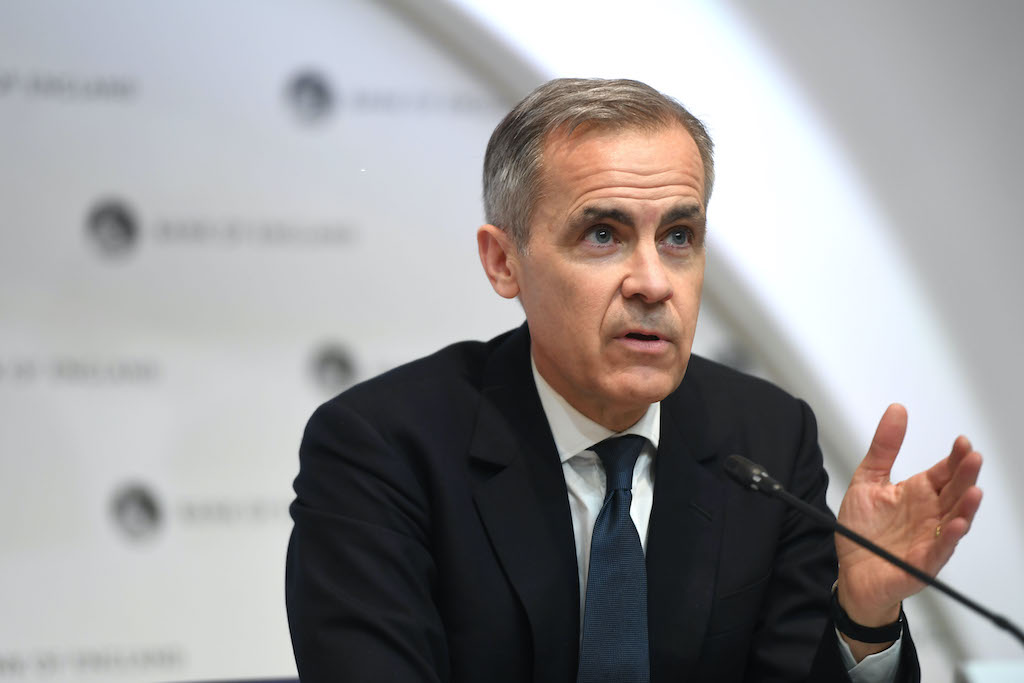
Mark Carney speaks during a news conference in London in March 2020. Photo: Peter Summers/Pool/AFP via Getty Images
Meanwhile in Canada, the federal government’s Fall Economic Statement budgeted $7.3 million for a Sustainable Finance Action Council tasked with recommending how to enhance climate disclosure and more clearly define sustainable investing. But by the time the council launches in early 2021, it will have been nearly two years since the Expert Panel on Sustainable Finance published its report urging Ottawa to “embed climate-related risk into monitoring, regulation and supervision of Canada’s financial system.”
In the absence of formal guidelines, scores of companies and investors in Canada have pledged to do better in a bid to reduce their risk—be it by lowering emissions, improving transparency or investing more sustainably. Institutional investors have themselves begun appealing to companies to begin disclosing climate risks in a consistent and standardized way. Every major Canadian pension fund now has a sustainable investing strategy. Last year, the Canada Pension Plan Investment Board, the largest such organization in the country, began screening all new investments for risks and opportunities related to climate change.
Regulators and policymakers have also begun exploring ways to improve disclosure. In July, the Capital Markets Modernization Taskforce, established by the Ontario government, recommended in a report that the Ontario Securities Commission require all companies it oversees to disclose ESG-related risks using the TCFD and another set of global standards called the Sustainability Accounting Standards Board (SASB).
The obstacle preventing a more organized approach, said Sawyer, is that Canada’s financial markets are regulated provincially and territorially, making it cumbersome to mandate disclosure nationally. “There’s a coordination problem,” he said. “When you have 13 regulators in the country, it’s hard to get everyone on board.”
They have made some effort. Last year, the Canadian Securities Administrators—the umbrella organization overseeing provincial and territorial securities regulators—published new guidance for companies noting that climate change is a mainstream business issue that all companies need to consider and disclose relevant risks for. “The law for publicly traded companies is if it’s material, you should be disclosing it,” said Janis Sarra, a principal investigator for the Canada Climate Law Institute (CCLI) and a member of the Canadian delegation to the UN Commission on International Trade. “Having said that, it’s clear that [climate risk] is not evenly reported. A lot of institutional investors say that their investee companies aren’t disclosing to any consistent standard. Investors want to be able to compare year over year and company to company and sector to sector, but they don’t have that information.”
Sarra said that as other countries pull away from Canada on financial climate-risk regulations, the country could see capital leave its borders. “We’re already a tiny part of the global financial markets, and capital will exit if we can’t find a sustainable finance strategy,” she said.
Barring formal regulations, eight of Canada’s largest pension funds, representing $1.6 trillion in assets under management, urged companies and investors to report their ESG risks using specific standards, the TCFD and SASB. Still, the CEOs of the pension funds, which include CPP Investments and the Ontario Teachers’ Pension Plan, are not mandating disclosure so much as strongly encouraging it. “It is not only the right thing to do, it is an integral part of our duty to contributors and beneficiaries,” reads their letter. “Doing this will unlock opportunities and mitigate risks, supporting our mandates to deliver long-term risk-adjusted returns.”
Sarra said Canada can do more than simply ask companies to protect their bottom line by protecting the planet. The federal government regulates some 35,000 companies in Canada— including banks, broadcast companies, port operators, many transportation-service providers and telecommunications firms—and has the authority to compel them to disclose climate-related risks. “[Ottawa] has the jurisdiction,” she said. “It could amend those statutes, or ask the regulators or supervisors—for example, banks—to say they should be disclosing to TCFD standards.”
So far, the federal government has not introduced plans to mandate disclosure among the companies it regulates. It has, however, made smaller gestures to encourage disclosure. Its Large Employer Emergency Financing Facility, announced in May, made funding through the COVID-19 relief program contingent on TCFD disclosure. Last month, the government tabled Bill C-12, its climate-accountability act, in which it called for the minister of finance to report annually on “measures that the federal public administration has taken to manage its financial risks and opportunities related to climate change.”
“It’s not related to business, but people can see that [Ottawa] is leading by example, and that will encourage businesses,” said Sarra. “I know many businesses and many institutional investors are applauding them for trying to do that. It is a good step forward.”
In the meantime, the various organizations that set guidelines for climate-risk disclosure—like TCFD and SASB—are trying to streamline the process, which can be confusing to navigate and a major barrier to reporting. In September, five standards-setters agreed to harmonize their frameworks and two others said they would merge theirs; the International Financial Reporting Standards Foundation is reviewing how it can lead the global effort.
Cynthia Williams, a principal investigator for the CCLI, said it’s unlikely Canada’s governments will take any substantial steps to regulate climate-risk disclosure during the pandemic. “I think there would be a reluctance to put anything on companies right now that’s perceived as a cost,” she said. “We’ll likely need to wait until some time next year, when vaccines are readily available and the economy is recovering, before any of the provinces or the federal government do anything on this. And that seems legitimate to me.”
It could be next fall by the time the pandemic ends. By then, Carney will be headed to Glasgow for the UN climate summit with recommendations in hand for global standards on climate-risk disclosure. The standards are meant to demystify the hard-to-navigate and daunting process that dissuades many companies from disclosing in the first place. During his talk at the Queen’s conference this fall, Carney lamented Canada’s securities regulators’ lack of leadership on the file, “given how mainstream this issue is now.” But even if Canada needs to be dragged along, Carney said regulation will arrive here—eventually. “It’s an anomaly that there’s not more consistent global policy on this,” he said. “I like to think that’s going to change soon.”