Skip to content

Canada's Business and Tech Newsroom

  • Professional Subscription
  • Partnerships & Advertising
  • Licensing & Syndication
Log In Subscribe
Welcome,
  • My Account
  • Log Out
  • Business
  • Tech
  • National
  • The Big Read
  • Briefings
  • Commentary
Search
Log In Subscribe
Welcome,
  • My Account
  • Log Out
News

Proposed EU laws could force breakup of Big Tech

This article is a preview of The Logic’s Daily Briefing newsletter, sent every weekday. Sign up for a free trial.

On Tuesday, the European Union published a pair of long-awaited draft laws that seek to curb the dominance of “gatekeeper” platforms like Amazon, Apple, Facebook, Google and Microsoft, as well as restrict their ability to spread hateful and violent content online. It’s the most aggressive attempt yet to regulate Big Tech. Here’s what you need to know:

News

Proposed EU laws could force breakup of Big Tech

By Catherine McIntyre
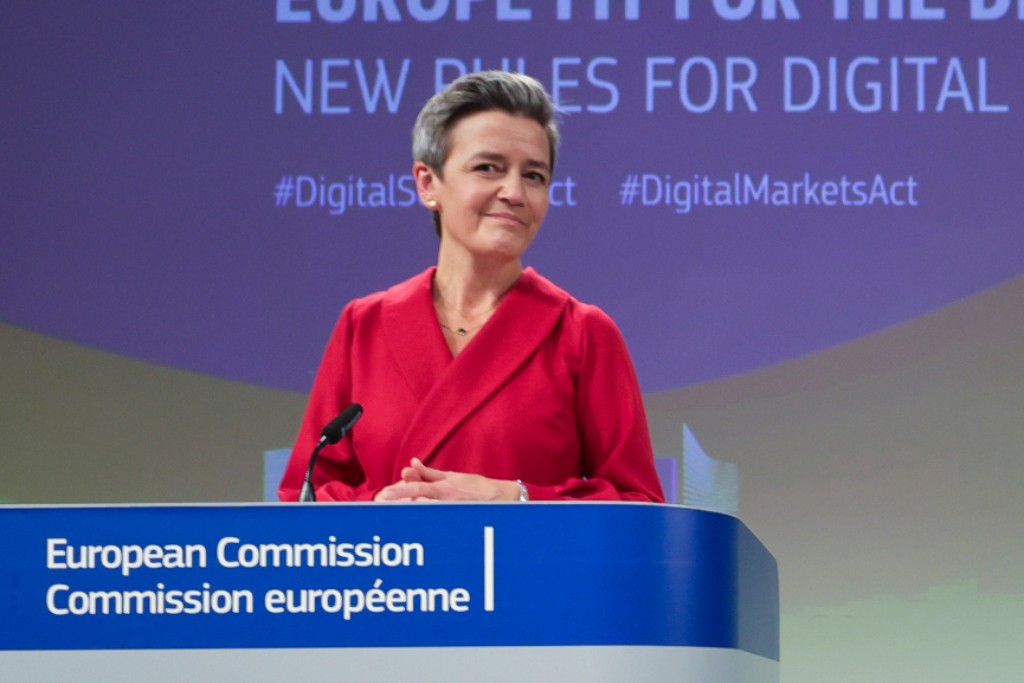
European Commissioner for Europe fit for the Digital Age Margrethe Vestager, left, and European Commissioner for Internal Market Thierry Breton during a news conference on Digital Services Act and the Digital Markets Act at the European Commission headquarters in Brussels, Tuesday, Dec. 15, 2020. Photo: AP Photo/Olivier Matthys
Dec 15, 2020
A A
A Small A Medium A Large
Share

Share

This article is a preview of The Logic’s Daily Briefing newsletter, sent every weekday. Sign up for a free trial.

On Tuesday, the European Union published a pair of long-awaited draft laws that seek to curb the dominance of “gatekeeper” platforms like Amazon, Apple, Facebook, Google and Microsoft, as well as restrict their ability to spread hateful and violent content online. It’s the most aggressive attempt yet to regulate Big Tech. Here’s what you need to know:

The details: The proposed Digital Markets Act would require firms to improve transparency around operations like online advertising. They would also have to end self-preferencing, like favouring their own products in search results or preventing users from uninstalling their apps on their own devices. A second piece of legislation, called the Digital Services Act, calls for companies to do more to prevent the spread of hate speech and sale of counterfeit merchandise through their platforms. 

Who has to comply: The Digital Markets Act covers large internet companies that have had an annual turnover in the EU of at least €6.5 billion in the last three financial years, or that have a market value of at least €65 billion in the last year. Firms also have to provide a “core platform service” in at least three EU member states. The degree to which companies need to comply with the Digital Services Act varies by the size and type of company, with very large digital platforms subject to the most scrutiny under the law. For example, Google and Facebook might have to provide data to authorities and researchers, but a domain-name registrar would not. 

The possible consequences: Companies that don’t comply with the Digital Markets Act could face fines of up to 10 per cent of their global annual sales and periodic penalty payments of up to five per cent. In severe cases, the regulator could compel a firm to divest its assets, including business units, subsidiary firms, intellectual property rights or brands. Failing to comply with the Digital Services Act could lead to fines of up to six per cent of its annual turnover for the previous financial year. 

The bigger picture: The draft laws follow two landmark lawsuits filed in the U.S. last week accusing Facebook of sweeping antitrust violations and calling for the firm to unwind its Instagram and WhatsApp acquisitions. Regulators elsewhere are likewise cracking down on Big Tech. Also on Tuesday, Britain proposed laws to ban large platforms from facilitating the spread of harmful online content, like terrorism material and child abuse, while Irish regulators announced a €450,000 fine against Twitter for violating EU data-protection laws. On Monday, China’s antitrust regulator fined three of the country’s largest tech firms for monopolistic behaviour and failing to disclose acquisitions of smaller firms; the regulator is scrutinizing more deals, including Tencent Holdings’ US$3.5-billion plan to take search engine Sogou private. 

What’s next: The proposed regulations still have to be approved by European governments and lawmakers. EU competition commissioner Margrethe Vestager said she hopes that will happen “as fast as possible,” but the process could take two years.

#big tech #european union

Sponsored Content

How to shift your workforce from AI experimentation to adoption

By Jessica Aftimus Rosa

The real-world economic offshoots of sovereign AI

By Deborah Aarts
Illustration of a plane flying above a mailbox

Increasing healthcare access across Canada

By Deborah Aarts
Paid promotional content

Loading...

Thanks for sharing!

You have shared 5 articles this month and reached the maximum amount of shares available.

Close
This account has reached its share limit.

If you would like to purchase a sharing license please contact The Logic support at [email protected].

Close
Want to share this article?

Upgrade to all-access now

Close
Gift the full article!

You have gifted 0 article(s) this month and have 5 remaining.

Copy link and gift
Copy Link
Email to a friend
Send Email
Gift on Social Media

Recipients will be able to read the full text of the article after submitting their email address. They will not have access to other articles or subscriber benefits.

Photo: AP Photo/Olivier Matthys

Most Popular This Week

Special Report

Canada pitched itself to the world’s biggest investors. Now comes the hard part

By David Reevely, Anita Balakrishnan, Murad Hemmadi, Chaimae Chouiekh, Claire Brownell and Kevin Carmichael
News

The Canada Investment Summit’s US$430B deal book, in charts

By Chaimae Chouiekh
An aerial image of a Syncrude oilsands field in Fort McKay, Alberta.
Exclusive

Inside the provinces’ pitches to the world’s biggest investors

By Anita Balakrishnan
Donald Trump holding up a board bearing the names of countries and tariff rates. He's standing behind a lectern bearing the U.S. presidential seal.
Analysis

The ‘red line’ in U.S. trade talks that sets Canada apart from other countries

By Joanna Smith

In-depth, agenda-setting reporting

Great journalism delivered straight to your inbox.

A side shot of Mark Carney walking up a set of stone steps into the Parliament buildings. He's wearing a dark suit. The straps of a case or tote bag are visible in his right hand.
News

How the Liberals plan to keep their promise on one-year project approvals

By David Reevely

Briefing

Defence department is learning to buy the way startups sell, senior officials say

By Murad Hemmadi   |   Sep 21, 2026 | 4:04 PM ET

Carney joins coalition of world leaders to promote and reform multilateral institutions

By Joanna Smith   |   Sep 21, 2026 | 2:15 PM ET

France and Canada to co-operate on space capabilities and tighten Atlantic links

By David Reevely   |   Sep 21, 2026 | 1:52 PM ET

Best business newsletter in Canada

Get up to speed in minutes with insights and analysis on the most important stories of the day, every weekday.

Exclusive events

See the bigger picture with reporters and industry experts in subscriber-exclusive events.

Membership in The Logic Council

Membership provides access to our popular Slack channel, participation in subscriber surveys and invitations to exclusive events with our journalists and special guests.

Recent Popular Stories

Analysis

The ‘red line’ in U.S. trade talks that sets Canada apart from other countries

By Joanna Smith   |   Sep 14, 2026
Donald Trump holding up a board bearing the names of countries and tariff rates. He's standing behind a lectern bearing the U.S. presidential seal.
News

Trump steps up effort to block Canadian goods from U.S. procurement—but his order leaves a lot untouched

By Joanna Smith   |   Sep 17, 2026
A nighttime shot of Donald Trump holding his hand while speaking. He's wearing a red hat with "USA" emblazoned on the front.
News

Arlene Dickinson launches $500M fund to back Canadian agriculture firms in Southeast Asia

By Catherine McIntyre   |   Sep 14, 2026
An aerial photo of a combine harvester swathing its way through a field of barley.
News

The Canada Investment Summit’s US$430B deal book, in charts

By Chaimae Chouiekh   |   Sep 15, 2026
Special Report

Canada pitched itself to the world’s biggest investors. Now comes the hard part

By David Reevely, Anita Balakrishnan, Murad Hemmadi, Chaimae Chouiekh, Claire Brownell and Kevin Carmichael   |   Sep 15, 2026
News

Canada’s investment problem isn’t a lack of money, investors say at Milken Institute event

By Chaimae Chouiekh, Anita Balakrishnan and Murad Hemmadi   |   Sep 14, 2026

Canada's most influential executives and policymakers are reading The Logic

  • CPP Investments
  • Sun Life Financial
  • C100
  • Amazon
  • Telus
  • Mastercard
  • bdc
  • Shopify
  • Rogers
  • RBC
  • General Motors
  • MaRS
  • Government of Canada
  • Uber
  • Loblaw Companies Limited
logic-logo

Canada's Business and Tech Newsroom

100% human-crafted journalism

Newsroom

  • News Tips
  • AI Policy
  • Editorial Disclosures
  • Story Pitches

Company

  • About Us
  • Terms of Service
  • Privacy Statement
  • Corporate Information

Contact

  • Contact Us
  • Advertise
  • FAQs
  • Work at The Logic

© 2026 The Logic Inc. All Rights Reserved.

Trusted by leaders

Error

Account creation failed.

Please email us at [email protected].

Create Account

[wppb-register form_name=”cozmo-registration-form-for-modal”]

I do have an account
Login
or

[wppb-login]

I don’t have an account









