OTTAWA — As India’s commerce minister kicks off a visit to Canada, one of the subcontinent’s largest business associations is pushing to double the bilateral trade in goods over the next three years, and for closer ties between the two countries’ technology ecosystems.
Skip to content


News
Indian business group seeks to grow trade, tech ties during Canada trip
Delegation of Federation of Indian Chambers of Commerce & Industry accompanies visiting minister
The State Bank of India building, in Mumbai in September 2022. Photo: Niharika Kulkarni/NurPhoto via Getty Images
OTTAWA — As India’s commerce minister kicks off a visit to Canada, one of the subcontinent’s largest business associations is pushing to double the bilateral trade in goods over the next three years, and for closer ties between the two countries’ technology ecosystems.
Talking Points
- The Federation of Indian Chambers of Commerce & Industry is hoping to see bilateral trade between India and Canada double over the next three years, secretary general Shailesh Pathak says
- A delegation from the business lobby group—which represents many of the subcontinents’ largest firms—is in Toronto this week as part of Commerce Minister Piyush Goyal’s visit to Canada
Top executives from several member companies of the New Delhi-based Federation of Indian Chambers of Commerce & Industry (FICCI) will meet with Canadian counterparts and officials in Toronto over the next two days, as part of Indian Commerce Minister Piyush Goyal’s visit to the country.
Delegates include Anish Shah, CEO of the Mahindra Group conglomerate; Rikant Pitti, co-founder of travel site EaseMyTrip, as well as representatives of firms in the subcontinent’s auto-parts, food, IT and pharmaceutical sectors.
“The goal is to increase trade between the two countries,” FICCI secretary general Shailesh Pathak said in an interview from Toronto on Monday. The association is targeting US$15 billion in bilateral merchandise movement in three years, up from US$6.9 billion in the 2021–22 fiscal year. (Statistics Canada data estimated two-way goods trade to be $13.6 billion in 2022).
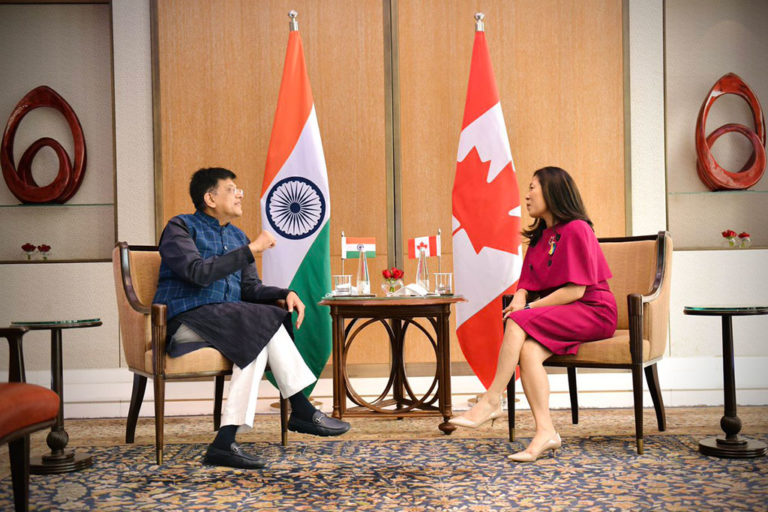
Canadian officials hope Goyal’s meetings with Trade Minister Mary Ng this week will help advance negotiations on a bilateral early-progress trade agreement, which the two launched in March 2022. The FICCI backs a deal that can remove “pain points” in commercial activity between the two countries, Pathak said; he declined to specify what the association would like included in an agreement, citing the ongoing talks.
Related Articles

Pathak noted that despite the lack of a trade deal, firms from each country are already expanding in the other. For example, Toronto-headquartered Fairfax Financial’s Indian affiliate owns a major stake in the Bengaluru airport, while the Canada Pension Plan Investment Board has bought up toll roads and other infrastructure projects. Meanwhile, Canada is a significant market for Mahindra’s farm-equipment unit, and automaker Ola Electric is looking to sell battery-powered scooters here, per Pathak.
Still, the FICCI would welcome bilateral agreement in areas like technology policy, Pathak said. He cited India’s unified payments interface, a government-built system that underpins bank and fintech apps on the subcontinent. In January, New Delhi extended access to non-resident Indians with domestic accounts, the first step in a play for wider international use. “This kind of technology-policy innovation tomorrow can make the lives of Canadians so much easier,” said Pathak, noting that provisions in a trade deal could allow such systems to flow between the two countries.
The Indian unit of Canada’s Trade Commissioner Service is also focusing on technology trade, with priority sectors including auto, digital industries and cleantech.
In the wake of the COVID-19 pandemic and amid rising tension with China, the governments of advanced economies are increasingly seeking to reorganize supply chains through geopolitically sympathetic nations. The Liberal government in particular has sought to position Canada to benefit from U.S.-led “friendshoring.”
With New Delhi hosting the G20 this year, businesses on the subcontinent are seeking similar opportunities. “It is just a fraught time in global trade,” Pathak said. “We just hope that the concept of friendshoring that all of us are talking about in the Indo-Pacific will benefit North America as well as India.” The U.S., Canada and India already share good diplomatic and business relationships, he said.



Loading...
Thanks for sharing!
You have shared 5 articles this month and reached the maximum amount of shares available.
CloseThis account has reached its share limit.
If you would like to purchase a sharing license please contact The Logic support at [email protected].
CloseGift the full article!
You have gifted 0 article(s) this month and have 5 remaining.
Recipients will be able to read the full text of the article after submitting their email address. They will not have access to other articles or subscriber benefits.
Photo: Niharika Kulkarni/NurPhoto via Getty Images
Most Popular This Week




In-depth, agenda-setting reporting
Great journalism delivered straight to your inbox.
News
Panel decries Canada’s chaotic way of funding world-class science
Briefing
AI is pushing insurers to become asset managers, Canadian CEOs say
Trump administration faces lawsuit over 50% tariffs on Canadian goods
Canada-U.S. trade war to reduce real GDP by 1.4% over 2024 levels after five years: PBO
Best business newsletter in Canada
Get up to speed in minutes with insights and analysis on the most important stories of the day, every weekday.
Exclusive events
See the bigger picture with reporters and industry experts in subscriber-exclusive events.
Membership in The Logic Council
Membership provides access to our popular Slack channel, participation in subscriber surveys and invitations to exclusive events with our journalists and special guests.