Deep in the wilderness, where the roads are covered by evergreen needles, a semi truck cab carves a path through the snow, slowing as it approaches a one-lane bridge. The only warnings of the gully ahead are two black-and-orange striped signs. A wrong move and the truck careens into the gulch below.
Skip to content
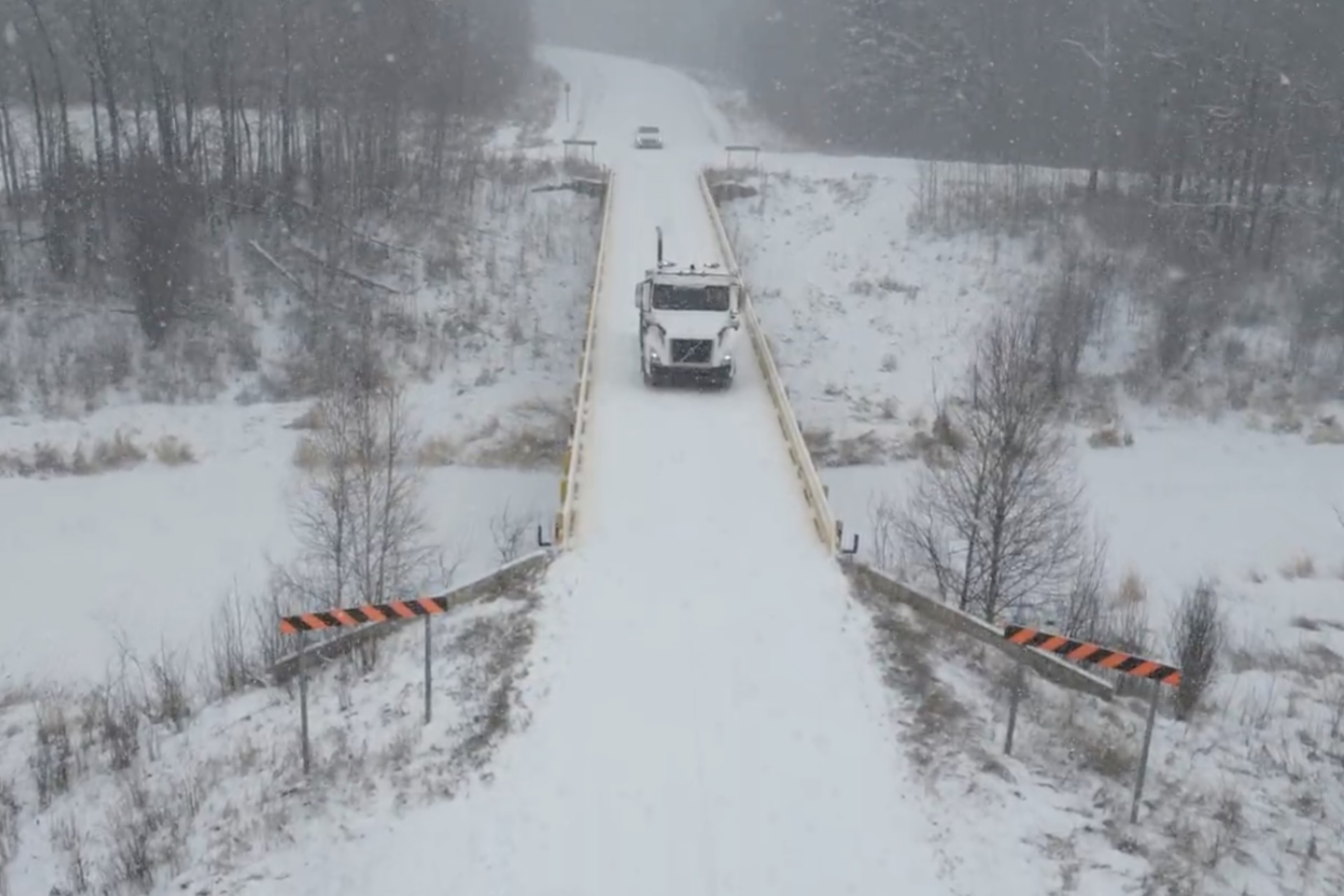 A truck using NuPort Robotics’ autonomous-driving technology crosses a narrow, single-lane bridge in wintery conditions. Photo: NuPort Robotics / Handout

News
Huge, self-driving trucks roll onto Canada’s most treacherous roads
Autonomous vehicle tech, usually designed for big cities, is getting a rugged makeover as the logging industry looks to AI to deal with major challenges
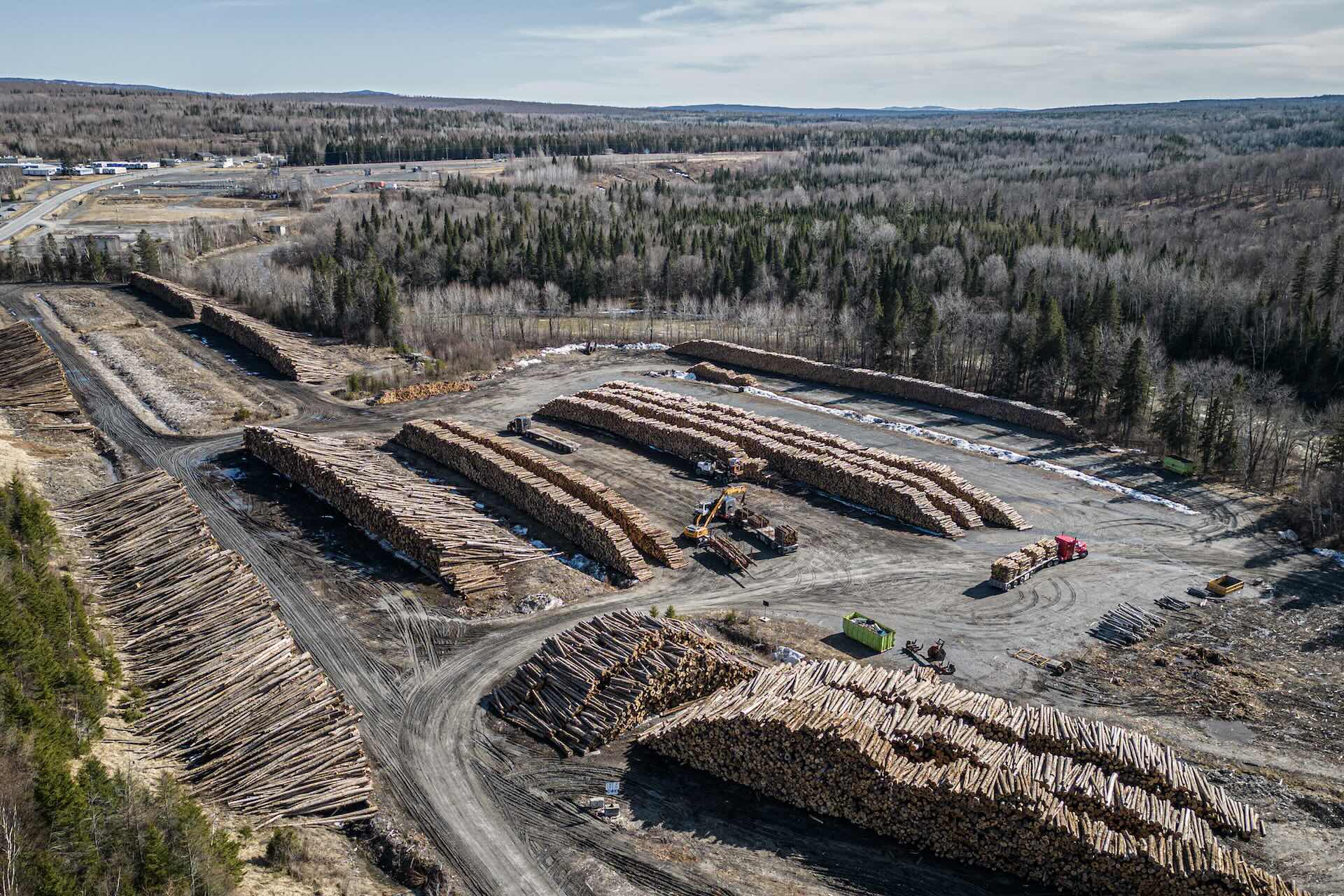
Those in the industry are split on whether the same artificial intelligence systems powering robotaxis in big cities are ready for the back roads of the Canadian wilderness. Photo: Roger Lemoyne for The Logic
Deep in the wilderness, where the roads are covered by evergreen needles, a semi truck cab carves a path through the snow, slowing as it approaches a one-lane bridge. The only warnings of the gully ahead are two black-and-orange striped signs. A wrong move and the truck careens into the gulch below.
The situation would be anxiety-inducing for a human, but this truck cab is driving itself. It’s using a system developed by NuPort Robotics, a Toronto-based autonomous-driving startup. Right now, it’s just a test run—but one day, Canada’s north could be criss-crossed with self-driving trucks hauling huge loads on dangerous roads.
Talking Points
- Loggers, under pressure from trade tensions, wildfires and fluctuating labour demand, are looking to automation to help Canada compete for lumber deals
- Self-driving trucks are one of the tools on the table, but they aren’t without critics
These experiments are, in some ways, an industry’s attempt to outrun a crisis. Canada’s wood-product companies are among the first and hardest hit by issues like the climate crisis and trade wars, while recruitment challenges and gruelling logistics threaten one of the country’s most iconic industries.
“Just transporting that log is a challenge,” says David Elstone, a professional forester and managing director of the supply chain firm Spar Tree Group. The country’s vast terrain makes it hard to compete with the U.S., where transportation is much simpler, he said. “In the U.S. South, mills are quite centralized, and there’s ample amount of timber everywhere. It’s a huge cost disadvantage in Canada.”
It’s been a tough supply chain issue, as seasonal logging firms struggle to compete with oil and mining companies for trained drivers. In 2022, Alberta-based trucking and forestry companies said that they would have hired another 305 drivers that year but couldn’t find candidates, according to a government-funded survey by Trucking HR Canada. The shortfall caused the firms’ revenue to fall by about 15.4 per cent, on average, the survey found.
Related Articles

Still, those in the industry are split on whether the same artificial intelligence systems powering robotaxis in big cities are ready for the back roads of the Canadian wilderness. Here, distances are long, roads are unpaved and often steep, and turns can be precarious and slick. “On the B.C. coast, we have a lot of mountains, steep terrain, twisty switchbacks,” said Elstone.
It’s the type of challenge that could be a coup for people like NuPort Robotics CEO Raghavender Sahdev, as the tech industry strives to prove that AI can make a difference in the physical world. The company already hauls freight for companies like Canadian Tire and has been in talks with several forestry companies to try and drum up more business. They’re looking for help, he said, to relieve driver fatigue, determine which complicated maneuvers can be automated, and which, like strapping logs to trucks, must be done by humans. NuPort is also testing how the technology reacts to unexpected issues like a log falling into the road—not the type of thing that’s common on a regular highway.
While Sahdev would not reveal the location of the trials or which companies he’s in talks with, the project builds on years of research by companies like Chantiers Chibougamau, Resolute Forest Products, Interfor, West Fraser and Alberta-Pacific Forest Industries.
Those companies, as well as NuPort, have all been working on ways to automate trucking with FPInnovations, a research and development non-profit funded by both federal and provincial governments, as well as over 50 forest-product companies. Christoph Schilling, a manager of business development at FPInnovations, said the increasingly heavy payloads and niche applications make it hard to get the right products off the shelf.
Since Canada is the world’s most active trader of wood products, there are high stakes to get lumber from mill to market efficiently.
These days, that’s an ask as big as Paul Bunyan himself. While tariffs are a new word for many workers, trade duties go back decades in the softwood lumber industry, and have taken a turn for the worse. That’s after historic wildfires forced sawmills to close over the past few summers, a harbinger of the climate crisis challenges ahead. Meanwhile, supply chain disruptions, like rail stoppages, have hit the sector in 13 of the last 14 years.
Automation is one of the many tools that companies are hoping will help the industry keep up. West Fraser began running trials of autonomous forklifts at mills in 2019, while companies like Kodama can operate skidders remotely. T-Mar Industries, based in Campbell River, B.C., designs log yarders that can be operated by remote control.
Still, the forestry industry may not be immune to a growing backlash against autonomous trucks. Unions oppose plans to use the technology in the Prince Rupert port, where some timber lands before being shipped overseas.
The Public and Private Workers of Canada, which represents some forestry workers, says it is closely monitoring the issue of self-driving trucks. Despite the struggles reported by hiring managers, logging truck drivers say that they like their jobs, even with days starting as early as 1:30 a.m., a University of Washington study found. The study also found that neither inclement weather nor the time of day was correlated with severe truck crashes, perhaps owing, the researchers suggested, to the skill possessed by trained operators of such large vehicles.
“Over the past several years, forestry workers—particularly in the pulp and paper sector—have faced tremendous uncertainty.”
PPWC says that it recognizes the safety and efficiency that could come with automation; it also needs to protect jobs. “Over the past several years, forestry workers—particularly in the pulp and paper sector—have faced tremendous uncertainty,” national president Geoff Dawe told The Logic. “We’ve seen multiple sawmill and pulp mill closures across British Columbia, with devastating ripple effects on workers, families, and rural communities.”
Schilling of FPInnovations said that their project is far from mass deployment, but is being received well in early discussions with workers. Elstone, from the supply chain firm, acknowledged the tension in an industry that faces such wild conditions that it swings from labour shortages to job losses.
“There has been a perennial skilled labour shortage, a critical skill labour shortage facing the B.C. logging industry for a number of years,” he said. “The only offset to the issue in British Columbia is the fact that we have a shrinking industry. Not the best way to find relief for your skilled labour shortage.”
Gord Magill, a trucker from Hamilton with experience in the logging industry, has been a vocal skeptic, calling automation a “relentless push to make truckers extinct.” In particular, he worries that drivers could actually be in more danger if their focus is encouraged to wander from the road as technology takes over.
Unlike highway driving, logging roads are often unmarked and unpredictable, and drivers have to exit the cab and adjust when loads shift during transit. He’s skeptical of claims that the technology is focused on protecting truckers’ safety, rather than just saving companies money by cutting staff.
“People should understand that trucking is way more than driving,” Magill said. “The claims of the autonomous truck makers, some of them are true, and some of them are fantasy, and some of them are omitting a lot of the complexities about the job.”
Magill is particularly puzzled by technologies like truck platooning, which involves programming a convoy of trucks to follow a lead human driver from harvesting sites to sawmills, sometimes in off-road conditions.
FPInnovations has been testing the technology on Billy-Diamond Road near Matagami, Que., a project it said has been paving the way for the autonomous driving trials going on today. California-based Kratos, a defence and security company, and Maryland-based autonomous vehicle startup Forterra both recently wrapped up a platooning trial hauling timber a few hours north of Montreal, near Resolute sawmills. Both companies said limited internet connectivity, dusty roads and unexpected appearances from wildlife, like a Canada lynx, required creative combinations of sensors beyond the traditional cameras or Lidars used by robotaxis.
Magill, the trucker, said his position is still evolving, but he isn’t sure such technology will be more useful than analog alternatives like road trains, where multiple trailers are hitched to one truck.
“They’re trying to bedazzle people with AI and tech about stuff we’ve been doing already for decades,” he said. “I’m not saying this isn’t going to happen. I’m not trying to expressly be a Luddite. But let’s be honest.”



Loading...
Thanks for sharing!
You have shared 5 articles this month and reached the maximum amount of shares available.
CloseThis account has reached its share limit.
If you would like to purchase a sharing license please contact The Logic support at [email protected].
CloseGift the full article!
You have gifted 0 article(s) this month and have 5 remaining.
Recipients will be able to read the full text of the article after submitting their email address. They will not have access to other articles or subscriber benefits.
Photo: Roger Lemoyne for The Logic
A truck using NuPort Robotics’ autonomous-driving technology crosses a narrow, single-lane bridge in wintery conditions.
Most Popular This Week




In-depth, agenda-setting reporting
Great journalism delivered straight to your inbox.
News
Tech firms want AI models to create better versions of themselves
Briefing
Lightspeed cuts 250 jobs through layoffs and attrition
Oil tycoon Adam Waterous aims to build new Canadian energy player with US$1B fund
Data centre infrastructure firms 3C and Datalec merge, plan Calgary expansion
Best business newsletter in Canada
Get up to speed in minutes with insights and analysis on the most important stories of the day, every weekday.
Exclusive events
See the bigger picture with reporters and industry experts in subscriber-exclusive events.
Membership in The Logic Council
Membership provides access to our popular Slack channel, participation in subscriber surveys and invitations to exclusive events with our journalists and special guests.