Listen Now
0:00
Citibank is expanding its Canadian operations by hiring more staff and buying new office space, a move its chief executive says is meant to capitalize on the country’s growing role in global markets.
In June, Citibank purchased its Mississauga site after leasing the property since it was built in 2007. Raymond Gatcliffe, Citibank Canada’s CEO, said the decision reflects a longer-term bet on Canada’s talent pool and the country’s growing role in Citi’s global operations. Citi is also renovating its Toronto office, upgrading sites in Calgary, Montreal and Vancouver, and continuing to hire across the country.
Talking Points
- Citibank has hired about 1,500 employees in Canada over the past few years and expects to add roughly another 1,000 in the coming years, says CEO Raymond Gatcliffe
- Citibank purchased its Mississauga site in June after leasing it since 2007; the hub now has about 3,500 employees, with technology roles making up 75 to 80 per cent of the workforce
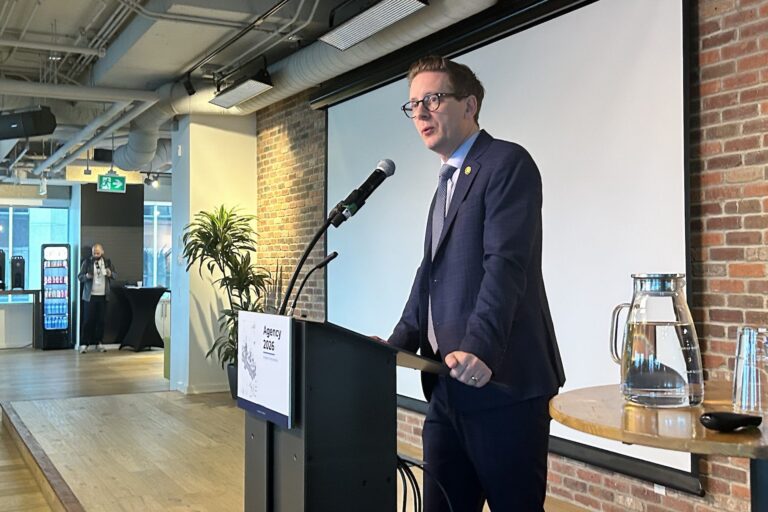
“We’ve probably hired about 1,500 [employees] over the last few years, and we expect to hire probably another thousand over the next few years,” Gatcliffe said in an interview with The Logic.
The Mississauga site now has about 3,500 employees, with technology roles accounting for about 75 to 80 per cent of the workforce, he said. Teams there develop and protect critical global platforms for payments, settlements and markets for Citibank worldwide. Gatcliffe said the site competes for global mandates with about 20 other Citi hubs around the world, including in Southeast Asia, India, Europe, Latin America and the U.S.
Citi’s expansion comes as Canada seeks to diversify its trade relationships amid growing geopolitical and economic uncertainty. Gatcliffe said companies are rethinking where they invest, trade and build supply chains, creating opportunities for Canada to play a larger role.
Related Articles

He pointed to Prime Minister Mark Carney’s efforts to court foreign capital and said Canada’s strategy is twofold: preserving its relationship with the U.S. while deepening business ties elsewhere. While uncertainty remains over the Canada-United States-Mexico Agreement, Gatcliffe said Canadian companies and policymakers are increasingly looking beyond the trade pact.
Citi is already seeing that shift reflected in client activity. The bank has seen growing inbound interest from multinational companies looking to do business in Canada, as well as Canadian companies seeking to expand abroad, said Gatcliffe.
Natural resources are one of the clearest opportunities for the country, he said, including critical minerals and large infrastructure projects. Gatcliffe cited the federal government’s push to accelerate major projects, as well as interest in pipeline infrastructure and other liquefied natural gas opportunities.
Defence is another area where the U.S. lender expects cross-border activity to increase. Gatcliffe said Canada’s planned increase in defence spending could create opportunities for foreign suppliers of equipment and technology to Canada, as well as for Canadian aerospace and defence companies seeking to sell into global markets.
Artificial intelligence is also changing how Citi’s Canadian workforce operates, Gatcliffe said, helping employees save time and improve productivity. Gatcliffe said the bank uses a combination of external models and internal proprietary systems, with safeguards in place to protect Citi’s network and data.
“Certain roles, absolutely, are susceptible to being done by AI,” he said. “[But] I look at it much more as an enabler, as opposed to a replacer of jobs.”
Present in Canada since 1919, Citibank is one of three U.S.-owned Schedule II banks, alongside Amex Bank of Canada and J.P. Morgan Bank Canada. Schedule II banks are Canadian-incorporated subsidiaries of foreign banks, regulated under the federal Bank Act and overseen by the Office of the Superintendent of Financial Institutions.
Gatcliffe, who has spent 32 years at Citi, took over the Canadian unit in April last year. He began his career as a credit analyst in Trinidad and Tobago before holding senior roles in Latin America, the U.S. and Europe.
Citi’s growth agenda also comes as other U.S. banks are sharpening their focus on Canada. Last month, JPMorgan said it was bringing its US$1.5-trillion Security and Resiliency Initiative to the country. First announced in October, the 10-year program is intended to direct financing, capital raising and investment toward sectors including energy, defence, critical minerals and advanced manufacturing, though the bank has not said how much spending will be allocated in Canada.
Asked whether Citi was considering a similar investment pledge for Canada, Gatcliffe said the bank’s strategy is to build on its existing businesses here. That includes helping more multinationals operate in the country while supporting Canadian companies as they expand abroad. A key part of that strategy, he said, is growing Citi’s Canadian commercial banking business, which launched in 2022 and has been growing 30 to 50 per cent.
Despite operating in a market dominated by the Big Six, Gatcliffe said he views the Canadian lenders as both clients and partners, noting that they use Citi’s global payments, settlement and trading platforms to serve their own customers internationally.
“We are not competing with the Canadian banks in 80 per cent of what they do in Canada,” he said. “We are really complementary to what they cannot deliver for companies that are genuinely international.”
Citi’s core Canadian business includes treasury and trade services, custody, clearing, markets, private banking, corporate banking, commercial banking and investment banking. Gatcliffe said Citi serves about 250 ultra-high-net-worth clients and family offices in its wealth management division.
Gatcliffe described Canada’s financial system as stable, well-capitalized and one that has served the country well over its history but said there are still pockets where other players, including fintechs and foreign banks, can bring more competition.
Canada is also catching up to other countries in financial-services infrastructure, he said, including in open banking and payments modernization. Once the architecture and regulatory environment is in place, Gatcliffe said Citi will be positioned to bring more products it has already developed globally, including tokenized payments and tokenized deposits, to Canada.
“Competition is inevitable, and it is happening in every industry,” Gatcliffe said. “Financial services is the same thing.”