TORONTO — Leo Cotta can date the dawn of the current age quite precisely. The Brazilian computer scientist began his postdoctoral fellowship at the Vector Institute on Nov. 30, 2022—the very day OpenAI loosed ChatGPT onto the world.
Skip to content

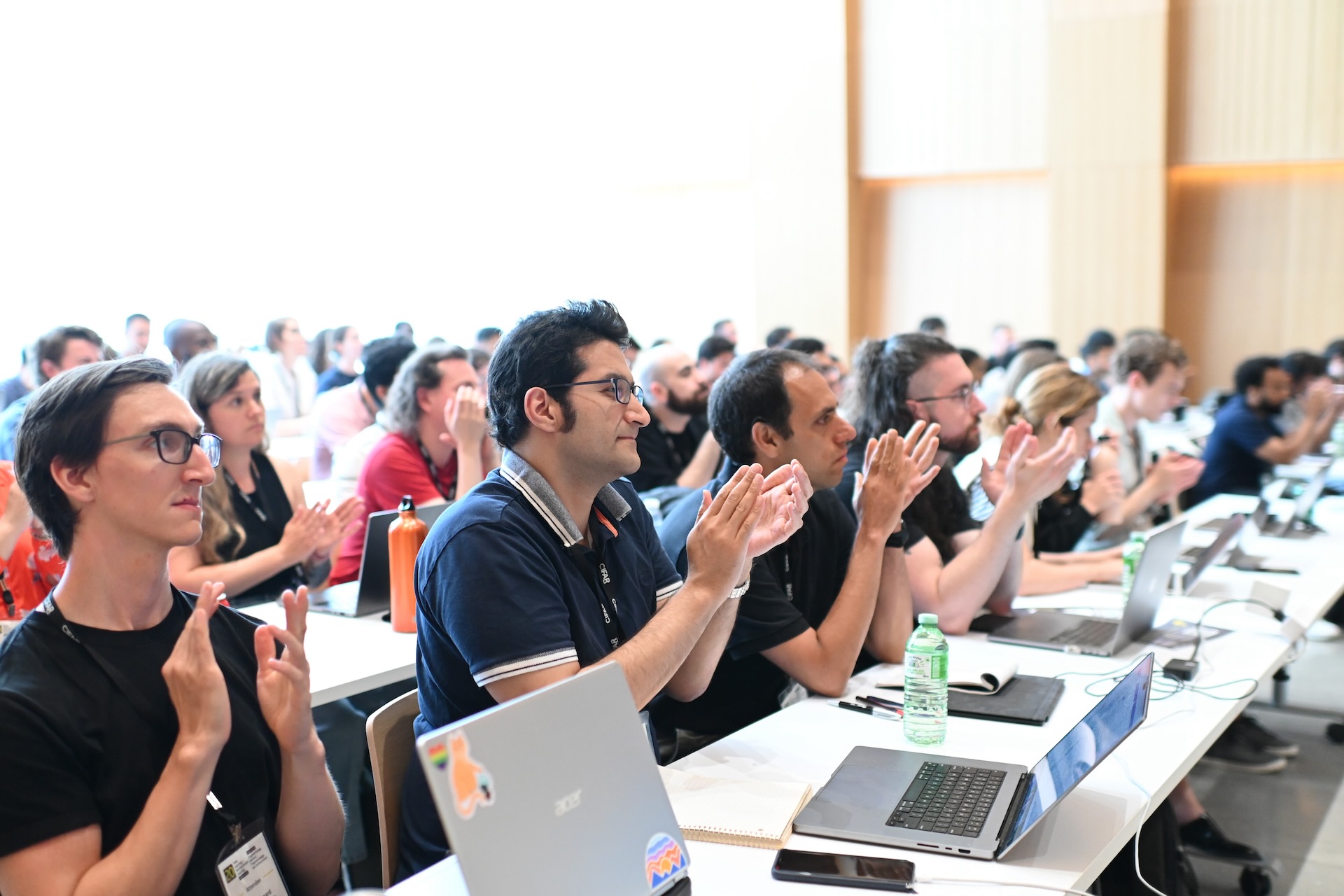 For 20 years, CIFAR has been facilitating summer school for students and faculty from Canada and around the world. Toronto’s Vector Institute, the AI research non-profit, is hosting the current edition. Photo: Christopher Katsarov Luna for The Logic
 The number of posted jobs in Canada requiring AI-related skills in 2022 was more than tenfold than that in 2012, but last year it fell off that peak somewhat, according to PwC. Photo: Christopher Katsarov Luna for The Logic

News
AI recruiters aren’t taking the summer off. Neither are these students
Corporate Canada and Big Tech mix with the next generation of deep-learning stars at a Vector Institute-hosted summer school
Students at a career mixer during CIFAR’s Deep Learning + Reinforcement Learning Summer School in Toronto, on July 11, 2024. Photo: Christopher Katsarov Luna for The Logic
TORONTO — Leo Cotta can date the dawn of the current age quite precisely. The Brazilian computer scientist began his postdoctoral fellowship at the Vector Institute on Nov. 30, 2022—the very day OpenAI loosed ChatGPT onto the world.
“Now I’m referring to my PhD as ‘modern deep-learning,’ and [the AI field] post-GPT as something like ‘contemporary deep learning,’” Cotta said Wednesday evening, to chuckles from the hundred-plus graduate and doctoral students gathered in a warm, wood-lined auditorium room at MaRS Discovery District.
Talking Points
- For 20 years, CIFAR has been facilitating summer school for machine learning students and faculty from Canada and around the world. Toronto’s Vector Institute, the AI research non-profit, hosted this current edition
- At a career mixer last week, students sized up the job market they hope to enter
It remains to be seen whether the history books will mark the day as the dawn of a new era, but there’s no contesting that the popular appreciation of large language models (LLMs) has exploded since ChatGPT’s launch, making quite the commodity of those with deep-learning degrees. And at last Wednesday’s event, a career mixer for students attending an AI summer school organized by research non-profit CIFAR, corporate Canada was suitably represented.
Royal Bank’s Borealis division and TD Bank’s Layer6 unit hosted booths at the front and back of the room, respectively. Telus stood for the telecoms, and MDA for the space sector. Ontario Power Generation and Natural Resources Canada occupied opposite corners of the central square. Google DeepMind had a long table featuring David Fleet, the senior research scientist and University of Toronto professor who’d given that morning’s lecture on generative vision. All were keen to meet the next generation of AI talent.
Related Articles


For 20 years, CIFAR has been facilitating summer school for students and faculty from Canada and around the world. Toronto’s Vector Institute, the AI research non-profit, hosted this summer’s edition. Cotta was on stage to showcase the opportunity for students to follow a postdoc path there. Edmonton’s Amii and Montreal’s Mila, the other two pillars of the federal Pan-Canadian AI Strategy, also had tables to meet potential fellows.
Quadri Adewale had come to the mixer in search of Roche, but couldn’t see the Swiss pharmaceutical giant’s table through the throng. The neuroscientist will be done his PhD at McGill University soon, and he’s in the early days of looking for an industry or postdoctoral role that could prove elusive.
“If somebody wants to do AI, there are positions for that,” he said. But Adewale’s thing is mathematical modelling for neuroscience; getting a gig doing that “might be quite challenging.”
Other summer school students say the market for AI skills isn’t quite as hot as in years past. “There was a lot of demand for it even before the whole ChatGPT craze,” said John Quinto, a master’s student at the University of Guelph. “But now the economic conditions are a lot worse.”
The AI hiring cycle may have flattened somewhat, even if the hype hasn’t. The number of posted jobs in Canada requiring AI-related skills in 2022 was more than tenfold that in 2012, but last year it fell off that peak somewhat, according to PwC. The firm’s data also showed a slightly smaller share of postings demanding AI chops in sectors like information and communication, professional services and finance.
Quinto still has another year to go at Guelph. This summer, he’s interning at logistics software firm Kinaxis. “There, we’re working on this LLM stuff—quite different from this,” he said, indicating a poster showcasing his team’s method for using AI to tell arthropods apart. “But it’s still interesting work.”
For the last two years, Sabrina Mokhthari has focused on how to do machine learning in ways that preserve privacy. Now, the soon-to-be-former University of Waterloo graduate student wants to “apply this knowledge in real-world problems.” Mokhthari hasn’t really started her search yet. “I’ve heard it’s pretty rough now to apply for jobs,” she said. “I’m optimistic.”
The buzz around the business booths on Wednesday suggested plenty of her peers felt similarly. And not all the recruiters had jobs on offer. At least one startup with a booth wasn’t yet hiring for machine-learning roles, though it planned to build out its AI team eventually.
GPTZero is building out now. The Toronto-originated, New York-headquartered startup closed a US$10-million Series A round last month to advance its technology for detecting AI-generated content. Alex Cui, the company’s co-founder and CTO attended CIFAR’s summer school in 2021 and came back this year to see if anyone from the current cohort could add to his 16-person team.
“What kind of person signs up, during the beautiful days of summer, to go and do more school?” Cui said, answering his own question: “People from around the world who are really curious and passionate about AI.” The startup’s already taken applications from some promising students who attended.
Thor Jonsson, another summer school alumnus, also has an open position to fill. EthicalAI, the Waterloo, Ont. firm where he’s CTO, applies deep learning to clients’ environmental and safety problems. “Summer school definitely confers a degree of skill,” Jonsson said, noting attendees are “being exposed to all the latest innovations in AI.” There’s still “lots” of demand for good talent, he said.
Adewale did eventually find the Roche booth, where he discovered that the firm has its own postdoc fellowship program. If that doesn’t end up appealing, he has a pretty good backup option—a pending offer from Harvard Medical School. Industry may have to wait.



Loading...
Thanks for sharing!
You have shared 5 articles this month and reached the maximum amount of shares available.
CloseThis account has reached its share limit.
If you would like to purchase a sharing license please contact The Logic support at [email protected].
CloseGift the full article!
You have gifted 0 article(s) this month and have 5 remaining.
Recipients will be able to read the full text of the article after submitting their email address. They will not have access to other articles or subscriber benefits.
Photo: Christopher Katsarov Luna for The Logic
For 20 years, CIFAR has been facilitating summer school for students and faculty from Canada and around the world. Toronto’s Vector Institute, the AI research non-profit, is hosting the current edition.
The number of posted jobs in Canada requiring AI-related skills in 2022 was more than tenfold than that in 2012, but last year it fell off that peak somewhat, according to PwC.
Most Popular This Week


In-depth, agenda-setting reporting
Great journalism delivered straight to your inbox.
News
Cohere plans to acquire cyber startup Aisle and set up a new security division
Briefing
Banks should have kill switches, IDs for AI agents, says global finance watchdog
B.C. First Nations decry rushed consultations as Major Projects Office CEO promises to do better
Feds pledge $100M to back Nova Scotia’s plans for offshore wind farms
Best business newsletter in Canada
Get up to speed in minutes with insights and analysis on the most important stories of the day, every weekday.
Exclusive events
See the bigger picture with reporters and industry experts in subscriber-exclusive events.
Membership in The Logic Council
Membership provides access to our popular Slack channel, participation in subscriber surveys and invitations to exclusive events with our journalists and special guests.