As more e-commerce and retail companies incorporate AI into their offerings, a prominent Canadian venture capitalist is warning retailers—and his fellow investors—to be cautious amid the hype.
Skip to content


News
AI is coming for e-commerce—but businesses should approach with caution, warns a leading investor
‘It’s having its hype cycle, for better or worse’
Wittington Ventures director Qasim Mohammad. Photo: Wittington Ventures/Handout
As more e-commerce and retail companies incorporate AI into their offerings, a prominent Canadian venture capitalist is warning retailers—and his fellow investors—to be cautious amid the hype.
Qasim Mohammad, a director at Loblaw-affiliated Wittington Ventures, has long studied the retail space, looking for startups that can benefit from Loblaw’s scale and that Loblaw may want to work with. Since 2016, he has created a biennial map illustrating Canada’s digital-commerce ecosystem, tracking the players and services they offer, as well as the money fuelling their growth.
Talking Points
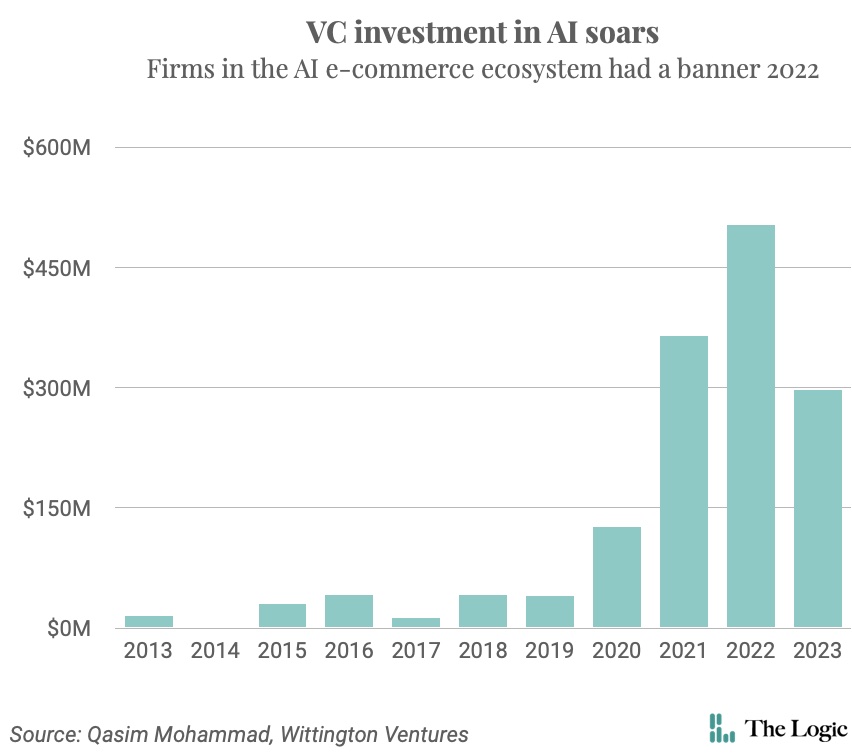
- Seventy-five firms whose AI products could shake up e-commerce raised a record $503 million in venture capital investment in 2022, according to new research
- Wittington Ventures director Qasim Mohammad warns that fellow investors and retailers should be cautious amid the hype as many questions around how best to incorporate AI into services remain unanswered
He’s now turning his attention to how the buzzy artificial intelligence sector can impact e-commerce and retail.
“I felt like it was a good time to just take a few steps back, give people a lay of the land,” he said. With all the headlines and popular culture hype around AI, retailers want to know how these new technologies can disrupt their work or help their business, he said.
In research he published Thursday, Mohammad identified 75 startups globally that offer generative AI services with which retailers can experiment. He started the process by identifying three broad categories in which retailers might be able to use AI—marketing, product and merchandising, and digital commerce and consumer experience—and then used professional databases, including PitchBook and Crunchbase, to create an exhaustive list of the firms working in those spaces.
Mohammad’s map of the potential intersections of AI and retail includes four Canadian startups: chatbot maker Ada, e-commerce product-discovery firm Adeptmind and writing assistant ParagraphAI, all of Toronto, and Copy Shark, a provider of copywriting software, based in Richmond Hill, Ont.
Related Articles


The 75 firms have raised more than $1.5 billion since 2015 from more than 187 investors around the world across more than 135 deals, according to his research.
“Things have really picked up in the last little while,” Mohammad said, especially last year. AI-centric startups have had an easier time fundraising, he said, despite the broader slowdown. As venture-capital activity rebounds from its 2022 slowdown, AI startups are helping to drive the rebound. Funding for the companies Mohammad identified raised a record of nearly $503 million last year, up from roughly $365 million the previous year. They’ve brought in almost $298 million so far this year.
“It’s having its hype cycle, for better or worse,” said Mohammad, comparing it to the recent crypto boom.
Mohammad believes generative AI is poised to transform retail. The companies he’s identified can, among other things, create new designs when presented with a set of parameters, write content for ad campaigns while taking into account consumer insights and past marketing performance, and build digital human models whose body composition shoppers identify with.
One area ripe with possibility, he said, is marketing, where brands currently invest heavily in telling their story to win over customers. “Suddenly, they can tell the story in the same way at a fraction of the cost,” Mohammad said, speculating they may soon not have to hire models for ad shoots, or even an external ad agency.
But with that opportunity comes risk. “You have to start thinking about, what’s the interpretation of that by consumers or the ethics of it?” said Mohammad. “That’s where I think things start to become murky.”
AI currently comes with unanswered questions around data privacy and ownership of intellectual property, as well as concerns around built-in bias. Technology that lets a customer virtually try on a garment, for example, can create biased or inaccurate representations due to the data on which it’s trained.
It’s also not yet clear how customers will respond to many of these technologies. Levi’s announced in late March that it would partner with Lalaland.ai—one of the companies on Mohammad’s map—to test using AI-generated models, supplementing its use of human models. It touted the move as a step forward for diversity, body inclusivity and sustainability. Then came the backlash. People questioned exactly how it would help with diversity and whether human models would lose work as a result. Levi’s had to walk back its language.
That’s not to say retailers should stay away from experimenting with new tech, said Mohammad, who warned those that don’t risk being left behind. Instead, they should get involved with AI startups early to help them understand how to aggregate data and to educate them about retail consumers, among other things. “I think it’s important to lean in and try to shape it in a way that’s responsible and that makes sense for all parties,” he said, “as opposed to just completely leaning out, where I think the risk is the technology still continues to develop and progress, but it’s not being done in a way that’s helpful to everybody.”
On the investment side, Mohammad said Wittington Ventures is “always keeping our ear to the ground toward what’s new.” He sees a few AI firms currently building the platform layer—such as OpenAI’s ChatGPT—and others building off that core technology—such as Expedia’s integration of ChatGPT into its app. “The question for us as investors is always: What’s the unique differentiating point?” He’s looking at, for example, whether the data a company trains its AI product on stands out as he weighs venture investments.
It may already be tough for investors to crack into some of the categories. The market size may be small, he said, or there may not be a clear business plan yet that would show investors how they will make money in the end.
And, Mohammad said, investors have a responsibility to consider downstream impacts and should be wary of ending up in the same scenario as in the early days of the social media boom, with money pouring into platforms though their political and social consequences hadn’t been well thought out.
“Hopefully that prudence is top of mind for all investors. It’s not just about dollars and cents. It’s about more than that.”



Loading...
Thanks for sharing!
You have shared 5 articles this month and reached the maximum amount of shares available.
CloseThis account has reached its share limit.
If you would like to purchase a sharing license please contact The Logic support at [email protected].
CloseGift the full article!
You have gifted 0 article(s) this month and have 5 remaining.
Recipients will be able to read the full text of the article after submitting their email address. They will not have access to other articles or subscriber benefits.
Photo: Wittington Ventures/Handout
Most Popular This Week




In-depth, agenda-setting reporting
Great journalism delivered straight to your inbox.
Commentary
Carmichael: Canadian ignorance about India is a strategic weakness
Briefing
Aritzia shares pop after earnings rise 204%
First Nation in Alberta goes to court over fast-tracked oil pipeline
Chinese EV maker Geely Auto Group to launch in Canadian market in 2027
Best business newsletter in Canada
Get up to speed in minutes with insights and analysis on the most important stories of the day, every weekday.
Exclusive events
See the bigger picture with reporters and industry experts in subscriber-exclusive events.
Membership in The Logic Council
Membership provides access to our popular Slack channel, participation in subscriber surveys and invitations to exclusive events with our journalists and special guests.





