Skip to content

Canada's Business and Tech Newsroom

  • Professional Subscription
  • Partnerships & Advertising
  • Licensing & Syndication
Log In Subscribe
Welcome,
  • My Account
  • Log Out
  • Business
  • Tech
  • National
  • The Big Read
  • Briefings
  • Commentary
Search
Log In Subscribe
Welcome,
  • My Account
  • Log Out
Subscriber Survey

Half of you think AI tools belong in the classroom

Listen Now
0:00
Subscriber Survey

Half of you think AI tools belong in the classroom

Respondents to The Logic’s latest subscriber survey think AI will be necessary for students’ future careers, but don’t want it to be a “crutch” in school

By Leila El Shennawy
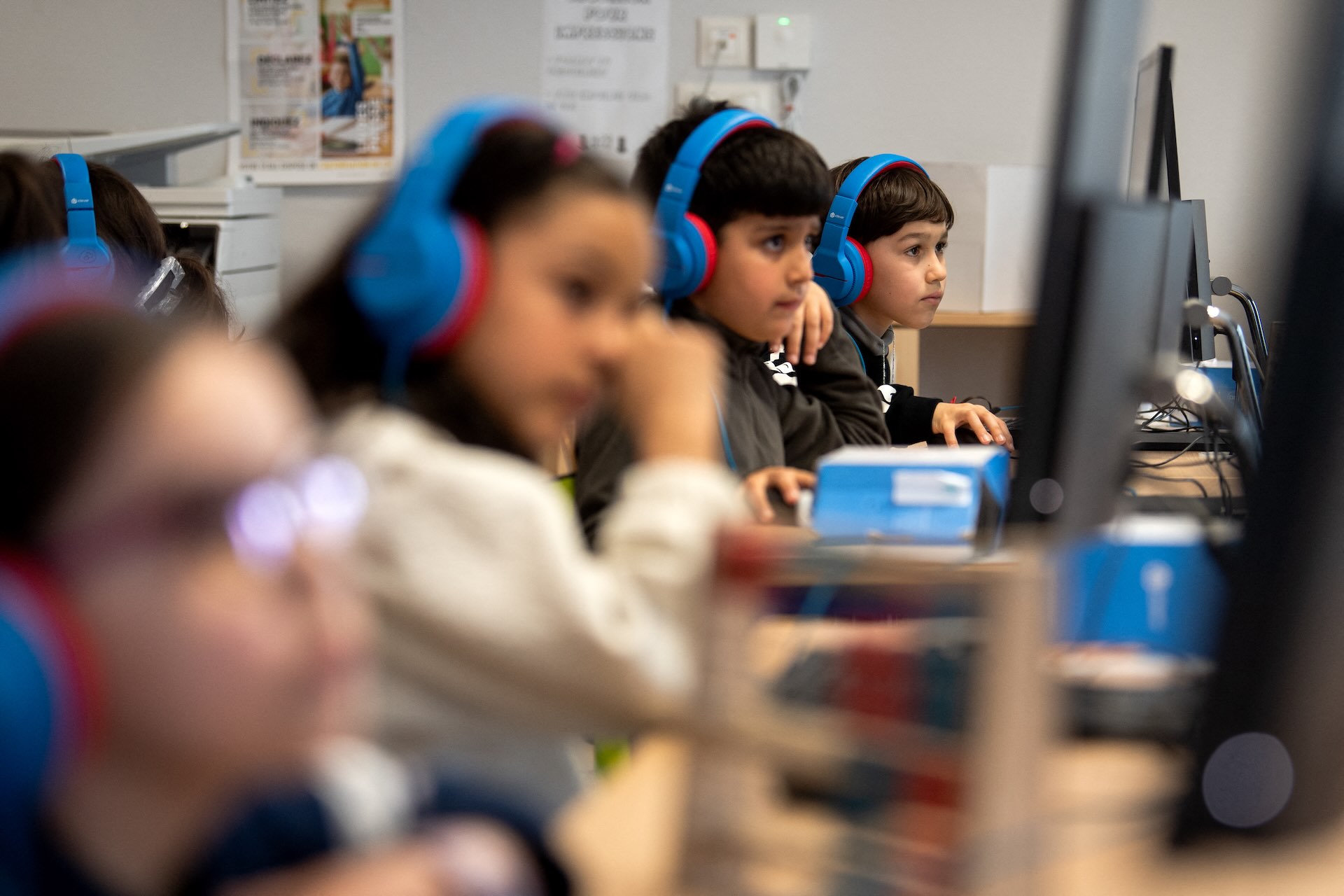
A row of school children at computers wearing brightly coloured headphones.
Children use artificial intelligence during a math lesson in France. Photo: Matthieu Rondel/Getty Images
Aug 31, 2026 | 5:45 AM ET
A A
A Small A Medium A Large
Share

Gift

Share

Listen Now
0:00

The Logic’s readers are split on whether artificial intelligence tools should be integrated into K-12 education in Canada, despite the majority agreeing that today’s students will need to use AI in the future. 

The federal government’s national AI strategy focuses on building an AI generation “from classrooms to careers.” To do this, the strategy backs AI literacy training programs, equipping students with the necessary tools to use AI ethically and responsibly in schools. To date, the federally backed Alberta Machine Intelligence Institute AI literacy program has reached around 60,000 K-12 students. 

Earlier this month, Google turned on its Gemini chatbot for some elementary and high school students using its Classroom app—a feature previously only available to students 18 and older.

Related Articles

A shot from above of five people clustered around a table, all working on near-identical laptop computers. Their computer bags lie on the floor and some are wearing yellow lanyards.

Most of you think AI will change your job, but not replace you

By Emma Buchanan

Fifty per cent of respondents to The Logic’s latest subscriber survey agreed that AI tools should be integrated into K-12 curricula, while 23 per cent did not agree with the tools being introduced. Roughly 27 per cent of readers said they were unsure. 

Most readers said they were greatly (30 per cent) or somewhat (42 per cent) comfortable with AI being used in K-12 classrooms, with the remainder of subscribers either unsure (six per cent) or not at all (22 per cent) comfortable with it. 
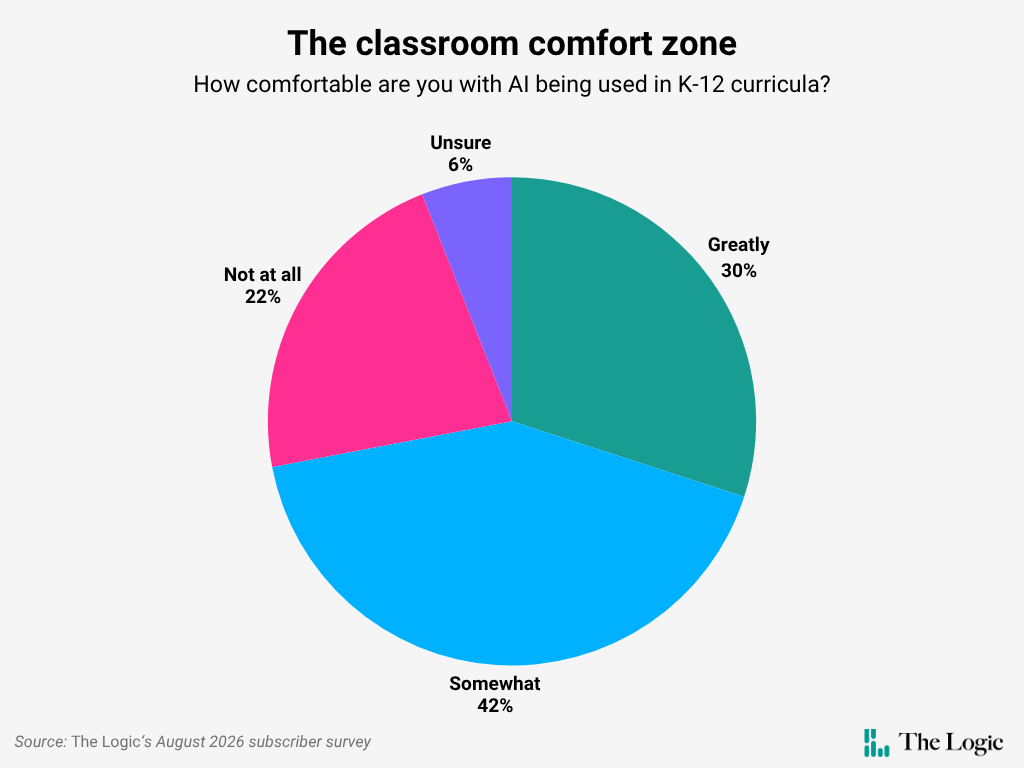
A pie chart depicting responses to the question, "How comfortable are you with AI being used in K-12 classrooms?" 42% said "somewhat," 30% said "greatly," 6% were unsure and 22% said "not at all."

Many readers said that while they agree AI tools should be incorporated into elementary and high school classrooms, it is a nuanced issue. “If used correctly, it can be a great individual learning tool,” wrote one reader. If not, said another reader, “it can quickly become a crutch for students.” 

Several readers said AI tools should be used to support learning, rather than serve as “a replacement for creative or critical thinking.” One reader wrote, “The goal of education is to teach someone how to learn—how to gather information, understand what is valuable versus what is noise and how to synthesize that into useful context.” Another said that while AI should be incorporated, students should still learn “how to do things the old-fashioned way,” referring to writing, grammar, math and research skills.  

Despite their hesitations, 70 per cent of respondents agreed that today’s K-12 students will need to use AI frequently in the future, with the remainder (roughly 30 per cent) saying students will need to use AI “sometimes.” No respondents said they were unsure or believed students will rarely need to use AI. 

“It’s an essential skill, just like using the internet,” wrote one reader. “Work professionals will use it. Might as well as get [students] up to speed, it’s here to stay,” said another.
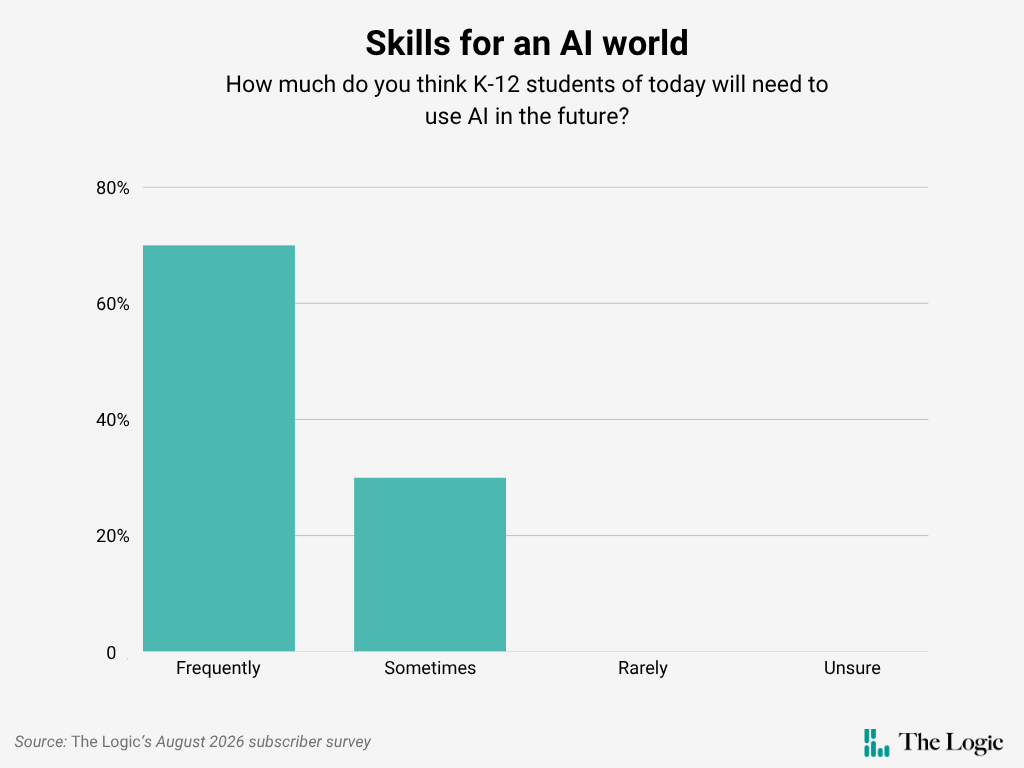
A pie chart depicting responses to the question, "How much do you think K-12 students of today will need to use AI in the future?" Roughly 70% said "frequently" and roughly 30% said "sometimes." "Rarely" and "unsure" received zero responses.

Some readers said AI has the potential to enhance learning, as long as it is not overly relied on. “Those who use it as a tool are learning and working more efficiently,” said one subscriber. Another said they encouraged “teaching responsible use early on, what AI can and cannot do, [and creating] standards for teaching AI in school.”  

The possibility that AI could impede critical thinking, stunt development of writing and literary skills, and lead to overreliance on the tech were the three most common concerns from readers, each cited as a worry by more than three-quarters of respondents. Fewer than half of readers (44 per cent) said they were concerned about cheating.
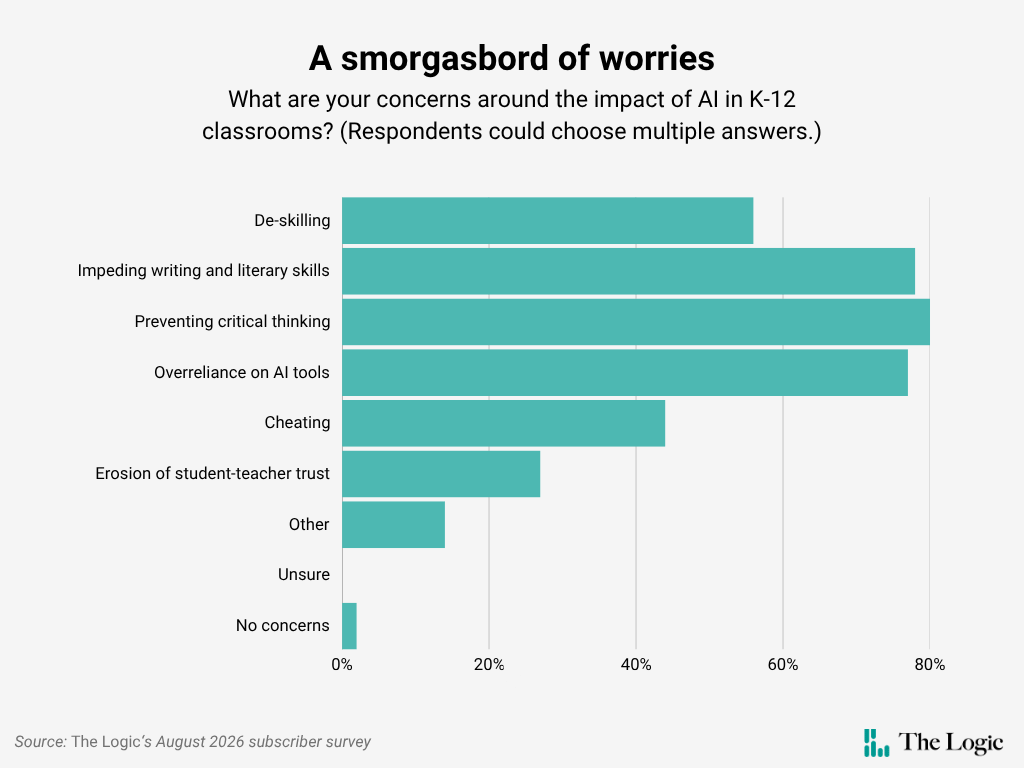
A row chart depicting responses to the question, "What are your concerns around the impact of AI in K-12 classrooms? (Respondents could choose multiple answers.)" The options depicted are de-skilling, impeding writing and literary skills, preventing critical thinking, overreliance on AI tools, cheating, erosion of student-teacher trust, other, unsure, and no concerns. Impeding writing and literary skills, preventing critical thinking and over reliance on AI tools each were selected by roughly two-thirds of respondents. De-skilling was selected by roughly 55% of respondents; cheating was selected by roughly 43% of respondents; erosion of student-teacher trust was selected by roughly 25% of respondents; other was selected by roughly 15% of respondents. No concerns was selected by roughly 5% of respondents, while unsure received zero responses.

“If the hard work of learning is avoided, then today’s kids will be permanently disadvantaged,” wrote one reader. “The reliance on AI is a worry to me, as during early education minds must be developed with human interactions,” another said. 

Gift the full article

One reader pointed to other growing challenges in K-12 education, such as rising absenteeism and teachers’ weakening authority. “AI will just amplify these problems and be the scapegoat for them,” they wrote. 

It’s too soon to tell how AI is affecting the quality of education in Canada, other subscribers wrote, and that more time, research and regulation are needed to avoid potential pitfalls. “There should be an evidence-based and well-researched national framework here,” one said. “Right now, AI has not been sufficiently designed, regulated or understood to be safely used” in classrooms, wrote another.  

#artificial intelligence #commentary #education #Subscriber Survey

Sponsored Content

How to shift your workforce from AI experimentation to adoption

By Jessica Aftimus Rosa

The real-world economic offshoots of sovereign AI

By Deborah Aarts
Illustration of a plane flying above a mailbox

Increasing healthcare access across Canada

By Deborah Aarts
Paid promotional content

Loading...

Thanks for sharing!

You have shared 5 articles this month and reached the maximum amount of shares available.

Close
This account has reached its share limit.

If you would like to purchase a sharing license please contact The Logic support at [email protected].

Close
Want to share this article?

Upgrade to all-access now

Close
Gift the full article!

You have gifted 0 article(s) this month and have 5 remaining.

Copy link and gift
Copy Link
Email to a friend
Send Email
Gift on Social Media

Recipients will be able to read the full text of the article after submitting their email address. They will not have access to other articles or subscriber benefits.

A row of school children at computers wearing brightly coloured headphones.

Photo: Matthieu Rondel/Getty Images

A pie chart depicting responses to the question, "How comfortable are you with AI being used in K-12 classrooms?" 42% said "somewhat," 30% said "greatly," 6% were unsure and 22% said "not at all."

A pie chart depicting responses to the question, "How much do you think K-12 students of today will need to use AI in the future?" Roughly 70% said "frequently" and roughly 30% said "sometimes." "Rarely" and "unsure" received zero responses.

A row chart depicting responses to the question, "What are your concerns around the impact of AI in K-12 classrooms? (Respondents could choose multiple answers.)" The options depicted are de-skilling, impeding writing and literary skills, preventing critical thinking, overreliance on AI tools, cheating, erosion of student-teacher trust, other, unsure, and no concerns. Impeding writing and literary skills, preventing critical thinking and over reliance on AI tools each were selected by roughly two-thirds of respondents. De-skilling was selected by roughly 55% of respondents; cheating was selected by roughly 43% of respondents; erosion of student-teacher trust was selected by roughly 25% of respondents; other was selected by roughly 15% of respondents. No concerns was selected by roughly 5% of respondents, while unsure received zero responses.

Most Popular This Week

Close-up of a red American roadside call box marked “Made in the U.S.A.,” with a blurred semi-truck approaching on Gordie Howe International Bridge.
News

U.S. industry leaders plead for truce as tariff fight escalates

By Anita Balakrishnan
Exterior of a University of Toronto building
News

Canadian universities are still struggling to commercialize their research, new data shows

By Catherine McIntyre
A head-on shot of Mark Carney at a lectern embossed with a maple leaf carved from wood. There is a row of Canadian flags behind him, and he's looking at the camera with a serious expression.
News

How Mark Carney plans to wage trade war against the United States

By Laura Osman and Murad Hemmadi
A shot from the bottom of a flight of red brick stairs of Dominic LeBlanc emerging from a building, with Janice Charette and Mark Wiseman in single file behind him.
News

Canada pulls out of trade talks at last moment, citing ‘unfair’ changes by U.S.

By Laura Osman

In-depth, agenda-setting reporting

Great journalism delivered straight to your inbox.

A row of school children at computers wearing brightly coloured headphones.
Subscriber Survey

Half of you think AI tools belong in the classroom

By Leila El Shennawy

Briefing

Canadian contractors brace for retaliatory duties on U.S. nuts and bolts

By Joanna Smith   |   Aug 28, 2026

Blue Owl leads deal to lend Iren US$2.4B to buy equipment for B.C. data centre

By Claire Brownell   |   Aug 28, 2026

Rare earth firm Cyclic Materials raises US$75M for U.S. expansion

By Anita Balakrishnan   |   Aug 28, 2026

Best business newsletter in Canada

Get up to speed in minutes with insights and analysis on the most important stories of the day, every weekday.

Exclusive events

See the bigger picture with reporters and industry experts in subscriber-exclusive events.

Membership in The Logic Council

Membership provides access to our popular Slack channel, participation in subscriber surveys and invitations to exclusive events with our journalists and special guests.

Recent Popular Stories

News

Canadian investors are dumping U.S. government debt for American corporate bonds

By Chaimae Chouiekh   |   Aug 24, 2026
An image of tall buildings against a cloudy blue sky.
News

Canada pulls out of trade talks at last moment, citing ‘unfair’ changes by U.S.

By Laura Osman   |   Aug 22, 2026
A shot from the bottom of a flight of red brick stairs of Dominic LeBlanc emerging from a building, with Janice Charette and Mark Wiseman in single file behind him.
News

How Mark Carney plans to wage trade war against the United States

By Laura Osman and Murad Hemmadi   |   Aug 22, 2026
A head-on shot of Mark Carney at a lectern embossed with a maple leaf carved from wood. There is a row of Canadian flags behind him, and he's looking at the camera with a serious expression.
News

Canadian universities are still struggling to commercialize their research, new data shows

By Catherine McIntyre   |   Aug 25, 2026
Exterior of a University of Toronto building
Commentary

Carmichael: America’s wobbly bonds are Canada’s advantage in the trade war. Here’s why

By Kevin Carmichael   |   Aug 24, 2026
A photo of Mark Carney on his way into a news conference, trailed by Dominic LeBlanc. There is a row of Canadian flags on stands behind the lectern Carney is approaching.
News

Thomson Reuters launches its own AI model to reduce reliance on big tech

By Anita Balakrishnan   |   Aug 24, 2026

Canada's most influential executives and policymakers are reading The Logic

  • CPP Investments
  • Sun Life Financial
  • C100
  • Amazon
  • Telus
  • Mastercard
  • bdc
  • Shopify
  • Rogers
  • RBC
  • General Motors
  • MaRS
  • Government of Canada
  • Uber
  • Loblaw Companies Limited
logic-logo

Canada's Business and Tech Newsroom

100% human-crafted journalism

Newsroom

  • News Tips
  • AI Policy
  • Editorial Disclosures
  • Story Pitches

Company

  • About Us
  • Terms of Service
  • Privacy Statement
  • Corporate Information

Contact

  • Contact Us
  • Advertise
  • FAQs
  • Work at The Logic

© 2026 The Logic Inc. All Rights Reserved.

Trusted by leaders

Error

Account creation failed.

Please email us at [email protected].

Create Account

[wppb-register form_name=”cozmo-registration-form-for-modal”]

I do have an account
Login
or

[wppb-login]

I don’t have an account