Commentary
Letter from the editor: Publishers’ fight with Big Tech shows the risk of giving away your most valuable asset
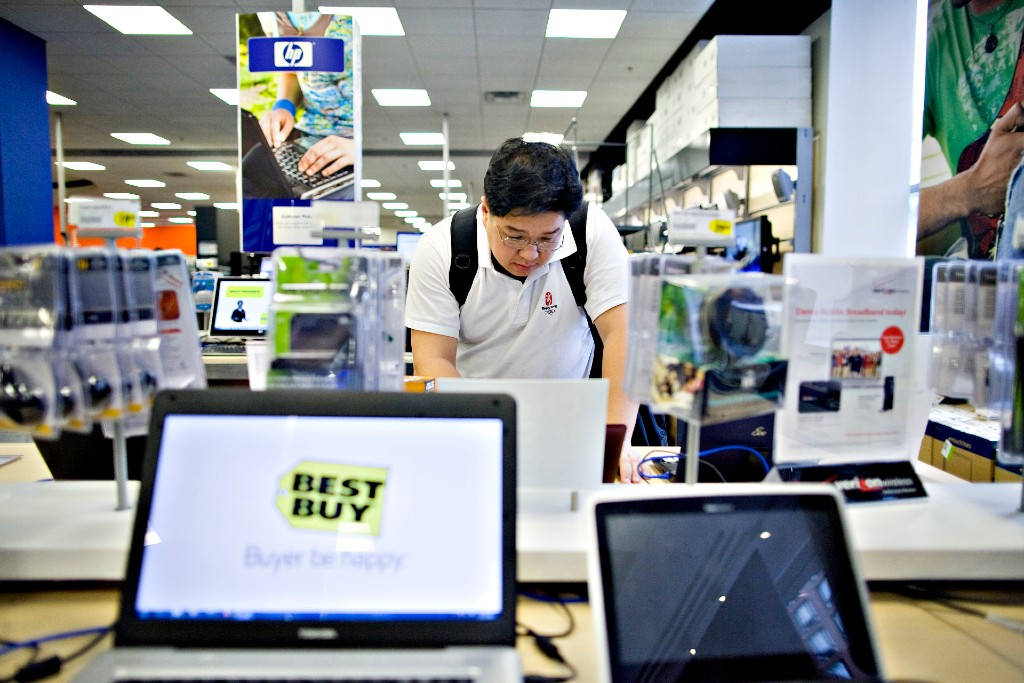
Keith Chan looks over an Asus Eee PC netbook at a Best Buy store in New York, U.S. in December 2009. Photo: Daniel Acker/Bloomberg via Getty Images
All the news about Facebook and publishers in Australia this week reminded me of a story the late Clayton M. Christensen shared with his students about Dell Computers, one he also wrote about in his book, How Will You Measure Your Life?
Michael Dell, you’ll recall, started the company from his University of Texas at Austin dorm room back in 1984, and over the years it moved upmarket from personal computer behemoth to microprocessing. The story Christensen used to tell begins with a Taiwan-based firm called AsusTek. Asus began its life making simple circuit boards, which it was very good at doing. Dell was its largest customer.
One day, Asus went to Dell with a proposal. “You know, Dell, we’ve been making these simple circuit boards for you, but we really know how to fabricate these things, so why don’t you let us take care of your motherboards, as well? We’ll guarantee you a 20 per cent reduction in cost.”
Dell considered the offer, thought long and hard with its analysts and decided it was a good deal. So, it agreed to let Asus take over its motherboard manufacturing.
A couple years later, Asus went back to Dell with another interesting proposal. “We know how to manufacture the motherboards and the simple circuit boards. Why don’t we take over your computer assembly?”
Dell’s analysts looked at it and said, “You know what? This is actually great for us. We won’t increase our revenue, but we’ll certainly increase our profitability, because we’ll be reducing a lot of the costs that go into making these computers.” For Asus, the deal was exciting because it could grow its margins and profit by moving upmarket into assembly.
A couple years later, Asus went back to Dell with yet another interesting proposal. (Have you heard this story before?) “You know, Dell, we do all this computer assembly, we do all of these motherboards, we do all these circuit boards—it makes sense for us to take care of the supply chain. It’s not really what you do—you’re a phenomenal brand, you have great value and prestige in the market. We can do all that other stuff for margins that are 20 per cent lower.”
So, predictably, Dell’s analysts looked at it and said, “Yes, thank you.” And Asus took over the supply chain and logistics.
A couple years later, Asus went back to Dell one last time with one more interesting proposal. “You know, Dell, you don’t need to be making these computers anymore at all. We guarantee that if you take all the chips, assembly, production and supply chain off your books, your return on assets will be fantastic.” (Of course, it didn’t mention that Dell’s return on assets would be fantastic because it wouldn’t have any more assets, but I digress).

Dell’s analysts looked at it and said, “Wow, another 20 per cent reduction in costs.” And agreed to the deal.
Dell saw a remarkable growth in profits as a result—the highest profits in the company’s history, in fact, because though its revenues hadn’t increased, it had wiped all that other stuff off its books.
A couple years later, Asus came back—but this time it didn’t go to Dell. It went to electronics retailer Best Buy, and said, “You know, you have all these computer manufacturers on your store shelves. You have Compaq, HP, you have Dell—well, what if we put your name on those computers, instead, and you were able to buy them for 20 per cent less than what you’re paying all those other brands?”
Of course, Best Buy loved it. And suddenly, Dell was completely out of the personal computer-manufacturing business.
Michael Dell would end up refuting Clay’s story, but his company was taken off the public market in 2013 in the largest leveraged buyout since the financial crisis. It would return nearly six years later, having transformed from a PC manufacturer into a broader seller of information-technology services.
I recounted this story, with Clay’s permission, at a journalism conference in Austin five years ago as a warning to publishers that if we continued to outsource our assets to tech platforms in an effort to reduce our costs, we could also end up like Dell.
On Wednesday, Facebook blocked news links from appearing in the feeds of Australian users. Almost immediately, publishers lost at least 20 per cent of their audience. Sound familiar?
If journalism’s original sin was giving away our work for free, then handing our users over to tech platforms comes a close second.

Building a direct relationship with our readers isn’t Facebook’s concern; it’s ours.
The most important asset this publication has is its direct relationship with you, our readers. That you are seeing my name in your inbox this morning is not something I take lightly. It is absolutely essential to The Logic’s business that we maintain your trust by giving you an outstanding product, great customer service and privacy protections. As an organization, we consider this relationship our most sacred.
Do we use tech platforms to get our stories in front of new readers? Absolutely. Just this week, we relaunched our Instagram. But most of our readers come to us directly; those who do come from social platforms like Facebook and LinkedIn predominantly come through our paid advertising campaigns.
If this all seems a little inside baseball, think again. Publishing has been at the tip of the spear for most of the disruption that’s taken place online over the past two decades. What happens to publishers first tends to happen to others later. Our relationship with tech platforms is a cautionary tale for all businesses and governments about outsourcing strategic assets in the intangibles economy.
One need look no further than Hootsuite, a once giant Canadian tech darling that—as our reporting first revealed back in 2018—had its entire business model upended when Facebook unilaterally changed its algorithm.
Or, perhaps more saliently, vaccine production. Have you heard of Connaught Laboratories? In 1955, the company’s innovative “Toronto Method” allowed for the mass production of polio vaccinations for 1.8 million children. The company was sold in 1972, eventually becoming part of the French Sanofi empire. Guess what happened when it came time to produce COVID-19 vaccines? Sanofi chose not to produce them in Canada. We had outsourced the one thing we as a country needed most.
Back to the Australian publishers’ dilemma: it turns out that Facebook isn’t entirely blocking them from the platform. News organizations can still have their content appear in news feeds, but now they have to pay for it—essentially buying back the audiences they once owned.
Be careful what you choose to outsource.
***
From scrappy business-news startup to scale-up and beyond, it was great to share The Logic’s story for the first time in Canadian media with The Peak. I hope you’ll give it a listen.



Loading...
Thanks for sharing!
You have shared 5 articles this month and reached the maximum amount of shares available.
CloseThis account has reached its share limit.
If you would like to purchase a sharing license please contact The Logic support at [email protected].
CloseGift the full article!
You have gifted 0 article(s) this month and have 5 remaining.
Recipients will be able to read the full text of the article after submitting their email address. They will not have access to other articles or subscriber benefits.