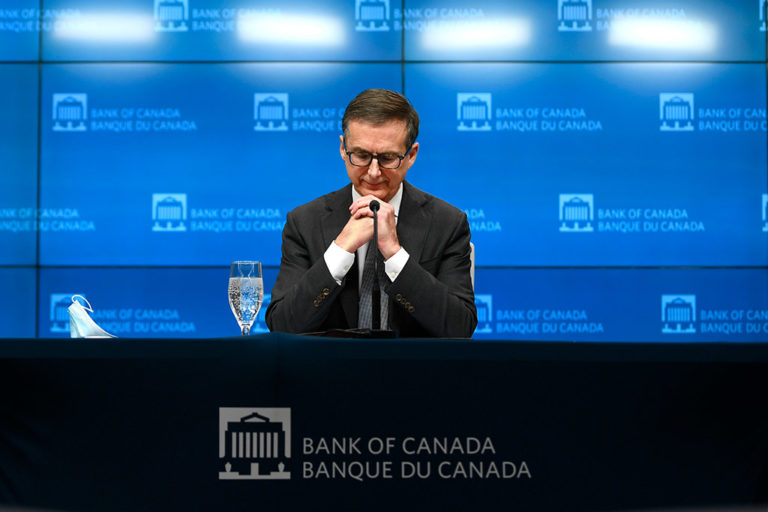
Bank of Canada governor Tiff Macklem is ready to talk about cutting interest rates.
Not ahead of the central bank’s next policy meeting in January, however. “It’s still too early to consider cutting our policy rate,” Macklem said in his year-end speech Friday. “Until we see evidence that we are clearly on a path back to two per cent inflation, I expect Governing Council will continue to debate whether monetary policy is restrictive enough and how long it needs to remain restrictive to restore price stability.”
But an interest-rate cut could be on the table in March, depending on how inflation evolves. “I expect 2024 to be a year of transition,” Macklem said. “Once Governing Council is assured that we are clearly on a path back to price stability, we will be considering whether we can lower our policy interest rate.”
It’s significant that Macklem is now openly entertaining the possibility of interest-rate cuts. He had been unwilling to go there, probably because he wanted to avoid raising expectations. The price of bonds and other financial assets that are linked to short-term borrowing costs imply that traders already are betting on cuts next year. On the margin, those bets make the Bank of Canada’s job harder because looser financial conditions could stoke demand and keep upward pressure on inflation.
So the governor’s willingness to allow talk of rate cuts into the conversation suggests a new level of confidence that the central bank will be able to bring inflation back to its target without causing a recession.
Macklem acknowledged that the next “two to three quarters” could feel like a recession for some people. He said the Bank of Canada expects growth will “remain weak into 2024.” Consumers likely will continue to hold back on spending and the labour fource will grow faster than employment, which will cause the unemployment rate to rise. But that’s what needed to happen to get inflation under control. Macklem noted that prices for durable goods such as furniture are now growing at an annualized rate of less than two per cent, and the cost of services excluding shelter is growing just a little faster than two per cent. “That’s pretty normal,” he said.
Maintaining normal doesn’t require a benchmark interest rate of five per cent. The Bank of Canada estimates that a neutral rate of interest—the rate that neither restrains growth nor stokes demand—is between two and three per cent. If inflation is beginning to normalize, then policymakers must pivot, as well. There’s some distance to travel to get back to a more neutral interest-rate setting.
Orchestrating the pivot will be a communications challenge for the Bank of Canada. Federal Reserve chair Jerome Powell excited markets on Wednesday by saying the Fed will consider interest-rate cuts next year; the following day, the European Central Bank and the Bank of England each said that they didn’t foresee cuts anytime soon. The major central banks responded to the post-pandemic inflation surge in much the same way, but their respective paths back to normal could vary. That’s a recipe for confusion.
Macklem appears to want to try to bridge the gap between hope and reality by asking the public to focus on the data. On Friday he opened the door to interest-rate cuts in 2024, but gave no hint on when that could happen. He said he still needs more evidence that inflation is on a sustainable downward track. “In a world with increased macroeconomic volatility, we are also conscious that we may need to be nimble, and we should be humble about our forecasts,” he said.
The governor did offer a hint on why he decided to start talking about rate cuts, though. He said a lesson of the last two years was one the central bank had to re-learn: inflation causes a lot of harm. “It harms Canadians and it harms the economy,” he said. “It makes people angry and it tears at the fabric of society.”
If that’s true, then it’s probably a good idea to offer people some hope as soon as reasonably possible.
Kevin Carmichael is The Logic’s economics columnist and editor-at-large. He has spent more than two decades covering economics, business and finance for outlets including Bloomberg News, The Globe and Mail and the Financial Post, where he also served as editor-in-chief.