As one rival emerges from bankruptcy and another targets its home market of Canada, Ottawa-based Telesat still believes its upcoming constellation of low-Earth orbit (LEO) satellites will prove a winner in the race to provide high-speed internet from space.
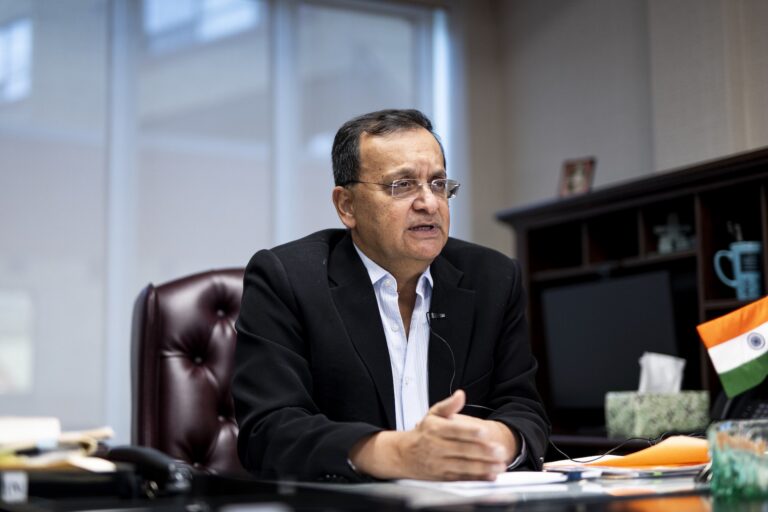
The firm has made “a huge amount of progress” on its technology and design over the last year, said Erwin Hudson, vice-president of Telesat LEO. He believes its long track record in the satellite market and conservative financial and technical approach will help make it a profitable operator. But one longtime space tech analyst says it’s not yet clear that there will be enough demand for LEO services to justify the billions of dollars companies are spending to launch their offerings.
Talking Point
Telesat isn’t worried about the competition to deliver services like high-speed broadband via new low-Earth orbit (LEO) satellites, despite reportedly failing in a bid for bankrupt rival OneWeb as SpaceX’s Starlink targeting its home market of Canada. The Ottawa-based firm continues to develop its design and technology ahead of a major decision on a manufacturer for its constellation. But a longtime aerospace analyst says the LEO market remains unproven, and not all of the new entrants will survive.
Telesat currently has 16 traditional geostationary satellites 36,000 kilometres above the planet’s surface. The firm’s LEO constellation—78 going from pole to pole and 220 covering the most heavily populated areas around the midsection—will orbit at 1,000 kilometres, substantially reducing the time a transmission takes to get there and back.
The setup will allow the firm to “provide terabytes of bandwidth [and a] very high quality of service approaching fiber-like performance, with full global coverage … at a price point that’s truly competitive with all the other alternatives,” Hudson said. Telesat will wholesale broadband to wireless carriers and internet service providers (ISPs) around the world, which will in turn sell to consumers and businesses. Airlines and fleet operators can use the service for mid-journey connectivity, while militaries can link to drones and remote deployments.
Other companies are also working on LEO constellations. London-based OneWeb has already launched 74 of the 650 satellites in its first phase. SpaceX added 58 satellites to its Starlink constellation in June for a total of 538; it has sought regulatory permission for up to 42,000 satellites. Amazon’s Project Kuiper includes 3,236.
Telesat launched the first—and so far only—satellite in its LEO constellation in January 2018. “Some of these potential competitors to our system have greater access to capital than we have and/or may be at a more advanced stage of development,” states the company’s 2019 annual report filed with the U.S. Securities and Exchange Commission. It notes that SpaceX and Amazon have greater financial resources than it, and that SpaceX and OneWeb have more aggressive launch timelines.
Being first and having more satellites aren’t insurmountable advantages, according to Hudson. OneWeb took the approach of having a “large number of very simple satellites, and I think they found that they couldn’t provide what the customers are really looking for,” he said. “They didn’t have the full global coverage, the inter-satellite links [and] the high data rates that we can offer.” Telesat is focusing on more sophisticated, powerful satellites, he said.
In March, OneWeb filed for bankruptcy after failing to secure up to US$2 billion in new funding; it had previously raised US$3.4 billion. Last week, the U.K. government and Indian telecom firm Bharti Enterprises won an auction for control of the startup, beating a reported Telesat bid. Hudson declined to comment.
Telesat, which is owned by New York-based holding company Loral Space & Communications and Canada’s Public Sector Pension Investment Board, has its own government backer for its LEO project. In July 2019, Ottawa awarded it $85 million from the Strategic Innovation Fund toward a $480-million effort to develop components for the constellation. Since then, the firm has been working on the laser technology that will connect each satellite to the four around it, onboard processors that will route data in space and antennas to precisely target equipment on the ground. It has “spent well over $100 million in R&D” over the last year and “hired at least 50 people” in engineering, software development and networking in the past six months, Hudson said.
The company plans to choose a satellite manufacturer for the LEO constellation in “the next few months,” according to Hudson. “Once we sign our contracts, we’re pretty much ready to begin satellite manufacturing right away, because the design phase is largely done,” he said, noting that a typical project would involve at least a year of lead time prior to production.
Last year, Telesat CEO Dan Goldberg said the firm planned to offer service in Canada’s far North in 2022, and would have Canada-wide coverage by mid-2023. “There’s always schedule challenges when you’re trying to do something [this] big and complex, but we’re largely on track,” Hudson told The Logic.
OneWeb previously promised service in Canada by late 2020 or early 2021. The company declined an interview with The Logic about its plans for the country following its bankruptcy. Starlink is “targeting service in the Northern U.S. and Canada in 2020,” and SpaceX recently applied to the Canadian Radio-television and Telecommunications Commission (CRTC) to carry international telecommunications traffic; unlike OneWeb and Telesat, it doesn’t yet have the necessary licence to deliver broadband.
“We don’t fear the competition,” said Hudson. “It reinforces that there’s a huge demand for the broadband services that a LEO constellation can offer.” Morgan Stanley estimates the space-delivered consumer broadband market will be worth US$95 billion in 2040, with an additional US$412 billion spent on other internet services.
But that’s decades away. Sash Tusa, an aerospace and defence analyst with London-based Agency Partners, says all these companies are competing for what’s currently a very small market. “Demand is much harder to stimulate than I think most [LEO projects’] business models expect,” he said, adding that the market is also fragmented. “Most of these constellations need refinancing—they don’t survive the first financial crisis they meet.”
Many advanced economies are well-served by existing satellite and terrestrial technology, according to Tusa. “In North America, you have the tyranny of distance that we don’t have in Europe,” Tusa said. “But fixed-line services are incredibly good, and fibre-optic cable is a powerful barrier to entry.”
Rural and remote communities in Canada face slower and choppier connections—only 40.8 per cent of such households and just 31.3 per cent on First Nations reserves could get service at the CRTC’s speed targets in 2018. Ottawa has also signed a $600-million deal with Telesat for access to its LEO constellation to help close some of those gaps. The company also has relationships with ISPs like Bell Canada and Xplornet for its existing geostationary satellites.
Telesat has worked with existing customers to show off the capabilities of its first LEO satellite. “We expect that people will be keen and enthusiastic to transition … as soon as these services become available,” said Hudson. It’s also ensured new ground equipment, such as antennae installed over the last two years, will be compatible with the new constellation. Tusa said ISPs in particular don’t want to pay a lot for new technology to connect to the LEO satellites, and “will go to the cheapest provider of bandwidth that provides the coverage they want.”
Telesat has a long record as a profitable geostationary satellite operator, and a “large family of customers” eager to buy its LEO services, according to Hudson. “We’ll build a really good business around it.”