Crypto had a rough weekend. On Sunday, the U.S. Treasury Department announced the closure of New York City-based Signature Bank, bringing the crypto industry closer to being effectively cut off from that country’s banking system. And until it regained its dollar peg on Monday, the fate of USDC, a stablecoin that’s systemically important to parts of the crypto ecosystem, appeared to be in jeopardy. What does it mean, and how will it affect Canada’s crypto sector? Here’s what you need to know.
Skip to content
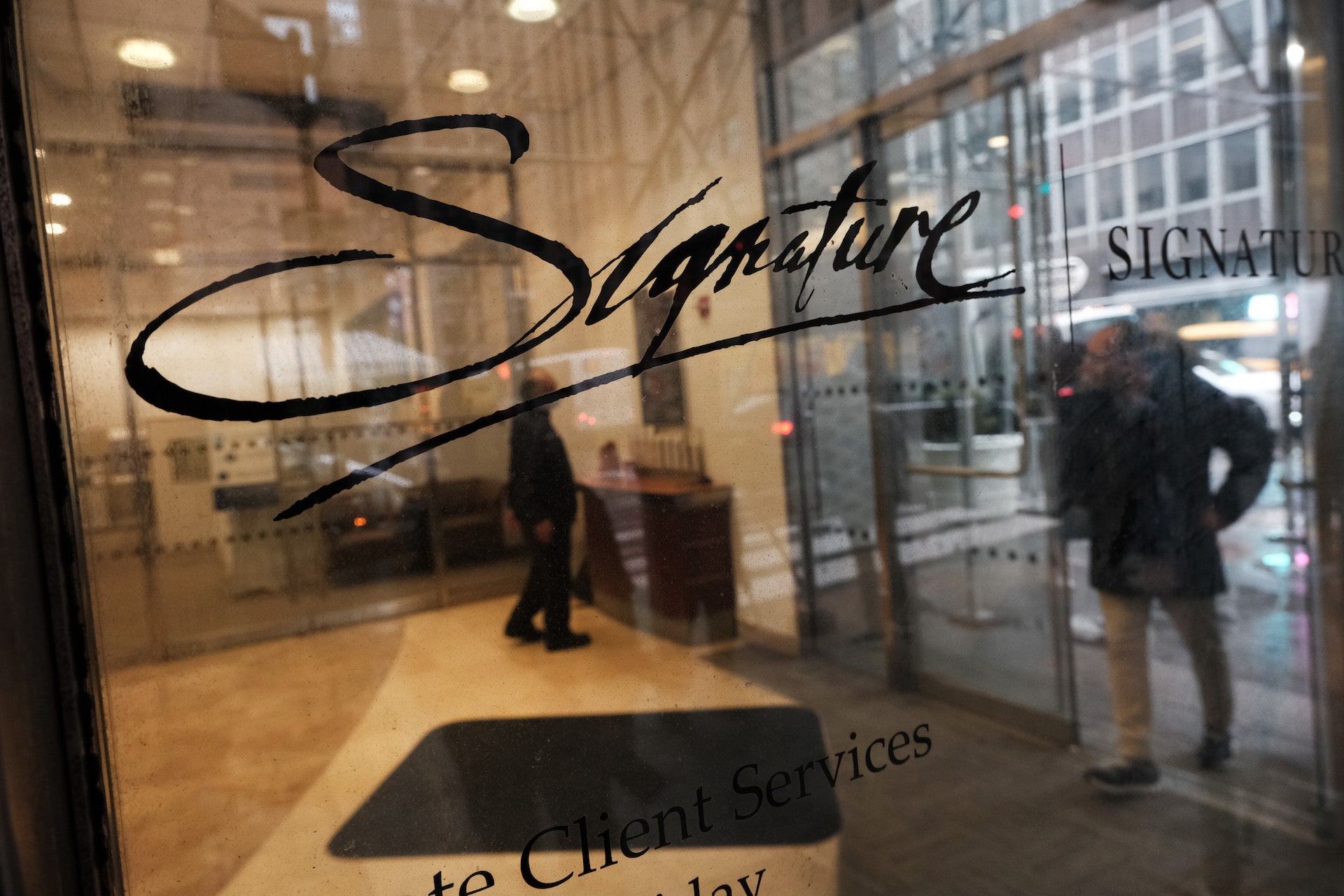 A Signature Bank branch in New York on March 13, 2023. The bank was closed by the state’s Department of Financial Services just a day earlier. Photo: Getty Images/Spencer Platt

News
Canada’s crypto sector watches warily as U.S. woes deepen
Limited banking and stablecoin options in Canada increase risk, industry warns
A Signature Bank branch in New York on March 13, 2023. The bank was closed by the state’s Department of Financial Services just a day earlier. Photo: Getty Images/Spencer Platt
Crypto had a rough weekend. On Sunday, the U.S. Treasury Department announced the closure of New York City-based Signature Bank, bringing the crypto industry closer to being effectively cut off from that country’s banking system. And until it regained its dollar peg on Monday, the fate of USDC, a stablecoin that’s systemically important to parts of the crypto ecosystem, appeared to be in jeopardy. What does it mean, and how will it affect Canada’s crypto sector? Here’s what you need to know.
What happened to Signature?: Signature’s shutdown comes on the heels of the closure of Silvergate and Silicon Valley Bank last week, two other relatively crypto-friendly financial institutions. It’s unclear exactly why regulators targeted Signature, but the bank had a mostly uninsured deposit base, which may have attracted the attention of officials looking to stave off contagion from the collapse of SVB. It also experienced a high volume of outflows on Friday, Bloomberg reported, citing a source.
Talking Points
- Crypto is getting closer to being cut off from the U.S. banking system, following the collapses of Silvergate Bank, Silicon Valley Bank and Signature Bank
- USDC, a systemically important stablecoin that is also effectively the only one Canadian platforms can offer to stay on the good side of regulators, came close to suffering a bank run of its own over the weekend
Depositors won’t lose their money, but Signature and Silvergate were very important to the crypto industry. Both institutions supported liquidity in crypto markets by offering payment systems that gave market makers the ability to shift funds between crypto and fiat currencies around the clock. The industry hasn’t been entirely de-banked, but it’s getting closer. Some think that’s a deliberate action by regulators and government officials who are concerned about crypto’s systemic risks to the financial system.
What happened to USDC?: USDC is a stablecoin, a digital asset with a value pegged to a government-issued currency, usually the U.S. dollar. Stablecoins are the grease that lets the gears of the crypto sector turn. When someone buys a crypto asset on a cryptocurrency-trading platform, a stablecoin typically serves as a bridge, making it possible to trade between various tokens. USDC plays an important role in decentralized finance, or DeFi, a form of blockchain-powered software that replicates elements of the financial system for crypto assets.
Over the weekend, USDC fell in value after holders rushed to redeem their tokens upon learning Circle, the company that issues it, kept funds at SVB. After regulators announced Sunday that SVB’s uninsured depositors would regain access to their funds, the value of USDC returned to US$1.
Related Articles


How do the collapses of Silvergate, SVB and Signature affect Canada?: Some Canadian crypto companies used those banks to do business in the U.S. Toronto-based crypto lender Ledn, for example, disclosed Sunday that it used Signature for banking and payments. Vancouver-based BIGG Digital Assets and WonderFi, which own crypto-trading platforms, said Friday they have no exposure to Silvergate or SVB.
But Canada has a similar problem with limited access to banking services for crypto companies, said Morva Rohani, executive director of the Canadian Web3 Council, in an interview with The Logic. She said cannabis companies have also struggled to gain access to Canadian banking. Rohani said she doesn’t think the problem for crypto is stigma. “They’re just not seeing the opportunity with the industry and they don’t want to take the risk,” she said.
How does USDC’s wobble affect Canada?: USDC is effectively the only stablecoin Canadian crypto platforms can offer if they want to stay on the good side of regulators, Rohani said. Some Canadian crypto platforms are explicitly barred from listing Tether, which has a history of controversy, in the regulatory orders granting them restricted dealer status; Crypto.com delisted it voluntarily at the behest of regulators. In guidance issued in February, the Canadian Securities Administrators, an umbrella organization of provincial regulators, reaffirmed their position that stablecoins may be securities and specifically barred platforms from offering algorithmic stablecoins, whose value is maintained by software rather than being backed by real-world assets.
That leaves Canadian crypto companies and their customers vulnerable if USDC runs into problems. Ledn, whose chief strategy officer Mauricio Di Bartolomeo did not provide comment in response to a request from The Logic, temporarily paused loan repayments in USDC over the weekend. In an email, Rohani said the restriction may also drive Canadians to unregistered offshore platforms.
What’s next: It depends. The fact that U.S. regulators have stepped in to make depositors whole at the failed banks has likely staved off an immediate crisis in crypto and the broader tech and banking sectors. Bitcoin, of course, was designed to make banks obsolete and some of its most ardent supporters would be content to let the system burn. But since Bitcoin and other cryptocurrencies still aren’t widely accepted for payments, the sector needs access to government-issued currencies—and therefore, the banking system—to survive. “We are still assessing the full impact of this,” Rohani said in an email.
Loading...
Thanks for sharing!
You have shared 5 articles this month and reached the maximum amount of shares available.
CloseThis account has reached its share limit.
If you would like to purchase a sharing license please contact The Logic support at [email protected].
CloseGift the full article!
You have gifted 0 article(s) this month and have 5 remaining.
Recipients will be able to read the full text of the article after submitting their email address. They will not have access to other articles or subscriber benefits.
Photo: Getty Images/Spencer Platt
Most Popular This Week




In-depth, agenda-setting reporting
Great journalism delivered straight to your inbox.
The Big Read
The small team in Montreal trying to save the world from AI
Briefing
First Quantum said to consider selling stake in Argentina mine
Sagard’s private credit fund raises US$1B
Electrovaya shares surge after striking major deal with Amazon
Best business newsletter in Canada
Get up to speed in minutes with insights and analysis on the most important stories of the day, every weekday.
Exclusive events
See the bigger picture with reporters and industry experts in subscriber-exclusive events.
Membership in The Logic Council
Membership provides access to our popular Slack channel, participation in subscriber surveys and invitations to exclusive events with our journalists and special guests.