Listen Now
0:00
In Canada, AI isn’t the only boom in town. Across the country, demand for skilled labour is soaring as everyone from property magnates to pipeline developers, mining firms and technology companies rush to secure the skilled workers needed to build projects big and small.
At stake is the country’s fate in the AI era, but also the viability of scores of ambitious nation-building projects. And there’s one thing that can hold it all back: a shortage of plumbers and electricians.
Talking Points
- Canada’s AI boom is creating new competition for skilled trades workers just as governments and companies push to build housing, energy infrastructure and other industrial megaprojects across the country
- Data-centre developers are partnering with unions and technical colleges to train and recruit workers amid growing concern Canada may not have enough tradespeople to build everything it wants to
Data centres are one of the biggest new pressures on Canada’s labour market, with the scale of construction ahead staggering. There are dozens of facilities being built or slated for development across the country. Some span over a million square feet, roughly the size of 17 football fields. Building a single data centre can require well over 1,000 workers, many of them needing specialized skills in building, insulating, cooling and securing these high-tech facilities.
Yet, as demand for data centres soars, it’s not clear there will be enough workers available to build them. Elsewhere, there’s a scramble to hire skilled tradespeople to build all manner of major infrastructure—from housing to pipelines to warships—at a scale not seen in Canada for generations. Economists, labour groups and industry leaders warn the AI buildout risks making the anticipated labour shortage in the coming years even worse. “If we don’t prepare for that, it will be a major issue,” said Benjamin Tal, deputy chief economist at CIBC Capital Markets.
Companies and governments are trying to get ahead of the labour crunch, investing billions of dollars to retrain workers for in-demand jobs and encourage more people to enter the trades. Tal said the initiatives don’t go far enough and could lead to major bottlenecks in building data centres and other infrastructure projects. “We have to do more… to encourage people to go into trades,” he said.
Related Articles


Those paying close attention have been worried about Canada’s labour shortage for years. “It’s not a new issue. It’s just gotten bigger and bigger,” said Todd Coleman, president and CEO of Montreal-based data-centre company eStruxture. The company started building data centres in Quebec in 2017, initially to serve growing demand from cloud providers. As that market expanded, eStruxture moved into Western Canada in 2022, where many of the country’s largest data-centre projects are now taking shape. The AI boom has only accelerated demand for even larger facilities and the workers needed to build them.
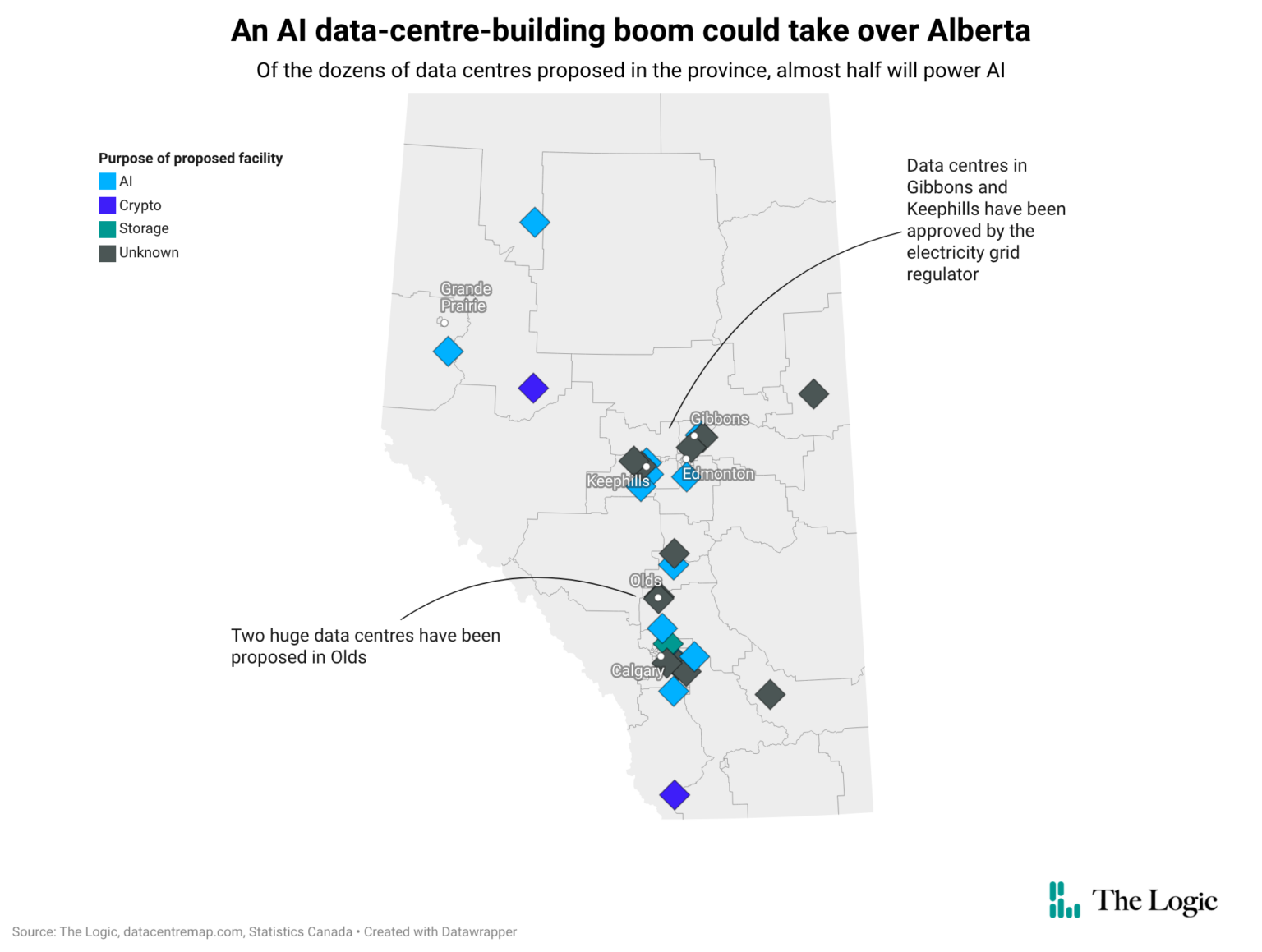
The move presented a challenge. While Alberta has an abundance of energy, it didn’t have an abundance of construction workers, Coleman said. And of the workers it does have, Coleman added, few were familiar with the nuances of building a data centre. To bridge the gap, eStruxture relocated workers from Quebec to help train and reskill the local workforce. Some of those workers have stayed in Alberta permanently, said Coleman, lured in by the promise of good work for years. The company now has two data centres in Alberta and another under construction, all clustered near Calgary. It’s building another outside Vancouver, said Coleman, with more facilities planned.
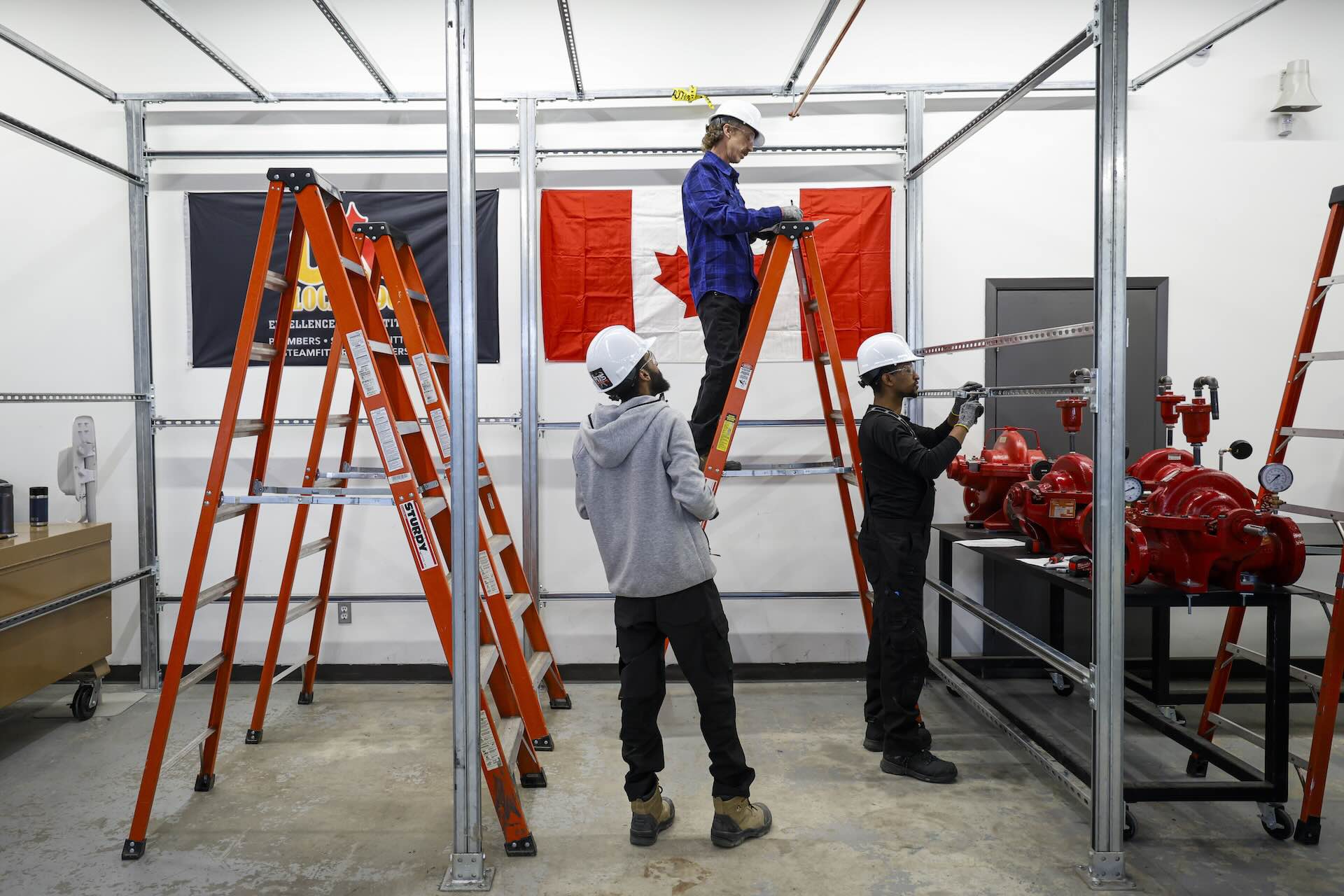
While the workers from Quebec helped, eStruxture knew it needed to do more to fuel its expansion. The company began working more closely with local trade colleges to help shape curriculums and connect students with contractors working on data-centre projects in Alberta. “It’s forced companies like ours to go get creative on how we look for, attract and train new skilled labour,” Coleman said.
At the Northern Alberta Institute of Technology in Edmonton, instructors are working with eStruxture and other data-centre operators and builders to create relevant course materials in the hope that the AI boom will create plentiful work for apprentices when they enter the job market.
Collaborating with colleges is just one way data-centre developers are shoring up their workforces. Some of the world’s largest technology companies are also building relationships with labour unions and construction firms as they prepare for a prolonged wave of AI-related construction.
Microsoft—which has three AI data centres at various stages of development in the Greater Toronto Area—is working with North America’s Building Trades Unions (NABTU) to develop AI and data-centre training for apprentices in the U.S. and Canada. The partnership is meant to both help workers understand how to use AI on the job and to prepare more tradespeople to work on the wave of planned data-centre projects.
“They create wonderful jobs, but these are wonderful jobs that are in demand,” Matthew Milton, president of Microsoft Canada, said of the work on the company’s data-centre construction sites. “We rely on trades developing more people, certifying more people, apprenticing more people, so that we can continue to build,” he said.
The partnership with NABTU gives Microsoft access to a large, organized labour force at a moment when competition for skilled trades workers is intensifying. NABTU represents more than three million workers across unions spanning electrical work, plumbing and pipefitting, sheet metal, insulation, roofing, cement finishing and other trades critical to data-centre construction.
Tom Kriger, a NABTU director who works on education and workforce development, said member unions are increasingly integrating data-centre-specific material into training as the facilities take up a larger share of construction demand. He recently heard from an apprentice in plumbing and pipefitting who had worked on five data centres during her five-year training program—a sign, he believes, of how deeply the projects are shaping the construction market.
Telecom giant Bell, meanwhile, recently struck a long-term partnership with Mississauga, Ont.-based Bird Construction, starting with its 300-megawatt data centre being built in Sherwood, Sask. The project, which is expected to host AI compute firms Cerebras and CoreWeave, will be what the company is calling the largest AI infrastructure development in Canada and will require at least 800 people to build. Bird saw its stock jump 14 per cent on the partnership news.
Labour groups say the influx of data-centre work comes as a relief, with some regions experiencing a lull in construction work right now. “For the first time, developers are telling me the trades are calling them for jobs,” said Tal. Right now, that’s good news for companies building data centres—but, he added, it also masks the severity of a looming worker shortage.

Such a lull is unlikely to last. Canada’s construction workforce is currently shrinking. Statistics Canada data shows the construction sector had 21,500 fewer employed workers in April 2026 compared to a year earlier, a 1.3 per cent decline. There were just 31,915 open construction positions in February 2026, down from 50,260 two years earlier. Over the same period, the job vacancy rate fell from 4.5 per cent to 2.8 per cent.
Tal blamed the slowdown on problems in the housing market and on the lag between major infrastructure projects being announced and construction starting. That lag will soon become a spike, and it remains to be seen if Canada will have enough well-trained hands to build what it wants to build when demand ramps up. Tal estimates the country has about two years before the labour market tightens again, as housing development recovers and governments accelerate infrastructure spending tied to energy, industrial policy and defence. “The demand for skilled labour will be there,” he said. “It will be competing with the infrastructure projects, and that would be a major issue slowing down the process of investment.”
Seemingly recognizing that looming gap, the federal government is spending big to prepare for the construction boom. In April, Ottawa announced $6 billion over five years to train, recruit and hire new trades workers. The initiative is also aiming to cut the time it takes to become Red Seal certified—which now typically takes between two to five years—in half.
Noel Baldwin, executive director at the Future Skills Centre, said those efforts will only begin to address the anticipated labour shortage. A 2025 Deloitte report found Canada will need about half a million more skilled trades workers by 2030. That’s not counting the 270,000 construction workers expected to retire by 2034. The government itself, meanwhile, pegs the shortage at about 1.4 million workers by 2033.
Baldwin said filling the gap will likely require construction firms and governments to draw more heavily from groups historically underrepresented in the skilled trades, including women, immigrants and racialized workers. “We have to think about how to bring as many people into this space as possible,” he said.
Tal agreed that Canada will need to rethink how it recruits and supports skilled trades workers if it hopes to meet its building ambitions. He said Ottawa could adjust the immigration point system to give more priority to applicants with trade skills, and employers could, for example, offer daycare services to draw more women to construction jobs.

There are signs that interest in trades careers is picking up. At the Northern Alberta Institute of Technology in Edmonton, the dean of the school of construction and building sciences Matthew Lindberg-Fowlow said student demographics have changed in recent years. Five years ago, most of the school’s apprentices were in their mid-twenties or thirties, often getting training to switch careers. Today, he said, many are arriving earlier, some straight out of high school.
Travis Merrett, a union representative for the International Brotherhood of Electrical Workers in Mississauga, Ont., said he’s starting to see a change in how younger people view trades work, after years of policymakers and high school counsellors overwhelmingly steering students toward university degrees and office jobs. “It’s no longer second tier. It’s being offered as a comparable choice for education,” he said.
Merrett said expanding the workforce, however, remains a balancing act. The apprenticeship model depends on there being enough stable work to offer trainees years of on-the-job experience just to get certified. In the past, uncertain construction plans made it hard to forecast how many electricians to train. That, said Merrett, is starting to change, as clearer signals from government and industry about long-term infrastructure plans give labour groups more confidence to take in more apprentices.
Terry Parker, executive director of Building Trades of Alberta, a union association, said the challenge—beyond training more workers—is getting the timing right. Governments, industry and labour groups need to carefully co-ordinate projects so workers are neither waiting to break ground nor scrambling to meet the demand for their labour when it inevitably spikes, Parker added. “If the major projects all start happening at once,” he said, “we’re not going to be able to pull the amount of labour from across the country.”