Listen Now
0:00
MONTREAL — Outwardly, the Liberal convention held this past week was a picture of giddy triumphalism, complete with silly suits, piles of swag and a notable turncoat in former Conservative MP Marilyn Gladu, near-giddy herself as she strutted through the Palais des congrès in a red cardigan.
A gander at the party’s proposed resolutions is a better gauge of what’s on the government’s mind beyond slow-rolling its own majority into existence. Two proposed resolutions stood out, if only because they best addressed a preoccupation in the country in general—and in Quebec in particular: mitigating the effects of social media and AI on children and youth.
Related Articles

The first resolution calls on the government to enact a blanket ban on the use of AI chatbots for anyone under the age of 16. The other proposes a similar ban on social media, as well as to compel the government to effectively regulate social media platforms based on their safety and privacy features and their ability to remove deepfake images of non-consenting individuals.
On Saturday, party faithful voted in favour of both resolutions, setting the table for stringent bans on AI and social media use in Canada. The results are non-binding, meaning the Liberal government could duly ignore both resolutions. Yet, right now, that seems unlikely.
That the Liberal Party’s Quebec wing put forward the AI chatbot ban and co-sponsored the social media resolution is no coincidence. The country as a whole has a wary take on both AI itself and the predominantly American companies peddling it. Canadians are also among the least excited and most nervous about the technology. Their trust in the ability of major tech firms to keep their data safe and root out disinformation is among the lowest in the world, according to a 2024 Ipsos AI Monitor survey of 32 countries.
Quebec is arguably ground zero for all this malaise. It’s home to Yoshua Bengio, noted AI godfather and staunch critic of its unbridled commercialization and apparent guardrail-free progress. As for social media, in May 2025, an all-party provincial government commission called on Quebec’s government to regulate online influencers and restrict social media use for anyone under the age of 14.
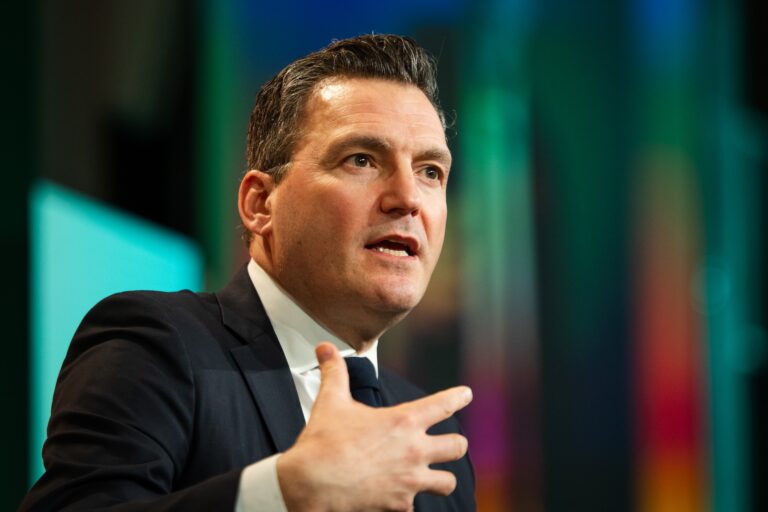
The federal government has promised to release its AI strategy in the next couple of weeks, AI Minister Evan Solomon’s office told me. Solomon himself wouldn’t divulge much regarding potential regulations on AI and social media when I spoke to him at the convention, though there were a few tells as to which way the government is leaning.
“I’ve had two kids that are past that age,” Solomon said before the resolution vote on potential age limits on AI and social media. “The cost of social media on their generation has been real, and for all the innovations that are technically there, there’s been a lot of harm. When we take consultation, it’s like an 80-20 thing. People want to put some guardrails around that.”
Another tell: The extent to which Solomon name-checks Bengio when speaking about AI regulation. “We are working really closely with Yoshua Bengio,” he said. The government has “invested heavily” in LawZero, Solomon said of Bengio’s startup that aims to finance and build safe-by-design AI systems. The AI minister also did a panel with Bengio, who was given a prime speaking spot at the convention.
Is this just lip service to one of the world’s most recognizable figures in AI? Perhaps. In the same breath, Solomon stressed the need for a “pragmatic balance” on AI and social media regulation, somewhere between the free-for-all espoused by the U.S. and the European Union’s heavy legislative hand. It remains, though, that in associating its AI policy with one of the sector’s most prominent critics, the Liberal party under Mark Carney is telegraphing a message to the country and beyond: get ready for guardrails, kids.
Martin Patriquin is The Logic’s Quebec correspondent. He joined in 2019 after 10 years as Quebec bureau chief for Maclean’s. A National Magazine Award and SABEW winner, he has written for The New York Times, The Guardian, The Walrus, Vice, BuzzFeed and The Globe and Mail, among others. He is also a panellist on CBC’s “Power & Politics.”