Like so many things in 2020, Canadian venture capital activity didn’t pan out as expected.
When lockdowns swept the country in mid-March, venture-backed companies braced for investors to lock their coffers. Instead, government programs designed to buoy the economy helped push local capital into private Canadian firms at record levels—at least initially. By mid-year, private spending began to slow, falling 11 per cent below 2019 levels in the first nine months of 2020. Meanwhile, south of the border, an onslaught of tech companies were reaching record valuations or listing on public exchanges, offering sky-high returns—including for some Canadian investors.
Here’s a look at the highlights for Canadian VCs amid the chaos of 2020.
Talking Point
Canada’s venture capital industry saw an uptick in health and pharmaceutical deals in 2020, while the retail sector dipped, reflecting pandemic-driven changes to the economy. After a tumultuous year, The Logic looked at the most active firms, including which ones cashed in on big exits and which ones made new bets.
The most active
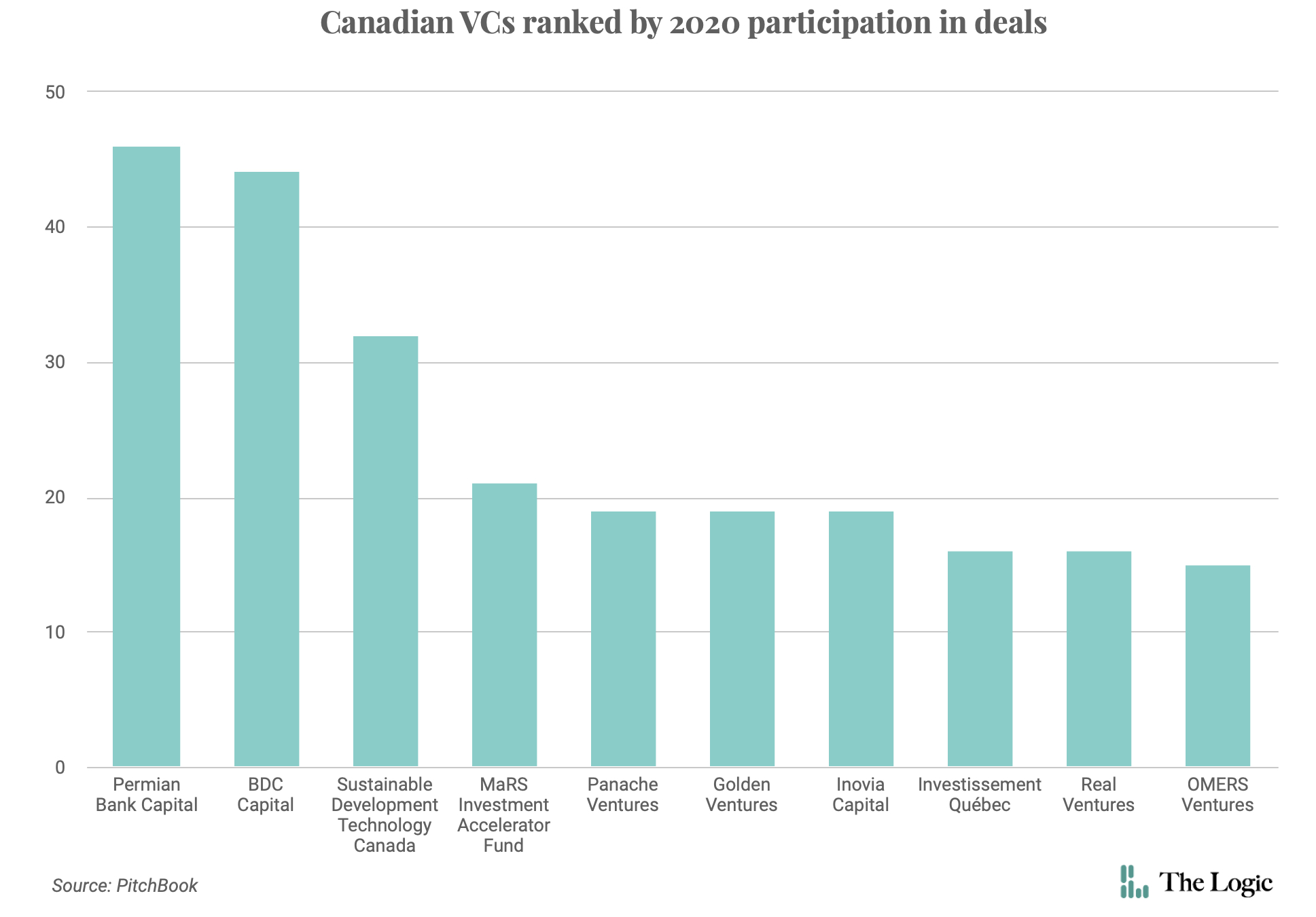
Permian Bank Capital, a relatively reclusive private equity and venture capital fund based in Toronto, was the most active Canadian VC in 2020, its participation in deals outpacing much larger VCs like BDC Capital and OMERS Ventures, according to data PitchBook provided to The Logic.
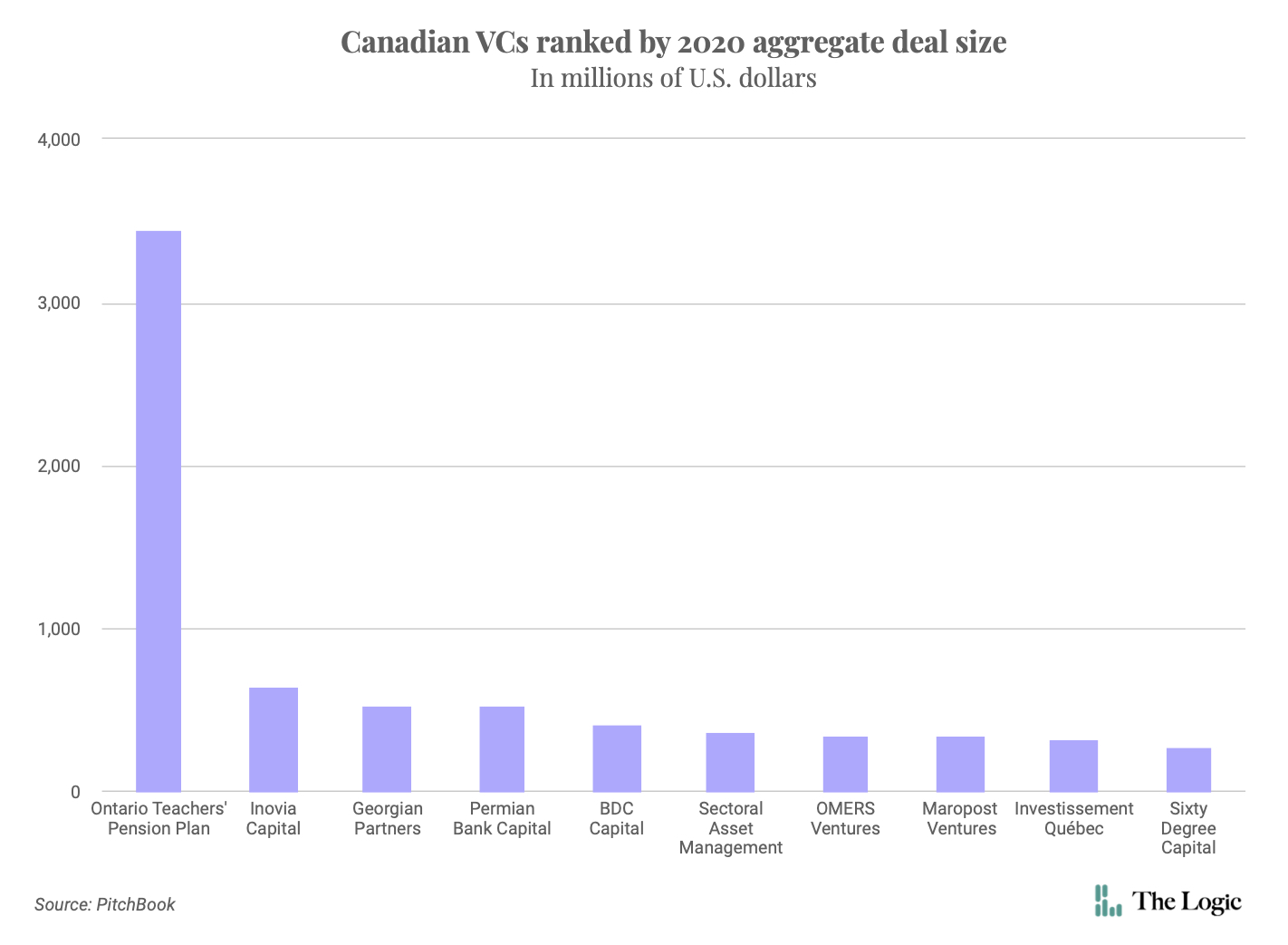
Permian participated in 46 deals in 2020. The cumulative value of those deals was US$527.2 million—the fourth-highest by aggregate deal size for a Canadian VC that year, though the firm did not lead most of those deals.
Founded in 2000 as a private equity firm, investing mostly in American-based community banks and real estate, Permian only recently pivoted to include venture investing, its website states. 2020 appeared to be the most active year ever for Permian by number of VC investments, according to PitchBook data, which shows the firm participated in just nine VC rounds in 2019, and just one in 2018.
The firm’s 2020 investments varied by sector, ranging from the cash-rewards company Pogo, and various healthtech investments, to participation in a December US$75-million raise for the Calm meditation app, along with Goldman Sachs and Marc Benioff, the billionaire Salesforce CEO. Permian did not respond to an interview request from The Logic.
BDC Capital was the second most active firm on the venture-deal circuit by participation in deals, with an aggregate deal size of nearly US$410 million through 44 deals, followed by Sustainable Development Technology Canada (SDTC), which engaged in 32 deals, each vastly smaller in value. SDTC’s aggregate deal size for 2020 was US$79 million, comparable to Montreal-based Real Ventures, which participated in 16 deals last year, netting US$78.5 million.
The big spenders
In terms of aggregate deal size, the Ontario Teachers’ Pension Plan came out far ahead—with participation in just seven deals, the OTPP’s aggregate deal size for 2020 was more than US$3.4 billion. Montreal-based Inovia Capital ranked second, with an aggregate deal size of US$650 million, and 19 deals.
“2020 started out as an amazing year for us, but March and April were disastrous,” acknowledged Chris Arsenault, partner at Inovia. “But overall, our venture deals that were in the growth stage blew it out of the water in 2020,” he added. Inovia said that according to its internal data, its 35 portfolio companies raised US$1.1 billion in 2020, and 80 per cent of them performed better in 2020 than 2019.
Notably, the PitchBook data painted a picture of a geographically concentrated dealmaking landscape in 2020—all of the 10 most active Canadian VCs in terms of deal participation and deal size were based in Toronto, Montreal or Ottawa.
The hot sectors
Companies in the pharmaceuticals and biotechnology sector saw a significant increase in venture capital deal activity in 2020 compared to the two years before, fuelled by the COVID-19 pandemic. Funding for the sector made up 12.5 per cent of all deals from Canadian VCs, with 55 investments involving 52 companies in the space; investments in the sector made up 8.1 per cent of all VC deals in 2019 and 2.2 per cent the year before. Investments in companies making health-care devices and supplies, as well as those offering health-care services, also increased in 2020, but remained relatively low, with 52 deals representing 4.4 per cent of all activity. Investments in the transportation sector jumped from 7.3 per cent of all deals in 2019 to 17 per cent in 2020, while retail investments dropped from 4.9 per cent to 0.7 per cent and deals in non-financial services fell from 8.2 per cent to 1.6 per cent.
The exit strategy
Canadian VCs participated in 104 exits in 2020, according to data PitchBook provided to The Logic. Of those, 83 were M&A deals and 21 were IPOs. June and July were the most active months for venture investors, which were involved in 13 and 14 exits those months, respectively.
While IPOs accounted for significantly fewer exits for Canadian firms in 2020, they generated more returns for firms, on average, than mergers and acquisitions. Altogether, Canadian VCs participated in exits worth at least US$20 billion, with about US$6.7 billion coming through public listings and at least US$13.3 billion through mergers and acquisitions, based on disclosed figures.
The returns
Desjardins Venture Capital, the venture arm of the Desjardins Group federation of credit unions, led Canada’s VCs in size of exits in which it participated in 2020. Three of the Montreal-based firm’s VC portfolio companies were acquired last year: Montreal-based AI security firm Delve, Sherbrooke, Que.-based technical-yarn company Filspec and The Stars Group, a Toronto-based online gaming company that Dublin-based Flutter Entertainment bought in a US$7.8-billion deal. Desjardins had invested $35.23 million in The Stars Group in 2011. The Ontario Teachers’ Pension Plan also saw three VC portfolio firm exits, worth nearly US$3 billion combined. Toronto-based BrandProject saw two of its portfolio firms acquired, in deals worth US$1.85 billion.
The M&A driving returns
The Stars Group sale was the biggest disclosed overall deal involving a Canadian venture capital firm in 2020, though Desjardins was the lone Canadian seller. Meal-subscription firm Freshly’s acquisition represented the second-largest involving a Canadan VC. Nestlé bought the Tempe, Ariz.-based firm in October 2020 for US$1.5 billion, valuing the firm at US$1.79 billion; Toronto-based BrandProject had led a US$1.55-million seed round in the firm in 2015. Northland Power’s $1-billion acquisition of Empresa De Energía De Boyacá in January 2020 was a boon for Toronto-based Brookfield Asset Management, which had owned 99.4 per cent of the Colombian electricity firm before the sale.
The IPO bump
In terms of public listings, GFL Environmental’s IPO was the largest exit involving Canadian VC investors. The Toronto-based waste-management company raised US$2.2 billion when it listed on the New York and Toronto stock exchanges in March. Ontario Teachers’, which still owned 15.6 per cent of the company as of September 30, had participated in a US$5.13-billion leveraged buyout of the firm in 2018. San Francisco-based entertainment-software firm Unity went public in September, raising over US$1.3 billion, giving the firm a market cap of about US$13.7 billion. The Canada Pension Plan Investment Board (CPP Investments) and Vancouver’s Vanedge Capital were among more than two dozen sellers in the IPO. CPP Investments had participated in a late-stage VC round in Unity of an undisclosed amount in July 2019; the pension fund owned 3.07 per cent of the company, as of September 30. Vanedge participated in a 2011 Series B, in which Unity raised US$17.5 million from six investors.
Canadian VCs also saw returns from AbCellera’s IPO. The Vancouver-based biotech company listed on the Nasdaq in early December, raising US$555.5 million in its public offering. Along with big-name U.S. investors like Peter Thiel and the Bill & Melinda Gates Foundation, Canadian private investors New Ventures BC and Northview LifeSciences also reaped benefits from the public listing. Several industry and government institutions had also banked on the company through grant financing over the years, including an undisclosed amount from research organizations CQDM and Brain Canada in 2018, as well as US$625,000 from Western Economic Diversification Canada in 2015, and $175.6 million from the federal government in May 2020 to be used for antibody discovery for COVID-19 treatments.