Skip to content

Canada's Business and Tech Newsroom

  • Professional Subscription
  • Partnerships & Advertising
  • Licensing & Syndication
Log In Subscribe
Welcome,
  • My Account
  • Log Out
  • Business
  • Tech
  • National
  • The Big Read
  • Briefings
  • Commentary
Search
Log In Subscribe
Welcome,
  • My Account
  • Log Out
News

Proposed EU laws could force breakup of Big Tech

This article is a preview of The Logic’s Daily Briefing newsletter, sent every weekday. Sign up for a free trial.

On Tuesday, the European Union published a pair of long-awaited draft laws that seek to curb the dominance of “gatekeeper” platforms like Amazon, Apple, Facebook, Google and Microsoft, as well as restrict their ability to spread hateful and violent content online. It’s the most aggressive attempt yet to regulate Big Tech. Here’s what you need to know:

News

Proposed EU laws could force breakup of Big Tech

By Catherine McIntyre
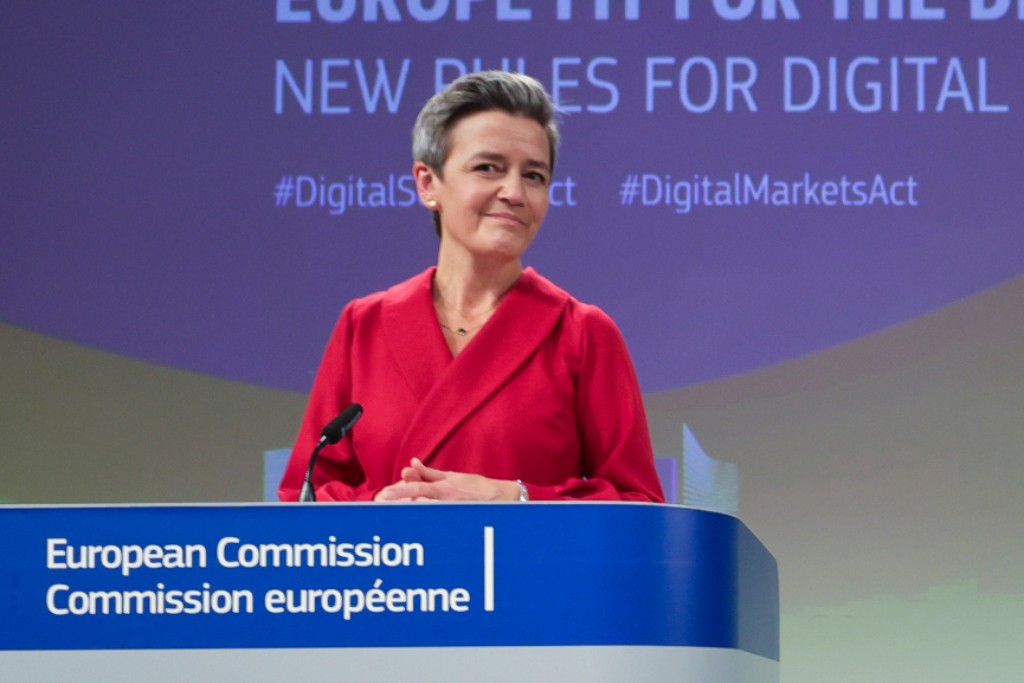
European Commissioner for Europe fit for the Digital Age Margrethe Vestager, left, and European Commissioner for Internal Market Thierry Breton during a news conference on Digital Services Act and the Digital Markets Act at the European Commission headquarters in Brussels, Tuesday, Dec. 15, 2020. Photo: AP Photo/Olivier Matthys
Dec 15, 2020
A A
A Small A Medium A Large
Share

Share

This article is a preview of The Logic’s Daily Briefing newsletter, sent every weekday. Sign up for a free trial.

On Tuesday, the European Union published a pair of long-awaited draft laws that seek to curb the dominance of “gatekeeper” platforms like Amazon, Apple, Facebook, Google and Microsoft, as well as restrict their ability to spread hateful and violent content online. It’s the most aggressive attempt yet to regulate Big Tech. Here’s what you need to know:

The details: The proposed Digital Markets Act would require firms to improve transparency around operations like online advertising. They would also have to end self-preferencing, like favouring their own products in search results or preventing users from uninstalling their apps on their own devices. A second piece of legislation, called the Digital Services Act, calls for companies to do more to prevent the spread of hate speech and sale of counterfeit merchandise through their platforms. 

Who has to comply: The Digital Markets Act covers large internet companies that have had an annual turnover in the EU of at least €6.5 billion in the last three financial years, or that have a market value of at least €65 billion in the last year. Firms also have to provide a “core platform service” in at least three EU member states. The degree to which companies need to comply with the Digital Services Act varies by the size and type of company, with very large digital platforms subject to the most scrutiny under the law. For example, Google and Facebook might have to provide data to authorities and researchers, but a domain-name registrar would not. 

The possible consequences: Companies that don’t comply with the Digital Markets Act could face fines of up to 10 per cent of their global annual sales and periodic penalty payments of up to five per cent. In severe cases, the regulator could compel a firm to divest its assets, including business units, subsidiary firms, intellectual property rights or brands. Failing to comply with the Digital Services Act could lead to fines of up to six per cent of its annual turnover for the previous financial year. 

The bigger picture: The draft laws follow two landmark lawsuits filed in the U.S. last week accusing Facebook of sweeping antitrust violations and calling for the firm to unwind its Instagram and WhatsApp acquisitions. Regulators elsewhere are likewise cracking down on Big Tech. Also on Tuesday, Britain proposed laws to ban large platforms from facilitating the spread of harmful online content, like terrorism material and child abuse, while Irish regulators announced a €450,000 fine against Twitter for violating EU data-protection laws. On Monday, China’s antitrust regulator fined three of the country’s largest tech firms for monopolistic behaviour and failing to disclose acquisitions of smaller firms; the regulator is scrutinizing more deals, including Tencent Holdings’ US$3.5-billion plan to take search engine Sogou private. 

What’s next: The proposed regulations still have to be approved by European governments and lawmakers. EU competition commissioner Margrethe Vestager said she hopes that will happen “as fast as possible,” but the process could take two years.

#big tech #european union

Loading...

Thanks for sharing!

You have shared 5 articles this month and reached the maximum amount of shares available.

Close
This account has reached its share limit.

If you would like to purchase a sharing license please contact The Logic support at [email protected].

Close
Want to share this article?

Upgrade to all-access now

Close
Gift the full article!

You have gifted 0 article(s) this month and have 5 remaining.

Copy link and gift
Copy Link
Email to a friend
Send Email
Gift on Social Media

Recipients will be able to read the full text of the article after submitting their email address. They will not have access to other articles or subscriber benefits.

Photo: AP Photo/Olivier Matthys

Most Popular This Week

A yellow ambulance is pictured outside of a hospital in Montreal. A red sign in the foreground reads, “Urgence / Emergency.”
Commentary: Quebec Ink

Quebec just found out what not having digital sovereignty really means

By Martin Patriquin
An image of Mark Carney standing in front of a red podium with the words "AI for All / L'IA pour tous." He is wearing a suit and tie. In the background, people wearing scrubs and white coats are visible.
Special Report

Canada’s new AI strategy sets lofty goals for adoption and growth

By Murad Hemmadi and Laura Osman
Exclusive

Canada’s new AI strategy includes $500M fund to back key firms

By Murad Hemmadi and Catherine McIntyre
The Big Read

Canada’s AI boom is about to collide with a major labour shortage

By Catherine McIntyre

In-depth, agenda-setting reporting

Great journalism delivered straight to your inbox.

Minister Marc Miller wears a blue suit and tie. He stands while speaking and gesturing.
News

Online harms bill would give new regulator power to slap massive fines on AI, social media giants

By Laura Osman and Martin Patriquin

Briefing

Cenovus’s Jon McKenzie says there’s no financial case for a new pipeline and major carbon capture

By David Reevely   |   Jun 10, 2026 | 3:46 PM ET

Ubisoft shuts down Winnipeg studio

By Brendan Sinclair   |   Jun 10, 2026 | 3:08 PM ET

Quebec invested over $760M in battery companies that eventually went under, report says

By Martin Patriquin   |   Jun 10, 2026 | 2:59 PM ET

Best business newsletter in Canada

Get up to speed in minutes with insights and analysis on the most important stories of the day, every weekday.

Exclusive events

See the bigger picture with reporters and industry experts in subscriber-exclusive events.

Membership in The Logic Council

Membership provides access to our popular Slack channel, participation in subscriber surveys and invitations to exclusive events with our journalists and special guests.

Recent Popular Stories

Commentary: Quebec Ink

Quebec just found out what not having digital sovereignty really means

By Martin Patriquin   |   Jun 8, 2026
A yellow ambulance is pictured outside of a hospital in Montreal. A red sign in the foreground reads, “Urgence / Emergency.”
News

Canada’s surprise plan to buy Saab command jets leaves competitors seeking answers

By David Reevely   |   May 29, 2026
A closeup of a scale model of a jet covered in pixellated camouflage, with sensor equipment attached to the top of its fuselage. There are civilians and uniformed military personnel milling in the background.
Exclusive

Canada’s new AI strategy includes $500M fund to back key firms

By Murad Hemmadi and Catherine McIntyre   |   Jun 3, 2026
The Big Read

We found every data centre in Canada

By Murad Hemmadi, David Reevely, Aleksandra Sagan, Chaimae Chouiekh, Martin Patriquin and Catherine McIntyre   |   Apr 8, 2026
Four vertical slices of aerial view photos. From left, a building in downtown Toronto housing several data centres, a picture of the Albertan wilderness where the proposed Wonder Valley data centre would go, a lit-up QScale data centre in Quebec, and a data centre at a Hydro-Quebec dam.
The Big Read

ApplyBoard faces a reckoning as Canada’s immigration boom turns into a bust

By Claire Brownell and David Reevely   |   May 27, 2026
News

A Canadian leader in nuclear fusion comes home—with big plans to make power

By David Reevely   |   Jun 4, 2026
A selfie taken by Spencer Pitcher inside a nuclear fusion facility. He is wearing a blue hardhat with the ITER logo on it, and is standing in front of a cavernous chamber full of fusion reactor equipment.

Canada's most influential executives and policymakers are reading The Logic

  • CPP Investments
  • Sun Life Financial
  • C100
  • Amazon
  • Telus
  • Mastercard
  • bdc
  • Shopify
  • Rogers
  • RBC
  • General Motors
  • MaRS
  • Government of Canada
  • Uber
  • Loblaw Companies Limited
logic-logo

Canada's Business and Tech Newsroom

100% human-crafted journalism

Newsroom

  • News Tips
  • AI Policy
  • Editorial Disclosures
  • Story Pitches

Company

  • About Us
  • Terms of Service
  • Privacy Statement
  • Corporate Information

Contact

  • Contact Us
  • Advertise
  • FAQs
  • Work at The Logic

© 2026 The Logic Inc. All Rights Reserved.

Trusted by leaders

Error

Account creation failed.

Please email us at [email protected].

Create Account

[wppb-register form_name=”cozmo-registration-form-for-modal”]

I do have an account
Login
or

[wppb-login]

I don’t have an account