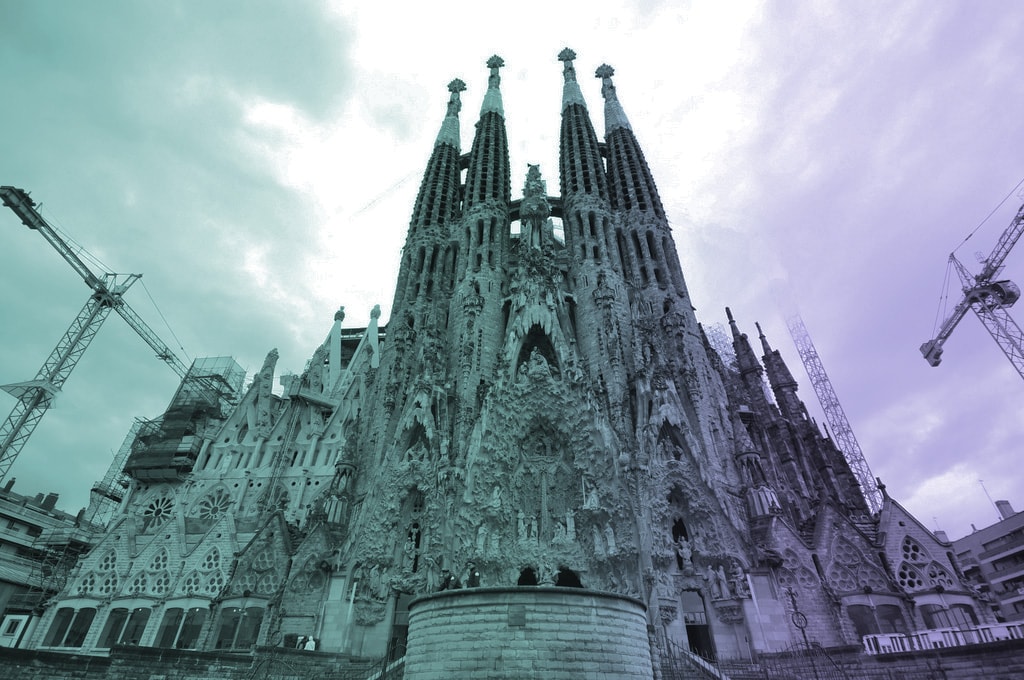
Barcelona’s La Sagrada Familia is a towering Roman Catholic cathedral that has been under construction for as long as Canada has existed. It’s a symbol of a city with a focus on the long term.
But, unbeknownst to the three million-plus tourists flocking to the Gaudí shrine every year, a vast network of cables and sensors snakes underneath, part of a 42-kilometre tunnel system that makes its way through the city, melding the Internet of Things with the city’s medieval roots.
The tunnels are comprised of fibre-optic lines, traffic signal cables, heating and cooling networks and gas and phreatic water canals. Those water canals are linked with rain sensors that know when to water the city’s parks and gardens; public fountains have timers to monitor and control the flow of water, all in an effort to cut down the city’s water usage.
It’s part of the burgeoning smart-city movement that has captured the attention of local and regional governments—along with tech firms angling for a piece of the action—across the globe.
Talking Point
Barcelona’s smart-city development has focused on participatory democracy and civic engagement. If it succeeds, it could set an example for similar projects across the globe.
Cisco has partnered with IBM in Amsterdam to cut energy-use with smart home meter systems. Saudi Arabia claims its smart city, Neom, will be bigger than Dubai. India aspires to have 100 smart cities of its own.
In Canada, IBM and Bell recently announced a partnership with the city of Markham, Ont. And, Sidewalk Labs—a Google sister company and subsidiary of Alphabet, one of the most powerful tech companies in the world—plans to build the “city of the future” along Toronto’s waterfront. Though its buzzword-laden pitch promised sustainability, mobility and economic opportunity, the project has spurred concerns among activists and community members uncomfortable with a city built on their personal data. There are also questions around how the project will be governed and, with a private corporation at the helm, whether it is truly in the interest of the public.
Meanwhile, Barcelona is the city heralded as the symbol of a smart future amid its storied past.
A close look at the city’s efforts suggest that for it to truly become a smart city, it will need to solve some very old problems: issues that have more to do with democratic participation, the basic needs of citizens—and their right to privacy—than whatever the latest technological innovation aims to solve.
If it succeeds, the Catalonia capital will be a beacon for similar projects around the world.
A Superblock in Barcelona's Poblenou District Photo: Amanda Roth
A city-organized tour of Barcelona’s Digital Smart City stops in front of a busy cafe near a playground. Children spill into the street, enjoying the last few moments of sunlight on a brisk winter’s evening.
It’s the star attraction of the tour, part of an effort called the Superblock. Meant to reclaim public space by redirecting car traffic to surrounding streets, it’s turned what were once roads into parks and public spaces.
Even so, the Superblocks—or “Superilles,” in Catalan—have received mixed reaction. Miquel Perez, partner at Solve Consulting Spain and the leader of the day’s tour, acknowledges that the installations have concerned residents over how it may affect businesses in the area or worsen gentrification.
Those concerns culminated in 100 residents taking to the streets in September 2017 in protest, cutting off traffic to deliver a message to the city’s mayor, Ada Colau.
The small protest lasted less than an hour, but the residents’ complaints over the Superblock—which they said forced local drivers to take circuitous routes around the neighbourhood—were a precursor to the grassroots challenges the smart-city developments posed.
A sign protesting Superblocks hangs in an apartment window: “The neighbours want to decide” Photo: Amanda Roth
Beside the playground is a bicycle docking station, where Perez details the city’s Urban Mobility Plan.
Bicing, the city’s bicycle-sharing system, uses bikes supplied by Quebec-based PBSC Urban Solutions, which also supplies Toronto’s Bixi network. In Barcelona, there are 420 locations to pick up and drop off bikes across the city, and cyclists have access to 208 kilometres of bike lanes, with a mandate to add more. Almost 90 per cent of the population has a bike lane less than 300 metres from their home, Perez explains. The city also has roughly 300 charging stations for cars, anticipating that 25 per cent of vehicles in Barcelona will be electric by 2025.
Barcelona’s smart-city projects are extensive. They include a public Wi-Fi network, incubators and community-building initiatives, such as MediaTIC—a building where various startups and entrepreneurs can network—and those aforementioned 42 kilometres of underground tunnels.
The project has been in the works since the early 1990s, but it wasn’t until recently that city planners and urbanist scholars began looking at Barcelona as inspiration for what city-building could be in the not-so-distant future.
The term itself—“smart city”—is loose. It can refer to industry-driven projects that use a company’s own technology to make cities more efficient. Alternatively, the local government, or citizen groups, might lead the initiative. Sometimes it’s a combination of the three.
“Smart cities is this thing that is relatively poorly defined and has really been shaped by industry,” says David Eaves, a public-policy lecturer at the Harvard Kennedy School. Industry’s approach has been to “promise a whole bunch of solutions that cities can buy to solve problems,” says Eaves, “and generally, the problems they’re solving are problems of efficiency and cost-savings.”
Eaves finds that approach challenging. Buying new technology for the public good is the opposite of how smart cities should be managed, he says. Rather, problems should be identified first, followed by effective solutions. “The smart cities dialogue inverses the right way of going out and trying to solve problems,” he says.
Barcelona’s goal is to build a smart city “the right way”—that is, driven by both government and citizens.
Perez shows the Digital Smart City Tour an app for Empark, a local parking service Photo: Amanda Roth
Since the mayoral election of housing activist Colau in May 2015, the city has taken a citizen-focused approach to its efforts. Before becoming mayor, Colau was widely-known for her housing activism on behalf of those affected by the real-estate and tourism boom and the 2008 housing crash.
“Public space is the place, par excellence, for democracy: this space that belongs to all of us,” Colau told The New Yorker in August 2018. “Therefore, this is also the space of the most vulnerable people, which is what democratic systems should prioritize: the people who have fewer opportunities.”
The city’s chief technology and digital innovation officer, Francesca Bria—an Italian who previously worked for a U.K.-based innovation foundation called Nesta, where she led a report for the European Commission on developing social innovation—was brought on by Colau to align the city’s technology developments with the new administration’s policy goals, like prioritizing public spaces, affordable housing and a more open, participatory form of democracy.
In 2016, the city introduced its Municipal Action Plan, which included an online platform for engaging citizens called Decidim: “we decide” in Catalan. The platform lets citizens participate in government by debating policy and ideas, suggesting new ones and ultimately voting on them. According to the website, Decidim has allowed for a strategic city plan, which includes almost 7,000 citizen proposals.
Barcelona approached its smart city by launching what Bria calls a “large-scale participatory democracy process” to identify policy opportunities. “The participatory democracy, for us, in this big crisis of trust, is the only way to win back the city for the people,” says Bria at the 2018 Smart Cities Expo World Congress.
Failing this, “what you end up doing is continuously externalizing and outsourcing these services to the tech giants,” Bria says, pausing to sip her espresso, “which, in return, of course they’re just going to monetize the data of your citizens.”
To avoid that, the government’s agenda was written using feedback from over 400,000 people (almost 25 per cent of the city’s population). City officials made an effort to go to each district—and to include all ages, ethnic backgrounds and genders—for feedback on how best to approach the many initiatives wrapped up in the Municipal Action Plan.
In the end, 70 per cent of the smart-city plan came from ideas that citizens themselves pitched. “This is a way to really transform the relationship between government and citizens,” says Bria, “and to put the question of trust, the question of making government more open, more collaborative and more transparent, at the very core.”
It’s that emphasis on openness that lends itself to city’s approach to data governance, too—an issue that finds itself at the centre of many smart city debates.
“We understand data as a public good, as a public infrastructure that should be governed in a way that citizens themselves can have sovereignty over their data,” says Bria. “We want to make the most out of data, but at the same time preserving information, self-determination, privacy and security by design in everything we do.”
Bria speaks over thousands of vendors modelling their technologies on the Smart Cities Expo conference floor. Transportation-rental company Lime displays its black and green electric scooters; Bosch, the electronics company, showcases a model neighbourhood to explain innovations like its environmental monitoring, connected parking and smart home appliances. Many of the technologies on display are already imbedded in urban landscapes around the world—and, as Bria notes, are not always to the public’s benefit.
Last year, for example, Barcelona introduced mandatory licences for short-term rental hosts amid concerns that Airbnb and its competitors were exacerbating the rental market, already tight from the city’s saturated tourism industry. The city demanded Airbnb remove more than 2,500 listings operating without a city-approved licence.
And, after Barcelona taxi drivers complained that Uber was undermining their business, the Catalan government ruled that ride-hailing services could only pick up passengers after a 15-minute delay from the time they were booked.
Bria says the key to solving these types of problems is healthy competition, which is why her government operates a number of incubators to help prop up local businesses that are trying to solve social or urban problems.
Bria sits on a panel at the Smart City Expo World Congress Photo: Amanda Roth
At the Smart City Expo World Congress, Barcelona introduces a coalition of digital rights, in partnership with Amsterdam and New York. The joint initiative is meant to promote the protection of people’s digital rights, and is founded on five pillars: universal and equal access to the internet and digital literacy; privacy, data protection and security; transparency, accountability and non-discrimination of data, content and algorithm; participatory democracy, diversity and inclusion; and open and ethical digital service standards.
The initiative builds on the relationship already established between Barcelona and Amsterdam, through Decentralised Citizen-owned Data Ecosystems, or DECODE. Funded by the European Commission, DECODE aims to “put individuals in control of whether they keep their personal information private or share it for the public good.” The multi-partner program was a defining feature of both cities’ displays at the Smart City Expo.
Barcelona has gone to great efforts to inform citizens of the innovative solutions that have been embedded throughout the city. “My sense is that they’ve done a little more public consultation and engagement around the work they’re trying to do than some other cities have done, which may have, kind of, got them more social license,” said Eaves.
This has won them respect around the world.
“Barcelona is the most progressive of the progressive smart city examples,” says David Murakami Wood, a sociology professor at Queen’s University who researches smart cities, security and surveillance.
And yet, it’s not without its critics.
Mila Gascó-Hernandez, an academic, wrote in April that Barcelona’s accolades are based on a successful PR campaign: “Barcelona’s smart-city marketing strategy has indeed proved even more successful than the city’s ‘real’ strategy.”
“I’m not sure yet whether we know how successful it’s going to be,” says Murakami Wood. “Half the success of these things is partly if it’s seen to be successful.”
Toronto echoes those concerns, where Waterfront Toronto and Sidewalk Labs continue to work toward developing a proposal for a tech-driven neighbourhood.
“I think regarding the Toronto project, the main question is the governance of infrastructure,” says Bria, and, she adds, who owns what. “If you give limited access to data and collectivity, and the project of the smart city is done by a private company, then what would happen to the right over the infrastructure and data of the citizens of Toronto?”
“So, my question would be: what is the model of the city that they’re trying to create?”
Returning to her own city’s efforts, she says, “For me, it has been absolutely important to reframe the entire smart city project, not starting from the technology.” When you start from a focus on technology, she says, instead of solving the “real problems and challenges of the city, which are many,” you end up solving technology problems.
“Technology is not the imperative,” Bria adds. “Technology and data should be put at the service of the people that live in the cities.”
This reporting on data privacy was produced in partnership with Journalists for Human Rights www.jhr.ca