Skip to content

Canada's Business and Tech Newsroom

  • Professional Subscription
  • Partnerships & Advertising
  • Licensing & Syndication
Log In Subscribe
Welcome,
  • My Account
  • Log Out
  • Business
  • Tech
  • National
  • The Big Read
  • Briefings
  • Commentary
Search
Log In Subscribe
Welcome,
  • My Account
  • Log Out
News

Montreal gets $50 million to improve transportation using bike-sharing and self-driving cars

Montreal is getting $50 million from the federal government as part of the first-ever Smart Cities Challenge.

The city won the program’s top prize, Infrastructure Minister François-Philippe Champagne announced at an event in Ottawa on Tuesday afternoon.

Montreal intends to use the funding to improve public transportation by integrating shared autonomous vehicles, bikes and cars into a new platform where all these services can be accessed simultaneously.

News

Montreal gets $50 million to improve transportation using bike-sharing and self-driving cars

By Amanda Roth and Murad Hemmadi
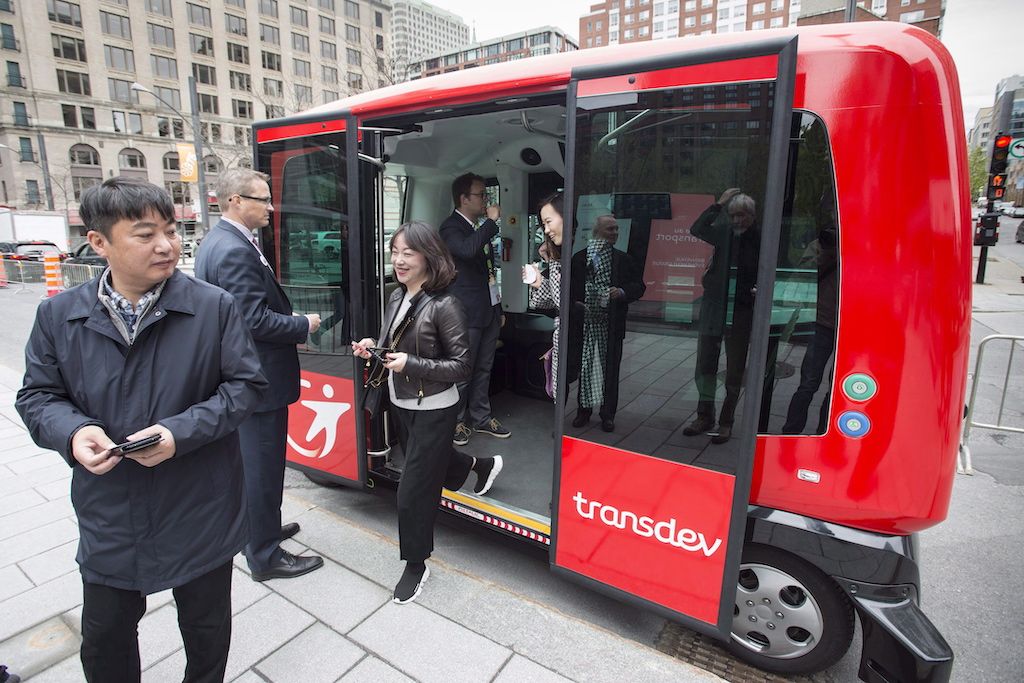
Passengers disembark from an autonomous bus after taking a short ride in Montreal in May 2017. The driverless vehicle was being featured at a transportation conference..
Passengers disembark from an autonomous bus after taking a short ride in Montreal in May 2017. The driverless vehicle was being featured at a transportation conference. Photo: Photo: Paul Chiasson/CP
May 14, 2019
A A
A Small A Medium A Large
Share

Gift

Share

Montreal is getting $50 million from the federal government as part of the first-ever Smart Cities Challenge.

The city won the program’s top prize, Infrastructure Minister François-Philippe Champagne announced at an event in Ottawa on Tuesday afternoon.

Montreal intends to use the funding to improve public transportation by integrating shared autonomous vehicles, bikes and cars into a new platform where all these services can be accessed simultaneously.

The city plans to improve transit within neighbourhoods with a fleet of shared self-driving cars and other modes of transport, and test new financing and insurance models to pay for and maintain the vehicles. It also wants to set up a central hub to collect data on transport routes and usage.

The city’s proposal emphasized that the use of new technologies would be decided upon collectively, “thus preventing abuse in terms of data collection and usage.”

Three other projects also secured funding. The communities of Nunavut and a joint project from Guelph, Ont. and Wellington County will each receive $10 million, while Bridgewater, N.S. will get $5 million.

More than 200 communities applied to the challenge. The government announced 20 finalists in June 2018. They met with the jury for the first time to present their submissions and receive feedback at the Future Cities Canada Summit in Toronto in November 2018.

Montreal beat Edmonton, Quebec City, the Waterloo region and a joint bid from Vancouver and Surrey for the largest award. The unsuccessful finalists for the $5-million category included the Biigtigong Nishnaabeg First Nation from Ontario; the Mohawk Council of Akwesasne in Quebec; the Cree Nation of Eastmain in Quebec; and Yellowknife. There were 10 finalists for the $10-million prizes, including Saskatoon; Richmond, B.C.; and a joint entry from Fredericton and nearby St. Mary’s First Nation.

Gift the full article

While the cities’ plans focused on the local context, the jury was looking for projects that could be “copycatted” elsewhere in Canada, chair Mark Romoff told The Logic in November 2018. Marco Mendicino, Champagne’s parliamentary secretary, said that’s also a focus for the government: “Our hope is that some of the solutions will be scalable and transferable and replicable right across the country.”

Montreal’s project also includes setting up a cloud-based platform to collect data on food access and manage produce sales and distribution, as well as establishing a greenhouse to test new crop yield-enhancing technology.

The Nunavut communities’ bid aims to address the risk of suicide in the territory—which is 10 times the national average—by setting up peer-support networks and educational resources online. The project includes creating a digital literacy curriculum in Inuktitut, developing mobile applications and setting up mental health services like digital art therapy.

“It [Nunavut] is an area that falls through the cracks, and it’s a pretty huge problem,” said Brian Fleming, executive director of the Nunavut Association of Municipalities. “Nunavut is geographically huge, so it’s been a big job trying to coordinate and liaison with all the communities and get their support and make sure they understand the project, so right now I just feel fantastic.”

The joint bid from the City of Guelph and Wellington County aims to establish “Canada’s first technology-enabled Circular Food Economy” by increasing access to affordable and nutritious food and simultaneously reducing food waste by mapping where food is available and produced. To make sense of all this information, the community is looking at using the data-collection platform Fiware, a program that uses data collection and aggregation to accelerate the development of smart-city solutions.

Bridgewater’s bid focused on reducing “energy poverty”: households spending more than 10 per cent of their after-tax income on power. The town is targeting a 20 per cent cut in energy poverty by 2025. It will install energy-monitoring equipment in low-income homes to decide where to invest in new infrastructure. The project aims to reduce the community’s climate impacts by reducing greenhouse gas emissions and shifting to clean energy resources.

“The City of Guelph and the County of Wellington have a very long history of working with agriculture. We have a lot of farming and agriculture within the county, and education and innovation and manufacturing sector around agriculture, as well, especially through the University of Guelph,” said Guelph Mayor Cam Guthrie.

The winners will have up to five years to implement their plans. The money will be paid out when the cities hit targets that they will set with the government.

While each of the four winning projects is based in a different province or territory, the western provinces were shut out. That’s despite eight of the finalists coming from Alberta, four from British Columbia, three from Manitoba and one from Saskatchewan.

But the communities may have another chance to win funding for their projects. This is the first of three funding rounds for the challenge, first introduced in the 2017 federal budget with funding of $300 million over 11 years. Mendicino said in November 2018 that the government would encourage unsuccessful bidders to resubmit their proposals for future rounds.

The federal, provincial and territorial privacy commissioners have raised concerns about the smart cities projects’ use of personal information. In a 2018 letter to then-infrastructure minister Amarjeet Sohi, they urged the government “to ensure that this initiative, in supporting and encouraging innovation, requires project proposals to directly build in privacy protections.”

In November, Romoff told The Logic that cities would need to address questions on data ownership, privacy and accessibility. “Each proposal had to demonstrate that they respected all the privacy terms and conditions that applied in their province or territory,” he said.

With files from Jessica Galang.
#Smart Cities

Loading...

Thanks for sharing!

You have shared 5 articles this month and reached the maximum amount of shares available.

Close
This account has reached its share limit.

If you would like to purchase a sharing license please contact The Logic support at [email protected].

Close
Want to share this article?

Upgrade to all-access now

Close
Gift the full article!

You have gifted 0 article(s) this month and have 5 remaining.

Copy link and gift
Copy Link
Email to a friend
Send Email
Gift on Social Media

Recipients will be able to read the full text of the article after submitting their email address. They will not have access to other articles or subscriber benefits.

Passengers disembark from an autonomous bus after taking a short ride in Montreal in May 2017. The driverless vehicle was being featured at a transportation conference..

Photo: Photo: Paul Chiasson/CP

Most Popular This Week

Andrew Forde, wearing a beige tweed blazer, black slacks and a white sweater, speaks on a stage at the Elevate conference in Toronto with three large blue screens in the backdrop. One screen displays the session topic, AI, another displays the logos for sponsors KPMG and Google, and a third screen depicts a photo of a stop sign covered in stickers. The stop-sign photo is labelled, “Stickers that beat supercomputers.”
News

KPMG’s AI whisperer says some Bay Street firms are falling into a productivity trap

By Anita Balakrishnan
The Big Read

ApplyBoard faces a reckoning as Canada’s immigration boom turns into a bust

By Claire Brownell and David Reevely
A shot of Anthony Hu in a semi-dark office, with his face illuminated by two computer screens.
The Big Read

Anthropic’s Mythos cracked software open like an egg. It’s just the beginning

By David Reevely
Susan Hawkins, chief executive officer of Payments Canada gestures with her hands as she speaks on stage in front of black screen at the Payments Canada Summit in Toronto.
Exclusive

Not all banks and fintechs will get access to the Real-Time Rail at launch

By Claire Brownell

In-depth, agenda-setting reporting

Great journalism delivered straight to your inbox.

An image of Mark Carney standing in front of a red podium with the words "AI for All / L'IA pour tous." He is wearing a suit and tie. In the background, people wearing scrubs and white coats are visible.
Special Report

Canada’s new AI strategy sets lofty goals for adoption and growth

By Murad Hemmadi and Laura Osman

Briefing

TD Bank inks 10-year carbon removal deal with Montreal’s Deep Sky

By Meghan Potkins   |   Jun 4, 2026 | 2:44 PM ET

Biotech automation firm Scispot raises US$8M all-equity round

By Aleksandra Sagan and Murad Hemmadi   |   Jun 4, 2026 | 12:07 PM ET

CSIS warns of Chinese intelligence operatives posing as job recruiters

By David Reevely   |   Jun 4, 2026 | 10:46 AM ET

Best business newsletter in Canada

Get up to speed in minutes with insights and analysis on the most important stories of the day, every weekday.

Exclusive events

See the bigger picture with reporters and industry experts in subscriber-exclusive events.

Membership in The Logic Council

Membership provides access to our popular Slack channel, participation in subscriber surveys and invitations to exclusive events with our journalists and special guests.

Recent Popular Stories

News

Canada’s surprise plan to buy Saab command jets leaves competitors seeking answers

By David Reevely   |   May 29, 2026
A closeup of a scale model of a jet covered in pixellated camouflage, with sensor equipment attached to the top of its fuselage. There are civilians and uniformed military personnel milling in the background.
Exclusive

Canada awards Ford $464M to make F-Series trucks in Ontario

By Murad Hemmadi, Anita Balakrishnan and Joanna Smith   |   May 7, 2026
Blurred red, white and black cars zoom down a street in front of Ford’s Oakville, Ont., assembly plant on Friday April 5, 2024.
News

European and Asian firms want a stake in Canada’s photonics factory, Joly says

By Murad Hemmadi   |   May 7, 2026
The Big Read

ApplyBoard faces a reckoning as Canada’s immigration boom turns into a bust

By Claire Brownell and David Reevely   |   May 27, 2026
Exclusive

RBC Insurance chief to depart in shakeup of key strategic role

By Chaimae Chouiekh and Anita Balakrishnan   |   May 27, 2026
Low-angle view of an RBC logo sign in front of a tall glass-and-concrete office tower, with surrounding skyscrapers visible in the background.
Exclusive

Shopify makes cuts to its operations team in latest round of layoffs

By Aleksandra Sagan   |   May 4, 2026
Tobias Lutke in a black shirt and grey jeans sitting on a couch, gesturing with both hands pinching the air as he speaks

Canada's most influential executives and policymakers are reading The Logic

  • CPP Investments
  • Sun Life Financial
  • C100
  • Amazon
  • Telus
  • Mastercard
  • bdc
  • Shopify
  • Rogers
  • RBC
  • General Motors
  • MaRS
  • Government of Canada
  • Uber
  • Loblaw Companies Limited
logic-logo

Canada's Business and Tech Newsroom

100% human-crafted journalism

Newsroom

  • News Tips
  • AI Policy
  • Editorial Disclosures
  • Story Pitches

Company

  • About Us
  • Terms of Service
  • Privacy Statement
  • Corporate Information

Contact

  • Contact Us
  • Advertise
  • FAQs
  • Work at The Logic

© 2026 The Logic Inc. All Rights Reserved.

Trusted by leaders

Error

Account creation failed.

Please email us at [email protected].

Create Account

[wppb-register form_name=”cozmo-registration-form-for-modal”]

I do have an account
Login
or

[wppb-login]

I don’t have an account