OTTAWA — A federal inquiry into foreign election interference has called for a dedicated government entity to monitor and intercept foreign meddling that uses social media platforms and artificial intelligence.
Skip to content

News
Inquiry calls for federal watchdog to fight foreign meddling done on social media
Fast-moving AI and other technologies pose an existential threat to democracy, commissioner concludes
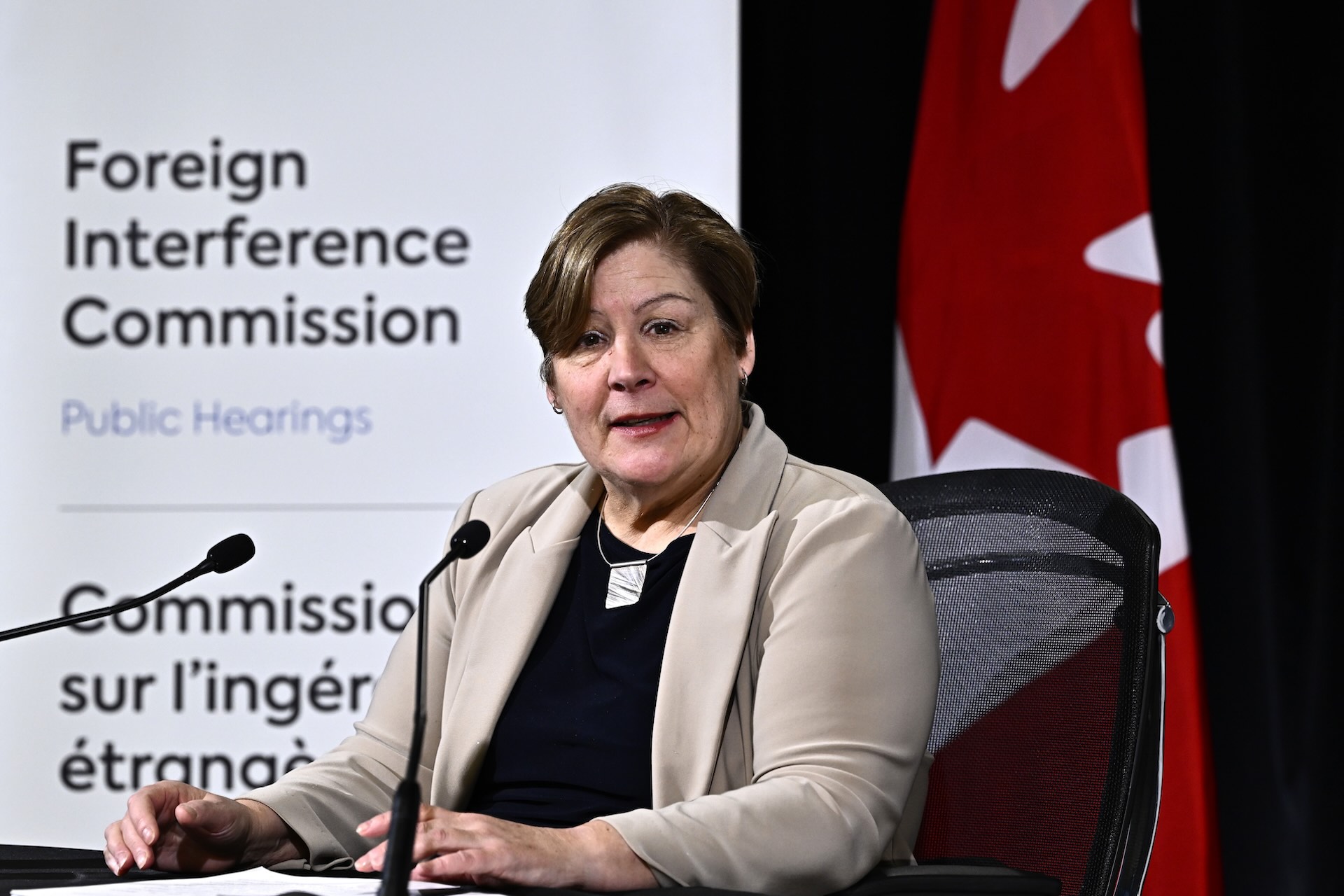
Marie-Josée Hogue, commissioner of the federal inquiry into foreign interference, says disinformation is the greatest threat to democracy. Photo: The Canadian Press/Justin Tang
OTTAWA — A federal inquiry into foreign election interference has called for a dedicated government entity to monitor and intercept foreign meddling that uses social media platforms and artificial intelligence.
“Foreign actors are no longer content to use traditional means to interfere. They are also using sophisticated technological means,” commissioner Marie-Josée Hogue said after her nearly 18-month investigation. “The greatest threat—the one that I believe threatens the very existence of our democracy—is disinformation.”
Talking Points
- With the recent proliferation of social media platforms and rapid advancements in AI, Canada needs a national entity to intercept foreign meddling online, an inquiry into foreign interference has found
- The new organization proposed by commissioner Marie-Josée Hogue would have authority to deal directly with social media platforms and share information with Canada’s intelligence agencies
Government efforts to regulate social media platforms to curb disinformation have been “unsuccessful so far,” Hogue said in her seven volume report. (She did not take questions.)
Because of new technologies, more foreign actors have the ability to target Canada than in the past, the report notes. “Alternative social media platforms have become more common and artificial intelligence has changed the way disinformation can spread,” it said. “This rapid evolution is likely to continue.”
The commission found foreign state actors certainly tried to interfere in Canada’s 2019 and 2021 federal elections, but there were only a very small number of isolated cases where interference may have impacted the results of a nomination race or the election of a specific MP.
Since the 2021 election, technology has evolved significantly, the commission said, and advances in generative AI and deepfake technology are far more advanced and commonplace, making it easier to manipulate information and spread content faster.
Related Articles

Hogue has called for the creation of a new government entity that would monitor the “domestic open source online information environment,” such as social media platforms and funnel that content to other intelligence gathering agencies like CSIS, the Communications Security Establishment and members of the task force that oversees the security of federal elections. The government should consider giving that new entity the authority to communicate with the platforms’ companies directly, the commission said.
Responsibility for that kind of surveillance currently rests with Global Affairs Canada during election periods as part of its “rapid response mechanism” (RRM).
However, RRM does not do baseline monitoring domestically. If it comes across something troubling as part of its international monitoring, or if foreign partners flag a concern, Global Affairs will pass the information along.
Hogue called for a legislative framework that would authorize the government to collect and assess social media contact in a way that respects Canadians’ privacy rights.
She also asked the government to consult with private industry and the public to make good on commitments outlined in an international declaration that Canada signed in 2023. It calls on Canada to protect and promote information integrity online, especially in the face of rapidly changing AI technology.
The commissioner acknowledged it’s likely not possible for the government to act on those recommendations before the next election is called.
In May 2023, RRM discovered that a network of accounts was amplifying false and misleading claims about Conservative MP Michael Chong’s political stances and family heritage. Between two and five million WeChat users viewed the material, according to RRM, which concluded with a “high level of confidence” that the disinformation campaign was linked to China.
The commission also heard evidence about a bot network that circulated three YouTube videos believed to be deepfakes of Xin Liu, a vocal critic of Beijing who lives in B.C. The videos depicted Liu making unfounded allegations against Prime Minister Justin Trudeau and other parliamentarians.
Global Affairs concluded this “spamouflage” campaign suggested a new tactic by the PRC, Hogue noted in her report, and that the method could be more persuasive to a wider audience.
Hogue made a total of 51 recommendations to curb the impact of foreign election interference, including improvements to internal government communication about possible threats and new rules for election financing, leadership races and party nominations.



Loading...
Thanks for sharing!
You have shared 5 articles this month and reached the maximum amount of shares available.
CloseThis account has reached its share limit.
If you would like to purchase a sharing license please contact The Logic support at [email protected].
CloseGift the full article!
You have gifted 0 article(s) this month and have 5 remaining.
Recipients will be able to read the full text of the article after submitting their email address. They will not have access to other articles or subscriber benefits.
Photo: The Canadian Press/Justin Tang
Most Popular This Week




In-depth, agenda-setting reporting
Great journalism delivered straight to your inbox.
Commentary
Carmichael: Canadian ignorance about India is a strategic weakness
Briefing
Aritzia shares pop after earnings rise 204%
First Nation in Alberta goes to court over fast-tracked oil pipeline
Chinese EV maker Geely Auto Group to launch in Canadian market in 2027
Best business newsletter in Canada
Get up to speed in minutes with insights and analysis on the most important stories of the day, every weekday.
Exclusive events
See the bigger picture with reporters and industry experts in subscriber-exclusive events.
Membership in The Logic Council
Membership provides access to our popular Slack channel, participation in subscriber surveys and invitations to exclusive events with our journalists and special guests.





