Skip to content

Canada's Business and Tech Newsroom

  • Professional Subscription
  • Partnerships & Advertising
  • Licensing & Syndication
Log In Subscribe
Welcome,
  • My Account
  • Log Out
  • Business
  • Tech
  • National
  • The Big Read
  • Briefings
  • Commentary
Search
Log In Subscribe
Welcome,
  • My Account
  • Log Out
Exclusive

Uber’s self-driving car research team has issues navigating with large vehicles on the road

Uber’s self-driving car research team is having difficulties driving in heavy rain, navigating when there are large vehicles on the road and detecting crosswalks, according to company research reviewed by The Logic.

Self-driving cars are a key focus for Uber as it gears up for a US$90-billion IPO later this year. The company’s Toronto self-driving research lab is the lynchpin of those ambitions. Uber currently has over 50 people working in that lab, with plans to grow the team to 100 by the end of 2019 as part of the company’s $200-million investment in Canada focused on developing self-driving technology.

The Logic analyzed 38 publications produced by Raquel Urtasun, chief scientist of Uber Advanced Technologies Group in Toronto, and found a number of stubborn problems for the company.

Exclusive

Uber’s self-driving car research team has issues navigating with large vehicles on the road

By Zane Schwartz
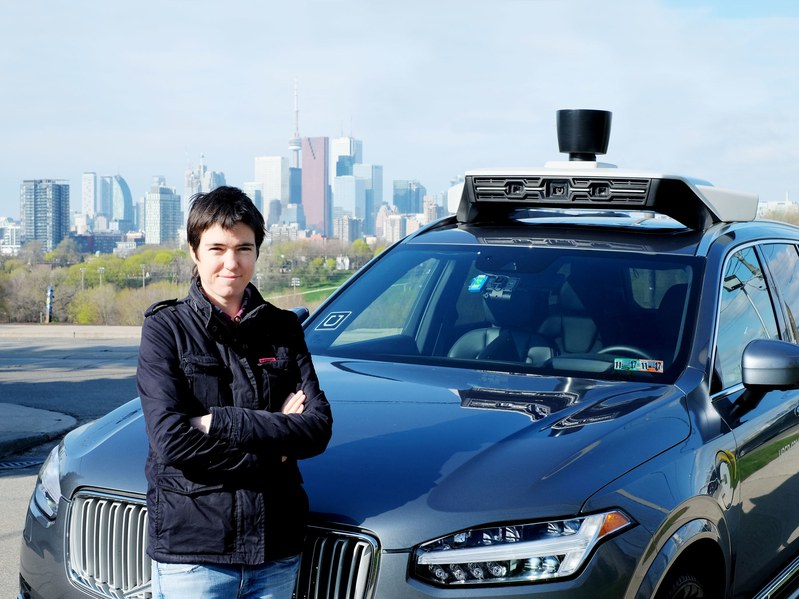
Raquel Urtasun, the head of Uber's Toronto Advanced Technologies Group Photo: Uber
Feb 28, 2019
A A
A Small A Medium A Large
Share

Gift

Share

Uber’s self-driving car research team is having difficulties driving in heavy rain, navigating when there are large vehicles on the road and detecting crosswalks, according to company research reviewed by The Logic.

Self-driving cars are a key focus for Uber as it gears up for a US$90-billion IPO later this year. The company’s Toronto self-driving research lab is the lynchpin of those ambitions. Uber currently has over 50 people working in that lab, with plans to grow the team to 100 by the end of 2019 as part of the company’s $200-million investment in Canada focused on developing self-driving technology.

The Logic analyzed 38 publications produced by Raquel Urtasun, chief scientist of Uber Advanced Technologies Group in Toronto, and found a number of stubborn problems for the company.

Talking Point

Uber is investing significant resources in its Toronto-based self-driving car research team ahead of a US$90-billion IPO later this year. That team is having difficulties driving in heavy rain, navigating when there are large vehicles on the road and detecting crosswalks.

In an emailed statement, Urtasun, who did not agree to an interview for this story, said the company has made improvements on some of the issues flagged in her publications.

Urtasun’s research has repeatedly flagged issues with identifying lane markings. An October 2018 paper titled “Deep Multi-Sensor Lane Detection” cites a number of “failure modes.”

“Heavy rain causes significantly reduced visibility, especially at a distance,” reads the paper. “Large vehicles block the view of the ground for both sensors, showing the negative impact of heavy occlusions.”

Uber relies on clear lines of sight for sensors to see what is happening around the car. When sensors are not blocked, Uber can predict lanes up to 48 metres ahead. However, the company still has difficulty when there’s no paint indicating where lanes should be.

When asked if Uber has found a way to solve these problems, Urtasun said the company has developed a “better” system but offered no specifics.

Crosswalks are also an issue for Uber. In a September 2018 paper, Urtasun proposes a way to combine LiDAR, a laser-based remote sensing method, and camera imagery with online maps to detect crosswalks.

“Drawing crosswalks is not an easy task. As shown in our experiments, crosswalks come in a variety of shapes and styles even within the same city,” reads the paper. “Furthermore, paint quality of the crosswalk markings can often be washed out, making the task hard even for humans.”

In the “failure modes” section of the publication, Urtasun notes an instance where a crosswalk marking with poor paint quality is mistaken for a stop line.

“Our model mistakes the crosswalk for a stop line at an intersection, and does not predict its presence,” reads the paper. Uber has now developed a research prototype which “solves some of these issues,” Urtasun told The Logic.

Uber currently lags behind rivals in self-driving. In 2018 tests, for example, Google sister company Waymo had to have a human take control of its self-driving cars once every 11,154 miles, according to data from the state of California. Uber drivers had to take over once every 0.4 miles.

It’s not just Waymo. Self-driving cars from every major company—including General Motors, Nissan, Nvidia, Apple, Baidu and Mercedes-Benz—were able to operate for longer periods without humans having to intervene. To catch up, Uber needs Urtasun’s research—much of which is in the academic prototype phase and not yet in Uber’s cars—to advance rapidly.

In a number of publications from 2018 and 2019, Urtasun claims Uber has beaten all competitors in high-definition 3D mapping for self-driving cars by combining LiDAR, stereo imagery and camera imagery to create maps that are both more accurate and less expensive.

“Our approach outperforms the state-of-the art while being an order of magnitude faster,” reads a September 2018 paper. “We can perform segmentation of large outdoor scenes of size 160m x 80m in as little as 30ms. In indoor scenarios, we can segment full rooms in less than 15ms.”

Uber has long-term ambitions to use self-driving cars for its ride-hailing service. This requires advances in precision mapping so cars can sense their proximity to other objects and stop at safe distances when picking up passengers. Urtasun claims Uber is beating all competitors on this front.

Gift the full article

“Our full system can operate in real-time at 15Hz while achieving centimeter level accuracy across different LiDAR sensors and environments,” reads an October 2018 publication based off a dataset that included 40,000 kilometres of driving.

Urtasun’s group is also working to combine complex tasks, like real-time 3D object detection and motion-tracking, into a single system that saves on computing time.

“Our experiments on a new very large scale dataset captured in several North American cities, show that we can outperform the state-of-the-art by a large margin. Importantly, by sharing computation we can perform all tasks in as little as 30 ms,” reads a November 2018 publication.

It is unclear how quickly Urtasun’s research prototypes end up in Uber’s self-driving car fleet. What’s apparent, however, is that self-driving is particularly important to the company in the run up to IPO. Of the 65 patents that Uber has filed so far in 2019, 60 relate to self-driving cars.

“We have a dedicated team that is responsible for taking my team’s research and bringing it to the production system,” Urtasun told The Logic, adding that her team’s research also indirectly influences the company by exposing non-research engineers to the latest research in self-driving vehicles.  

“This cross-pollination across R&D and technology development is an advantage we have over all other self-driving car companies, largely because we have a sizable world-class in-house research team.”

#Uber

Sponsored Content

How to shift your workforce from AI experimentation to adoption

By Jessica Aftimus Rosa

The real-world economic offshoots of sovereign AI

By Deborah Aarts
Illustration of a plane flying above a mailbox

Increasing healthcare access across Canada

By Deborah Aarts
Paid promotional content

Loading...

Thanks for sharing!

You have shared 5 articles this month and reached the maximum amount of shares available.

Close
This account has reached its share limit.

If you would like to purchase a sharing license please contact The Logic support at [email protected].

Close
Want to share this article?

Upgrade to all-access now

Close
Gift the full article!

You have gifted 0 article(s) this month and have 5 remaining.

Copy link and gift
Copy Link
Email to a friend
Send Email
Gift on Social Media

Recipients will be able to read the full text of the article after submitting their email address. They will not have access to other articles or subscriber benefits.

Photo: Uber

Most Popular This Week

News

Tangerine plans new products as it reinvents itself as a tech-powered challenger bank

By Claire Brownell
A shot across an expanse of low forest of a rocket launching into blue skies.
News

People hired to promote Canadian rocket firm didn’t actually help, company alleges in lawsuit defence

By David Reevely
News

Ottawa taps Patrick Pichette to lead new digital transformation agency

By Murad Hemmadi
News

AI giants sign federal pledge that Canadian data centres will bring benefits

By Murad Hemmadi

In-depth, agenda-setting reporting

Great journalism delivered straight to your inbox.

Financier Michael Milken leads a discussion at the Milken Institute Global Conference in Beverly Hills, Calif. He wears a blue suit and a red tie against a blue background.
News

Milken Institute adds Australia’s Future Fund, Microsoft and Cohere executives to Toronto conference

By Chaimae Chouiekh

Briefing

Scotiabank sets rules for new ‘defence bonds’ to finance investments in military companies

By David Reevely   |   Sep 9, 2026 | 2:11 PM ET

Neo Financial lays off 10% of its staff

By Claire Brownell   |   Sep 8, 2026

Von der Leyen to highlight Canada relationship in state of the EU speech

By Joanna Smith   |   Sep 8, 2026

Best business newsletter in Canada

Get up to speed in minutes with insights and analysis on the most important stories of the day, every weekday.

Exclusive events

See the bigger picture with reporters and industry experts in subscriber-exclusive events.

Membership in The Logic Council

Membership provides access to our popular Slack channel, participation in subscriber surveys and invitations to exclusive events with our journalists and special guests.

Recent Popular Stories

News

Ottawa taps Patrick Pichette to lead new digital transformation agency

By Murad Hemmadi   |   Sep 3, 2026
News

Tangerine plans new products as it reinvents itself as a tech-powered challenger bank

By Claire Brownell   |   Sep 8, 2026
News

AI giants sign federal pledge that Canadian data centres will bring benefits

By Murad Hemmadi   |   Sep 3, 2026
News

Dominic Barton will keep role at Rio Tinto while chairing federal investment agency

By Anita Balakrishnan   |   Sep 3, 2026
News

People hired to promote Canadian rocket firm didn’t actually help, company alleges in lawsuit defence

By David Reevely   |   Sep 4, 2026
A shot across an expanse of low forest of a rocket launching into blue skies.
News

Trump ups trade war stakes with bans on Canadian booze and other imports

By Joanna Smith   |   Sep 8, 2026 | 8:45 PM ET
Canadian and U.S. flags wave beside Gordie Howe International Bridge under a clear blue sky.

Canada's most influential executives and policymakers are reading The Logic

  • CPP Investments
  • Sun Life Financial
  • C100
  • Amazon
  • Telus
  • Mastercard
  • bdc
  • Shopify
  • Rogers
  • RBC
  • General Motors
  • MaRS
  • Government of Canada
  • Uber
  • Loblaw Companies Limited
logic-logo

Canada's Business and Tech Newsroom

100% human-crafted journalism

Newsroom

  • News Tips
  • AI Policy
  • Editorial Disclosures
  • Story Pitches

Company

  • About Us
  • Terms of Service
  • Privacy Statement
  • Corporate Information

Contact

  • Contact Us
  • Advertise
  • FAQs
  • Work at The Logic

© 2026 The Logic Inc. All Rights Reserved.

Trusted by leaders

Error

Account creation failed.

Please email us at [email protected].

Create Account

[wppb-register form_name=”cozmo-registration-form-for-modal”]

I do have an account
Login
or

[wppb-login]

I don’t have an account








