The federal government rejected multiple proposals from Canadian fintechs looking to distribute aid to businesses affected by COVID-19, The Logic has learned.
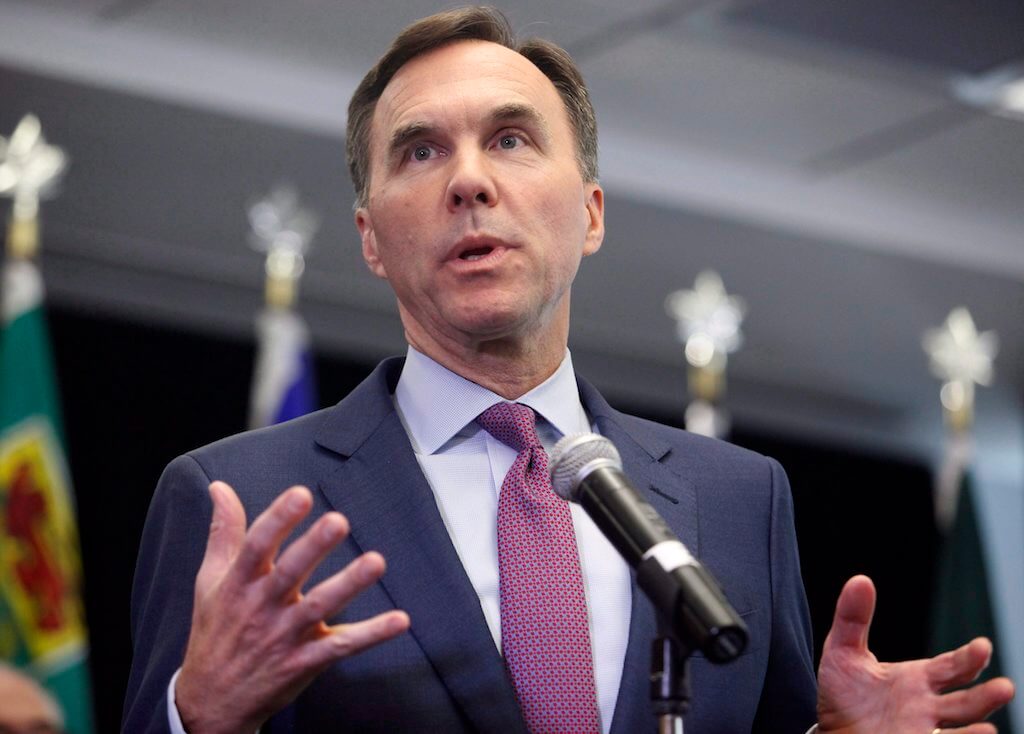
The Canadian Lenders Association (CLA), PayPal and Wave all offered to help. Small Business Minister Mary Ng championed the fintechs’ proposals within government, but Finance Minister Bill Morneau’s office blocked them, according to four sources with knowledge of the situation.
Talking Point
The federal government rejected multiple proposals from Canadian fintechs looking to distribute aid during the pandemic. Finance Canada is concerned about operational and reputational risk, but the U.S., U.K., Australia and New Zealand are all relying on fintechs to distribute aid.
The sources, all from outside government, spoke on the condition they not be named because they weren’t authorized to discuss the conversations publicly.
In April, The Logic reported that Ottawa was in talks with the CLA on a $2-billion plan to lend money to up to 100,000 firms shut out of existing government programs. The CLA’s 80 members include many of the country’s leading fintech lenders, several of which helped distribute government aid in the U.S.
The CLA wanted to lend money to small businesses that didn’t qualify for existing government assistance programs because their key workers are contractors rather than employees; because staff are paid via dividends instead of payroll; or because their payroll is below $50,000 or in excess of $1 million.
“Everybody in the government said … it’s a good initiative, it will get money to the businesses that the banks aren’t reaching,” said CLA president Gary Schwartz.
Schwartz said his association offered to change any part of their proposal, but Finance Canada repeatedly said they had concerns about “operational and reputational risk” when it came to working with fintechs, but did not elaborate further.
Minister Bains’s office declined to comment. Ryan Nearing, Ng’s press secretary, did not directly answer questions about disagreements with Morneau. “We continue to engage with fintechs to see how we can work closer together to ensure Canadians are supported now, and as we begin to safely restart our economy.”
Maéva Proteau, Morneau’s press secretary, did not directly answer questions about why the department chose not to work with fintechs to distribute aid. “Across government, our collective goal since the beginning of this crisis has been to quickly act and efficiently deliver necessary support for Canada’s businesses and workers,” said Proteau.
“In that spirit, we chose to collaborate with banks and credit unions in order to arrive at faster delivery outcomes considering the infrastructures that were already in place.” Some of the problems the CLA’s proposals were designed to solve, like getting money to very small businesses, appear to have been resolved. Earlier this week, Finance Canada announced that companies with less than $20,000 on payroll could access the $40,000 Canada Emergency Business Account, which is being distributed via banks and credit unions.
Some fintechs argue that they would be more efficient conduits for that aid. Wave CEO Kirk Simpson said his firm, which has over 400,000 customers, offered to distribute government aid but was rebuffed. “We have a tremendous amount of data about our small-business customers, in some ways more than what the banks see. And yet there’s been a reticence in Canada to open it up,” said Simpson. “We know in the U.S., that players like QuickBooks and Square and others are distributing funds. And in Canada it’s been a, quite frankly, frustrating experience to try and help.”
The U.S., U.K., Australia and New Zealand are all using fintechs to distribute government aid during the pandemic. Square and QuickBooks said they haven’t offered to distribute federal government aid, while Nicole Watts, PayPal Canada’s head of government relations, said her firm has held talks with Ottawa.
“Since the start of the pandemic, we have had various conversations with the Canadian government to explore solutions that could be deployed quickly to support Canadians now and in the future,” said Watts. Asked if PayPal would distribute government aid if Ottawa greenlit involvement, Watts said, “It depends on what the options are for payout, and if we have a corresponding solution in the market that fits the need. Every market is unique.”
Schwartz, by contrast, said if the government changed its mind, he’d be eager to work together. “A ton of small businesses had difficulty getting loans from banks before the pandemic and they’re still having difficulty today. We know how to help them,” said Schwartz. “We could contribute to keeping thousands of businesses afloat and tens of thousands of workers employed today if [the federal government] change their mind.”
CLA member firms have loaned out $2 billion to small businesses in recent years, with average loan sizes ranging from $25,000 to $250,000.
It’s not just fintechs that are being excluded. The Canadian Finance and Leasing Association, a shadow banking industry association, said its members have been blocked from distributing aid under the $20-billion Business Credit Availability Program (BCAP). The shadow banking sector in Canada rose to US$1.5 trillion in 2018, controlling assets worth about half those by the regulated banks. Ottawa’s reliance on credit unions and regulated banks to distribute aid has had mixed success.
The Large Employer Emergency Financing Facility, which offers funding of $60 million or more to big firms struggling due to COVID-19, hasn’t approved a single application. Meanwhile, RBC, Canada’s largest bank, has disbursed just $30 million under the BCAP, and TD Bank also reported minimal uptake. Thirty-four per cent of companies were rejected or ineligible for BCAP loans, according to a survey conducted by CLA member firm Lending Loop. In May, a third of businesses surveyed by the CLA said they’d run out of cash in less than a month.
This is the second time in recent months that Ottawa did not heed a request from fintechs. In May, the federal government delayed consultations on open banking scheduled for the spring until the fall at the earliest. Many fintech CEOs, including Borrowell’s Andrew Graham, expressed concerns about making it harder for Canadians to access digital financial services during the pandemic. Graham also expressed concern about today’s move.
“Canada has many strong fintech companies that could be supporting COVID response efforts,” he said. “In the US, fintech companies have processed billions of dollars in PPP loans, getting funds into the hands of small businesses quickly and effectively. It’s disappointing that Canadian fintechs have been excluded.”