Skip to content

Canada's Business and Tech Newsroom

  • Professional Subscription
  • Partnerships & Advertising
  • Licensing & Syndication
Log In Subscribe
Welcome,
  • My Account
  • Log Out
  • Business
  • Tech
  • National
  • The Big Read
  • Briefings
  • Commentary
Search
Log In Subscribe
Welcome,
  • My Account
  • Log Out
Exclusive

Bank of Canada exploring digital currency that could share information with police, tax authorities

The Bank of Canada is considering launching a digital currency that would help it combat the “direct threat” of cryptocurrencies and collect more information on how people spend their money, The Logic has learned. 

An internal Bank of Canada presentation, prepared for Governor Stephen Poloz and the bank’s board of directors, offers the most detailed public insight yet into the bank’s thinking on a proprietary digital coin. According to the presentation, the currency would be widely available. It would initially coexist with coins and paper money, eventually replacing them completely.

Exclusive

Bank of Canada exploring digital currency that could share information with police, tax authorities

By Zane Schwartz
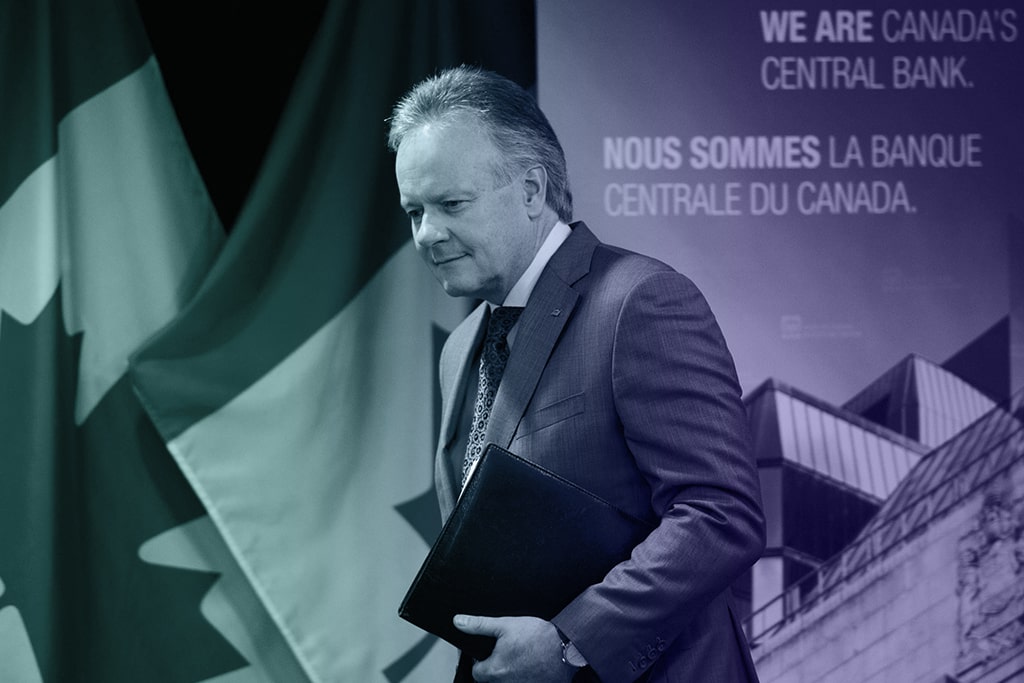
Stephen Poloz, Governor of the Bank of Canada, arrives to hold a press conference with Senior Deputy Governor Carolyn Wilkins at the Bank Of Canada in Ottawa on Thursday, May 16, 2019. Photo: THE CANADIAN PRESS/Sean Kilpatrick
Oct 15, 2019
A A
A Small A Medium A Large
Share

Gift

Share

The Bank of Canada is considering launching a digital currency that would help it combat the “direct threat” of cryptocurrencies and collect more information on how people spend their money, The Logic has learned. 

An internal Bank of Canada presentation, prepared for Governor Stephen Poloz and the bank’s board of directors, offers the most detailed public insight yet into the bank’s thinking on a proprietary digital coin. According to the presentation, the currency would be widely available. It would initially coexist with coins and paper money, eventually replacing them completely.

Talking Point

A central bank digital currency is needed because “we need to innovate to stay in the game,” according to Bank of Canada documents obtained by The Logic. They offer the most detailed insight yet into the bank’s thinking on the subject, and emerge amid growing questions about the future of money. The annual joint World Bank/International Monetary Fund meetings are underway in Washington, D.C., and include a session on Big Tech and the future of finance. Meanwhile, China is in the final stages of launching its own digital coin and Libra, Facebook’s digital offering, is losing key backers and facing scrutiny from regulators worldwide, including the Bank of Canada.

The presentation, titled “Central Bank Money: The Next Generation” and acquired by The Logic via an access-to-information request, was prepared by Stephen Murchison, an adviser to Poloz tasked with leading the bank’s digital currency research, for a September 2018 board meeting. Murchison presented it as part of a two-year research project on whether or not the bank should issue its own digital money.

It emerges at a moment of heightened concern over the implications of digital money. Global regulators and central bankers—including representatives from Canada—are gathered this week in Washington, D.C. at the annual joint World Bank/International Monetary Fund meetings, which include a session on Big Tech and the future of finance. China is in the final steps of launching its own digital coin and Libra, Facebook’s digital offering, is losing key backers and facing scrutiny from regulators worldwide, including the Bank of Canada.

“We need to innovate to stay in the game,” the presentation reads. A digital currency would provide “all the benefits” of a central bank-backed asset, it says, as well as “all the convenience and security of wireless, electronic payments.” 

It lists over a dozen benefits to the bank launching its own digital currency, and only one downside.  

“An additional payment method could make the payment system more robust.” But, the presentation notes, digital currency “also presents a risk to stable, low-cost funding for [banks] (deposits).” 

It suggests a digital currency could come with the option to pay interest on balances, and the ability to collect more information on Canadians than is possible when people use cash. “Personal details not shared with payee, but could be shared with police or tax authorities,” reads the presentation. 

Murchison, who is on secondment at the Caisse de dépôt et placement du Québec, directed questions to the Bank of Canada, which declined an interview request. In an email to The Logic, spokesperson Louise Egan said the bank has not yet decided whether it will launch a digital currency, and that the question of sharing information with police and tax authorities is “among the many issues that continue to be assessed by Bank researchers.” 

Egan also said the bank is aware of more potential downsides to issuing its own digital currency than the one listed in the report, including a reputational risk for the bank if it issues an e-money that is not widely used, or is used, but for illegal activity. 

She did not directly answer questions about whether a digital currency issued by the Bank of Canada would include the specific details included in the presentation.  

Asked if the project had concluded and if the bank would be issuing a currency, Egan said its “research on this topic is ongoing.” Scott Hendry, the bank’s senior director for financial technology, now oversees the bank’s digital currency research.

The presentation suggests two deployment options for a digital currency: token-based and account-based. It warns that banknotes are becoming obsolete as a means of payment, creating problems for the banking system as a whole: “The time may come that merchants/banks find it too costly to accept banknotes.” 

If that happens, “ordinary Canadians would lose access to central bank money,” but the bank’s ability to carry out monetary policy and act as a lender of last resort would not be affected, it states. However, those functions could be threatened by the rise of cryptocurrencies, according to the presentation. 

“Cryptocurrencies may become a direct threat to our ability to implement monetary policy and lender of last resort (LOLR) role.” 

Cryptocurrency use is growing. A July 2018 study from the bank found five per cent of Canadians owned Bitcoin, up from 2.9 per cent the year previous. 

The Bank of Canada has been studying digital currencies since at least 2013, when its two-year plan said it would “explore the frontiers of e-money—digital alternatives to cash and their implications for central banks.” More recently, however, the issue has taken on new urgency: in October 2018, a Financial Stability Board working group, chaired by Murchison, released a report on how cryptocurrencies could destabilize the global financial system and what steps central banks should take to avoid it. Since the report’s release, Facebook has announced plans for Libra, and China is poised to launch its own coin. 

International cooperation is cited as a key issue in the presentation: “The incentive to produce a ubiquitous international currency is huge.” The Bank of Canada is already taking steps to work with other central banks on digital currencies. In May, it announced it had conducted the world’s first transfer of a digital currency from one central bank to another, in partnership with Singapore. 

Canada is far from the only country exploring a digital currency. Last week, Switzerland’s central bank started exploring the use of digital currencies for trading. Sweden and Singapore both have research efforts underway. China appears ready to be the first to launch, with plans to have its own currency up and running either late this year or early next.

Gift the full article

It’s not just countries getting into the digital currency game. In addition to Facebook’s Libra, JPMorgan is already using a digital coin and Vanguard is testing a blockchain-based currency trading system. 

The Bank of Canada, by contrast, has been relatively quiet about digital currencies in recent months. In April, deputy governor Timothy Lane spoke at an International Monetary Fund event on the topic. In July, the bank told The Logic it would monitor Libra for potential risks to the financial system, but did not specify any particular concerns.

#Bank of Canada #Bitcoin #China #cryptocurrency #Libra

Sponsored Content

The road to risk-smart regulation

By Deborah Aarts

Why cybersecurity needs to match pace with AI

By Jessica Aftimus Rosa

How to shift your workforce from AI experimentation to adoption

By Jessica Aftimus Rosa
Paid promotional content

Loading...

Thanks for sharing!

You have shared 5 articles this month and reached the maximum amount of shares available.

Close
This account has reached its share limit.

If you would like to purchase a sharing license please contact The Logic support at [email protected].

Close
Want to share this article?

Upgrade to all-access now

Close
Gift the full article!

You have gifted 0 article(s) this month and have 5 remaining.

Copy link and gift
Copy Link
Email to a friend
Send Email
Gift on Social Media

Recipients will be able to read the full text of the article after submitting their email address. They will not have access to other articles or subscriber benefits.

Photo: THE CANADIAN PRESS/Sean Kilpatrick

Most Popular This Week

An image of Prime Minister Mark Carney, standing in front of a microphone and speaking. He is wearing a blue suit and tie, while looking away from the camera. He is standing in front of a dark background. The Cohere logo is visible in the background.
News

Conservatives challenge Ottawa to justify its $1.6B Cohere investment

By Catherine McIntyre
A logo that reads AI in blue lettering against a light yellow background.
News

BDC launches programs to test Canadian AI tools in small businesses

By Catherine McIntyre
A man wearing a headset microphone sits on a stage. He is speaking and gesturing with his hands. The background is dark blue.
News

Ottawa will invest up to $1.6B in Cohere as firm’s valuation hits $35.7B

By Catherine McIntyre
Prime Minister Mark Carney and the rest of the Liberal front bench stand applauding Finance Minister François-Philippe Champagne in the House of Commons. Champagne is in the middle of the frame, with his hands on a desk lectern.
Special Report

What business wants from the 2026 federal budget

By David Reevely, Joanna Smith, Anita Balakrishnan, Claire Brownell, Chaimae Chouiekh, Murad Hemmadi and Meghan Potkins

In-depth, agenda-setting reporting

Great journalism delivered straight to your inbox.

A side shot of Annie Andrews passing a cluster of supporters with a hand outstretched and a joyful look on her face.
News

What the Democrats’ midterm sweep means for Canadian business

By Joanna Smith

Briefing

Suncor more than doubles Q3 profit to $3.8B amid booming returns from refining

By Meghan Potkins   |   Nov 4, 2026 | 3:04 PM ET

Ottawa moves to ban transfer fees for switching banks

By Claire Brownell   |   Nov 4, 2026 | 3:02 PM ET

Finance partly walks back proposed ban on crypto ATMs

By Claire Brownell   |   Nov 4, 2026 | 2:22 PM ET

Best business newsletter in Canada

Get up to speed in minutes with insights and analysis on the most important stories of the day, every weekday.

Exclusive events

See the bigger picture with reporters and industry experts in subscriber-exclusive events.

Membership in The Logic Council

Membership provides access to our popular Slack channel, participation in subscriber surveys and invitations to exclusive events with our journalists and special guests.

Recent Popular Stories

Analysis

Why a midterm sweep for the Democrats won’t end Canada’s trade nightmare

By Joanna Smith   |   Oct 29, 2026
Commentary

Carmichael: Canada’s Nobel-winning economist thinks Carney is on the right track

By Kevin Carmichael   |   Oct 31, 2026
A man wearing a dark suit jacket, blue button-down shirt and spotted brown-and-blue tie stands in front of a black and blue background, gesturing and speaking into a microphone.
News

Ottawa will invest up to $1.6B in Cohere as firm’s valuation hits $35.7B

By Catherine McIntyre   |   Oct 29, 2026
A man wearing a headset microphone sits on a stage. He is speaking and gesturing with his hands. The background is dark blue.
News

Bank of Canada raises key interest rate amid soaring energy costs

By Kevin Carmichael   |   Oct 28, 2026
Bank of Canada Governor Tiff Macklem in a suit, speaking and gesturing with his right hand.
Special Report

What business wants from the 2026 federal budget

By David Reevely, Joanna Smith, Anita Balakrishnan, Claire Brownell, Chaimae Chouiekh, Murad Hemmadi and Meghan Potkins   |   Oct 28, 2026
Prime Minister Mark Carney and the rest of the Liberal front bench stand applauding Finance Minister François-Philippe Champagne in the House of Commons. Champagne is in the middle of the frame, with his hands on a desk lectern.
News

The Canadian Forces were warned about safety gaps for 20 years before Wainwright disaster

By David Reevely   |   Oct 30, 2026
A side shot of a row of fully equipped soldiers making a beach landing from zodiac watercraft, rifles in hand.

Canada's most influential executives and policymakers are reading The Logic

  • CPP Investments
  • Sun Life Financial
  • C100
  • Amazon
  • Telus
  • Mastercard
  • bdc
  • Shopify
  • Rogers
  • RBC
  • General Motors
  • MaRS
  • Government of Canada
  • Uber
  • Loblaw Companies Limited
logic-logo

Canada's Business and Tech Newsroom

100% human-crafted journalism

Newsroom

  • News Tips
  • AI Policy
  • Editorial Disclosures
  • Story Pitches

Company

  • About Us
  • Terms of Service
  • Privacy Statement
  • Corporate Information

Contact

  • Contact Us
  • Advertise
  • FAQs
  • Work at The Logic

© 2026 The Logic Inc. All Rights Reserved.

Trusted by leaders

Error

Account creation failed.

Please email us at [email protected].

Create Account

[wppb-register form_name=”cozmo-registration-form-for-modal”]

I do have an account
Login
or

[wppb-login]

I don’t have an account