Alimentation Couche-Tard’s failed, year-long pursuit of 7-Eleven parent Seven & i is unlikely to be the last convenience-store mega-merger, as chains wage a cutthroat war to own the shop on every corner.
Skip to content


News
The battle for control of the world’s convenience stores is just beginning
Couche-Tard’s failed attempt to gobble up 7-Eleven won’t be the last megadeal on the table in a cutthroat industry where major players eye total dominance
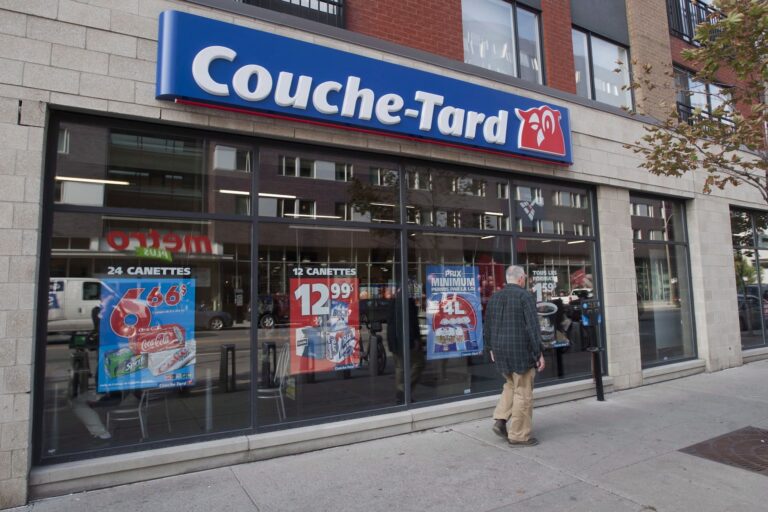
A Couche Tard convenience store in Montreal, Friday, October 5, 2012. Photo: The Canadian Press/Graham Hughes
Alimentation Couche-Tard’s failed, year-long pursuit of 7-Eleven parent Seven & i is unlikely to be the last convenience-store mega-merger, as chains wage a cutthroat war to own the shop on every corner.
Canada’s convenience store giant, Couche-Tard comes off as a “sleepy blue chip.” But Cole Smead, whose firm owns a stake in the Quebec firm, expects the company to pursue another major deal. “It’s just their history,” said the CEO of Smead Capital Management.
Winning customers from rival corner store brands is tough—ask anyone in Winnipeg that’s loyal to their favourite 7-Eleven Slurpee. But challenges facing companies like Couche-Tard and Seven & i go much deeper, analysts and investors told The Logic. C-store chains need to add more stores in new markets, fast, at a time when nationalism is challenging foreign investments.
Talking Points
- The convenience store industry is under pressure as it tries to manage a disparate distribution network and cope with trends like vehicle electrification and online delivery
- C-store growth often hinges on acquisitions, but Couche-Tard’s failed bid for Seven & i underscores how rising nationalism remains a hurdle for deal making
The well-worn business model of convenience stores relies on fine-tuning each store to its neighbourhood, not wasting an inch of shelf space or cold-food storage, said Jim Danahy, who runs Canadian retail consultancy CustomerLAB. Consumer demands are evolving fast, and there are only a few options for a chain to boost profits: either bargaining down suppliers’ wholesale prices of Pepsi and bread, or adding more locations in between customers and their nearest supermarket.
Couche-Tard expected the unrivalled number of stores it would gain from 7-Eleven to help on both fronts. But the US$47 billion deal went bitter over the past year.
In-person meetings between the two companies went poorly, according to Couche-Tard, starting with resistance by top 7-Eleven executives to attend a meeting in Dallas, Texas. There, Stephen Dacus, CEO of 7-Eleven parent company Seven & i, “rebuked” another 7-Eleven leader who tried to answer Couche-Tard’s questions about international licensees. The Canadian company said a second meeting in Japan appeared to be tightly scripted by Seven & i and lasted only half the allotted time. Couche-Tard said in July it would have considered sweetening its bid, leaving 60 per cent of Seven & i’s Japan business in local hands.
Related Articles

Seven & i, meanwhile, said it was peppered with calls from U.S. antitrust regulators, adding that Couche-Tard had “an unfortunate lack of knowledge of the Japanese market.”
“To suggest that our management presentations were scripted is to misunderstand Japanese culture,” Seven & i wrote in a public letter. “Despite continued claims that they had a Japanese partner to work with and educate them about specifics of the Japanese market, they were never able to do so.”
Couche-Tard and Seven & i declined to comment further to The Logic.
Chénier La Salle, who was a trade attache for Quebec in Japan until February, said that the Japanese media raised questions about how Couche-Tard, with its almost 17,000 stores, would have managed Seven & i’s 87,000 locations, which include the world’s largest network of retail stores and businesses like banking, music software copyrighting and shiitake mushroom production. Couche-Tard didn’t seem to provide a satisfying answer, given it’s “a major, major retail chain in a foreign country,” he said.
Looking at the “i” in Seven & i reveals key differences between the two business cultures, said Daniel Heller, a business professor at Yokohama National University, part of McGill University’s international management program. The Ito-Yokado department and grocery store, mostly associated with older shoppers, might seem like an albatross to short-term shareholders. But Japanese business leaders may view the founding family’s namesake as “core” to the company’s identity, if not its revenue, said Heller.
“We have seen this movie before,” said Feng Gu, a professor at the University at Buffalo School of Management who studies why M&A deals fail.
“Differences in laws, in regulations, in traditions, in cultures and everything is going to work against achieving success in this type of international acquisition. Consolidation can be a nightmare…the gains are very limited.”
Nationalism also foiled Couche-Tard’s plans to acquire French grocer Carrefour, after political outrage over the need to protect the national food supply.
It hasn’t stopped Couche-Tard from pursuing M&A—if anything, the company is known for it, scooping up 75 businesses in the past 20 years, including 270 GetGo stores this summer.
“Couche-Tard demonstrated they’re really good at that,” said Danahy.
Couche-Tard’s bank card is now free to spend on share buybacks, dividend hikes and more M&A. Before the Seven and i deal fell through, the Quebec firm had $2.3 billion cash on hand.
CoBank, a lender focused on rural U.S. communities, expects C-Store chains will remain popular takeover targets, as the mom-and-pops that comprise 63 per cent of stores struggle to manage scattered distribution networks. Sunoco, for example, sold over 200 stores to 7-Eleven last year, and recently agreed to buy Canadian gas station chain Parkland for US$9.1 billion.
C-store brands may need to scale to survive as U.S. retail sales cool. Seven and i said on Aug. 6 it needed to transform and reinforce its “founder’s mentality” amid a lack of rigorous planning and consistent decision-making at its head office.
At Couche-Tard, meanwhile, gas pumps are no longer fuelling the same level of growth at existing U.S. stores, as more customers switch to electric vehicles they can charge at home, and use same-day delivery services to buy last-minute essentials.
The company could have benefitted from importing 7-Eleven’s focus on food rather than fuel to some of its stores, La Salle said. In a June earnings call, chief financial officer Filipe da Silva Nogueira said its globalized network has been key as Europe and Canada helped offset its flatlining sales in existing U.S. stores.
About 70 per cent of the company’s network was added through M&A, including its entry into the U.S., Europe and Asia. But if Couche-Tard wants to expand further, it may not be easy. Negotiations between Couche-Tard and 7-Eleven spanned two U.S. administrations and a global trade war. During that time, Japan’s decision to open its market to foreign takeovers began to look like a fire sale due to a weak yen, Heller said.
“Countries engage in economic nationalism,” he said, “and increasingly so.”
Smead, the shareholder, was more optimistic. “Risk taking is exactly what brought [Couche-Tard’s] business to where it is today. They want to close deals.”



Loading...
Thanks for sharing!
You have shared 5 articles this month and reached the maximum amount of shares available.
CloseThis account has reached its share limit.
If you would like to purchase a sharing license please contact The Logic support at [email protected].
CloseGift the full article!
You have gifted 0 article(s) this month and have 5 remaining.
Recipients will be able to read the full text of the article after submitting their email address. They will not have access to other articles or subscriber benefits.
Photo: The Canadian Press/Graham Hughes
Most Popular This Week



In-depth, agenda-setting reporting
Great journalism delivered straight to your inbox.
Commentary
Carmichael: What Finland can teach Canada about sleeping next to an elephant
Briefing
Financing instability is slowing down Ottawa’s housing agency, CEO says
Cleveland-Cliffs CEO says federal lawsuit would be a bad business decision for Canada
BoC shows off its new forecasting model, Prima
Best business newsletter in Canada
Get up to speed in minutes with insights and analysis on the most important stories of the day, every weekday.
Exclusive events
See the bigger picture with reporters and industry experts in subscriber-exclusive events.
Membership in The Logic Council
Membership provides access to our popular Slack channel, participation in subscriber surveys and invitations to exclusive events with our journalists and special guests.