Canada’s publicly traded companies are facing sweeping losses in the global shift to a net-zero economy, according to a new analysis from the Canadian Institute for Climate Choices and U.K. data-analytics firm Planetrics. The report, published Thursday, shows that some of the country’s energy and resource sectors could see nearly all their profits from exports erased by 2050 if they don’t make significant changes to address the risks related to the climate crisis.
Skip to content


News
Climate stress test reveals Canadian companies’ profits threatened without major changes
A pumpjack draws oil from underneath a canola field as a haze of wildfire smoke hangs in the air near Cremona, Alta., July 2021. Photo: THE CANADIAN PRESS/Jeff McIntosh
Canada’s publicly traded companies are facing sweeping losses in the global shift to a net-zero economy, according to a new analysis from the Canadian Institute for Climate Choices and U.K. data-analytics firm Planetrics. The report, published Thursday, shows that some of the country’s energy and resource sectors could see nearly all their profits from exports erased by 2050 if they don’t make significant changes to address the risks related to the climate crisis.
“Stress-testing Canada’s publicly traded companies shows that roughly half of large exporters and multinationals are not yet transition-ready,” the report reads.
Talking Point
Public companies in Canada’s energy and resources sectors are facing steep profit losses in the global shift to net zero, according to a new report from the Canadian Institute for Climate Choices and data analytics firm Planetrics. Canada’s equities market also appears to be more vulnerable than its global peers, putting domestic firms at risk of losing investments or business from international players. Despite the risks many sectors face in the shift to net zero, the report found the cost of doing nothing is still higher.
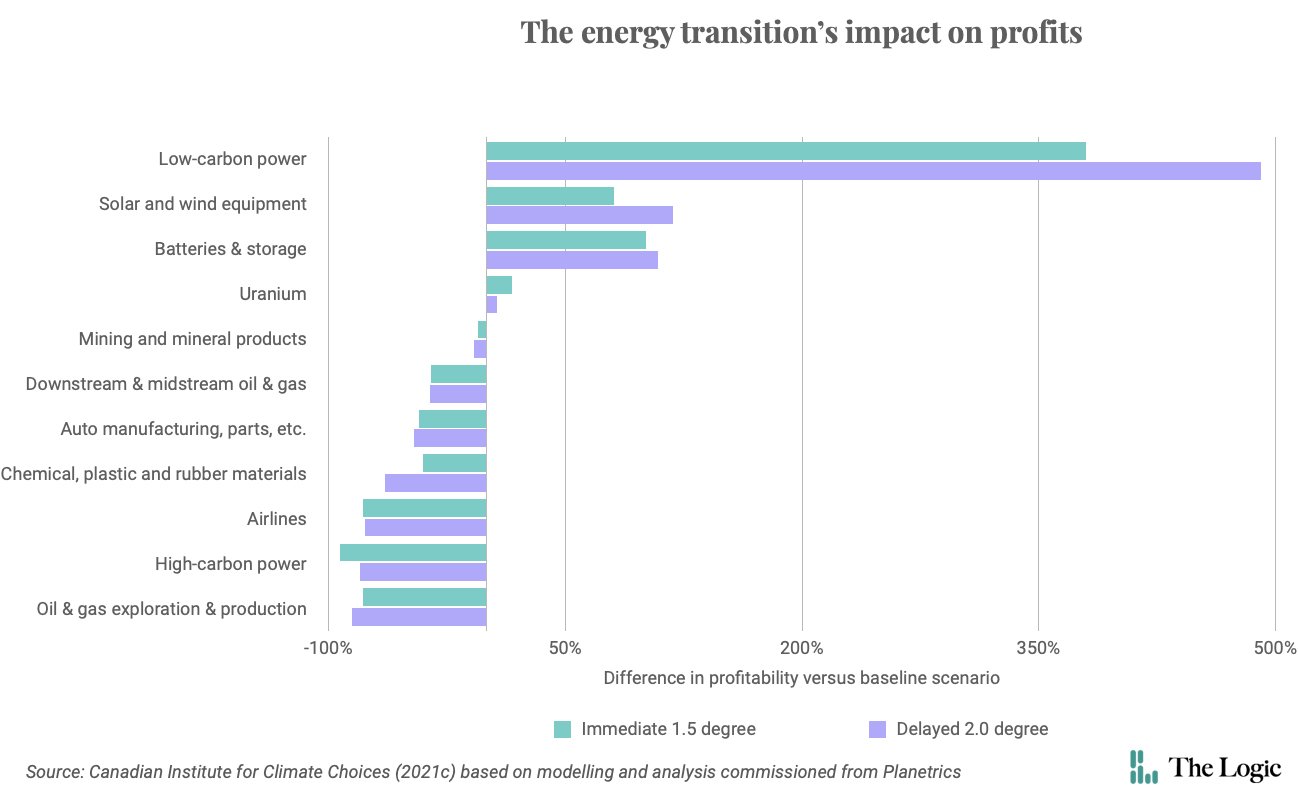
The report assesses global trends in the transition to a net-zero economy by 2050, and how prepared Canada is for that shift. It describes three possible outcomes, depending on how policymakers choose to address climate change: a baseline scenario with no new climate-change policy; a scenario in which policy changes begin immediately and succeed in limiting global temperature increases to 1.5 C; and one in which policy changes are delayed until 2030 and temperatures rise 2 C.
The analysis shows that seven out of 11 sectors are poised to see profits fall under both transition scenarios. Emissions-intensive sectors are most vulnerable. For example, under the scenarios, the oil and gas industry is expected to shed between 78 per cent and 85 per cent of its global profits by 2050, while airlines could lose 77 or 78 per cent.
Meanwhile, sectors likely to benefit from the transition include those in renewable-energy spaces, like wind and solar equipment as well as battery storage.
Rachel Samson, clean-growth research director at the institute and a co-author of the report, said the results are particularly concerning, given the industries at risk have an outsized impact on Canada’s economy. “Around 70 per cent of Canada’s goods exports, and around 60 per cent of our foreign direct investment come from transition-vulnerable sectors,” she said.
The Canadian market also appears to be more vulnerable than its global peers. The analysis of international exchange-traded funds shows that the 60 largest companies on the Toronto Stock Exchange would suffer the greatest losses from the energy transition relative to five other major indices including the S&P 500 and Japan’s Nikkei. “International investors undertaking similar stress-testing analyses may choose to shift away from companies that present a transition risk,” the report reads.
Canada is among the dozens of countries that have pledged to reach net-zero carbon emissions by 2050. Regulators around the world are beginning to hold companies and investors accountable for their role in meeting those targets, with businesses increasingly expected to disclose their financial climate risk—including reporting their carbon intensity and what their businesses will look like in a net-zero economy. Financial climate-risk disclosure and mitigation is expected to garner significant attention from world leaders at next month’s United Nations COP26 conference in Glasgow.
The Canadian Securities Administrators (CSA) this week recommended mandatory climate-risk disclosure for securities issuers in the country. In a review of the current voluntary system, the CSA found that while 92 per cent of issuers under its purview already report some climate-related risks, just 59 per cent of disclosures were “relevant, detailed and entity-specific, while the remaining risks were either boilerplate, vague or incomplete.” The report also noted that none of the country’s issuers quantified the financial impact of their climate risk.
That lack of transparency makes it difficult for investors and consumers to make informed decisions, Samson said, and could lead to delays in transitioning to net zero.
The report notes three main factors expected to drive changes to companies’ profitability during the transition: increased demand for its products and services, decreased demand for its products and services, and the increasing cost of carbon businesses will have to bear. “For companies that expect demand creation for their products, the primary objective should be to grow sales and capture export opportunities,” the report reads. “Firms facing high carbon costs, but steady or growing demand, will need to decarbonize to compete in markets seeking low-carbon goods. And companies facing demand decline will need to transform into new business lines.”
Many companies in high-risk sectors have pledged to invest in decarbonizing their operations. The report acknowledges that adopting new technology could help accelerate the energy transition and make it smoother for emissions-intensive sectors. Climate Choices identified over 500 Canadian companies across nine sectors that are producing technologies and services that could help facilitate that shift, and found investment in these firms is growing.
However, it also found that foreign investors are purchasing Canadian cleantech at a higher rate than domestic firms. “Canada lost 23 promising companies to foreign buyers that are in this space,” said Jonathan Arnold, a senior research associate at the institute and a co-author of the report. “Foreign direct investment is a positive thing for economic development, but only if the growth and the jobs stay in the country,” he said. “We see that Canadian investors are supporting some of the more mature areas, like renewable energy, electric transport and even things like low-carbon building projects. But they’ve been slower to support less mature emerging sectors or companies such as [carbon capture and storage], or clean hydrogen batteries and storage and agtech.”
Along with risks to firms’ profits, hundreds of thousands of jobs in Canada are vulnerable in the shift to net zero, according to the report. “Companies that fail to navigate the transition successfully could face contraction or even bankruptcy, leaving many workers jobless,” the study reads. It estimates there are more than 800,000 “transition-vulnerable” jobs in Canada, and that Indigenous people and visible minorities are at higher risk of unemployment as sectors move away from fossil fuels. “New opportunities will emerge and will offset some of these job losses,” the report reads. “However, regional and skills mismatches may lead to a bumpy transition for some people. It could be particularly bumpy for those who already face discrimination and other barriers to employment, including Indigenous Peoples and visible minorities.”
Despite the risks many sectors face in the shift to net zero, Climate Choices notes that the cost of doing nothing is still higher. “The global human, environmental, and economic costs of failing to reduce greenhouse-gas emissions far outweigh the costs of transitioning to a low-carbon economy,” the report reads, citing research by the Central Banks and Supervisors Network for Greening the Financial Systems.
The report recommends policymakers take greater responsibility in preparing companies for the energy transition by investing more public funds and creating tax incentives for “future-fit” projects, like electric vehicles and green infrastructure, as well as clarifying climate-risk disclosure rules. It also emphasizes the need to focus on vulnerable communities and workers whose livelihoods are threatened by the transition, with, for example, new procurement schemes, more funding and training opportunities. “These programs could apply not just to transition-vulnerable communities, but to those most in need of new opportunities, including Indigenous communities and communities with high pre-existing levels of unemployment,” the report reads, citing an “opportunity to build a stronger, more inclusive, and more diverse economy.”



Loading...
Thanks for sharing!
You have shared 5 articles this month and reached the maximum amount of shares available.
CloseThis account has reached its share limit.
If you would like to purchase a sharing license please contact The Logic support at [email protected].
CloseGift the full article!
You have gifted 0 article(s) this month and have 5 remaining.
Recipients will be able to read the full text of the article after submitting their email address. They will not have access to other articles or subscriber benefits.
Photo: THE CANADIAN PRESS/Jeff McIntosh
Most Popular This Week




In-depth, agenda-setting reporting
Great journalism delivered straight to your inbox.
Commentary
Carmichael: What Finland can teach Canada about sleeping next to an elephant
Briefing
Financing instability is slowing down Ottawa’s housing agency, CEO says
Cleveland-Cliffs CEO says federal lawsuit would be a bad business decision for Canada
BoC shows off its new forecasting model, Prima
Best business newsletter in Canada
Get up to speed in minutes with insights and analysis on the most important stories of the day, every weekday.
Exclusive events
See the bigger picture with reporters and industry experts in subscriber-exclusive events.
Membership in The Logic Council
Membership provides access to our popular Slack channel, participation in subscriber surveys and invitations to exclusive events with our journalists and special guests.